
NC-based SFR: Aligning Social Roles for Precision Friend Recommendation
11169_Social Friend Recommendation Based on Multiple Network Correlation.
This paper introduces a Network Correlation-based Social Friend Recommendation (NC-based SFR) algorithm that aligns different "social role" networks (e.g., tag similarity vs. contact list) to predict new friendships. By utilizing feature selection and structure preservation, it achieves superior precision on the Flickr dataset compared to traditional similarity-based and collaborative filtering methods.
TL;DR
Social networks are not monolithic; we act differently as photographers, fans, or neighbors. This paper presents NC-based SFR, an algorithm that bridges the gap between what we say (Tags) and who we know (Contacts). By aligning these distinct "social role" networks via sparse feature selection and preserving the intrinsic data manifold, the authors achieve a significant leap in friend recommendation accuracy on large-scale platforms like Flickr.
The "Social Role" Gap: Why Similarity Isn't Enough
Most recommendation engines use a "birds of a feather" approach—if you use similar tags, you must be friends. However, the authors argue that "Making friends" is a complex intersection of social environment, behavior, and status.
The fundamental problem is Network Heterogeneity:
- Tag Networks reflect interests but are noisy.
- Contact Networks reflect established trust but are sparse.
- The Conflict: Not every shared interest leading to a tag overlap results in a social connection. We need to identify which specific interests (features) actually drive the formation of social edges.
Methodology: Alignment through Feature Selection
The core innovation lies in treating friend recommendation as a Network Alignment problem. Instead of simply matching tags, the algorithm seeks a subspace where the Tag Network and the Contact Network "look" the same.
1. The Alignment Mechanism
The authors project the Contact Network into its eigen-subspace to capture its essential topology. They then train a transformation matrix to align the Tag Feature matrix with this subspace. To make this efficient and interpretable, they use an -norm, which forces the model to pick only the most "socially relevant" tags.
2. Preserving the Original "Vibe" (Structure Preservation)
A common pitfall in alignment is over-fitting, where the projection destroys the natural relationships in the source data. The authors incorporate a Manifold Preservation term (based on Locality Preserving Projections) ensuring that users who were semantically close in the tag space remain close after alignment.
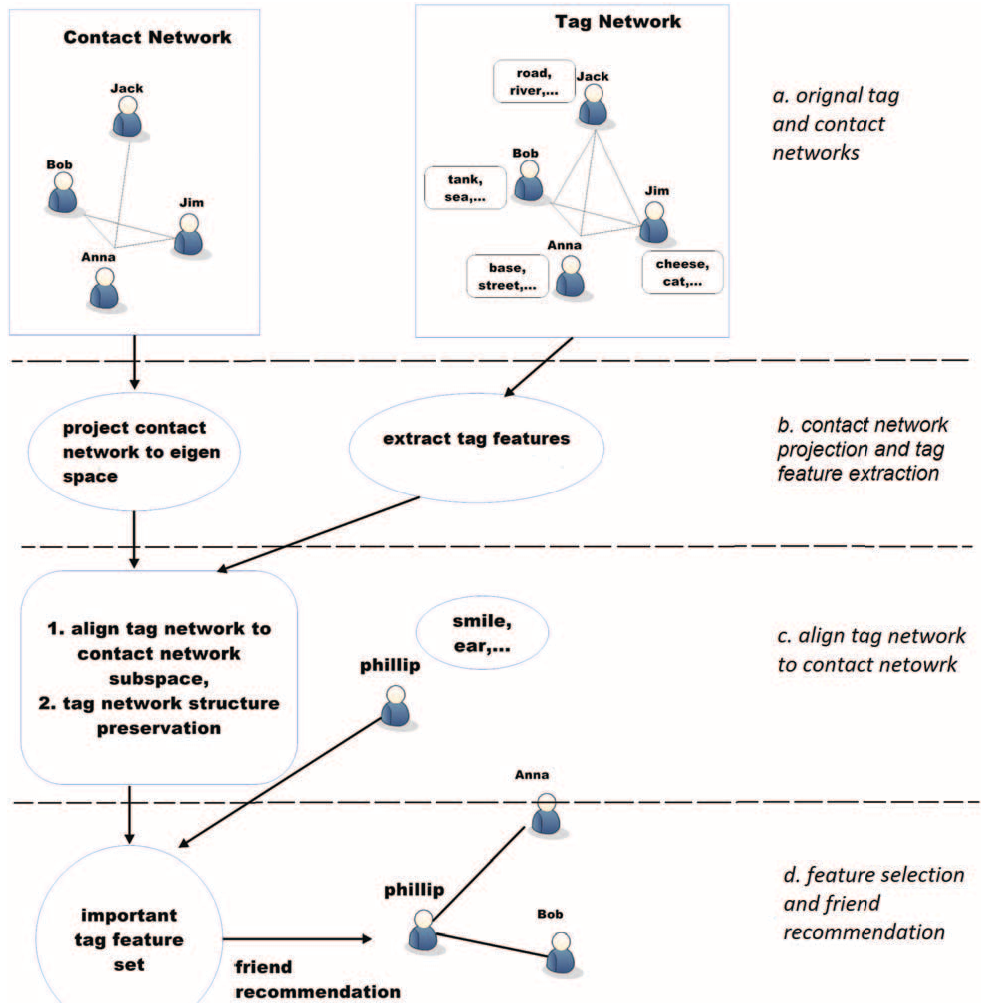 The workflow: from raw networks to eigen-representation, followed by alignment and important feature selection.
Experiments: Quality over Quantity
The team tested their approach on a massive Flickr crawl (10k users, 500k photos).
Key Insight: The "Turning Point"
One of the most fascinating findings is the relationship between the number of features and precision. Recommendation accuracy peaks and stabilizes at around 3,000 to 4,500 tags. Adding more tags (up to 12,000) yields diminishing returns. This proves that social decisions are driven by a sparse subset of highly salient features, not the entirety of our digital footprint.
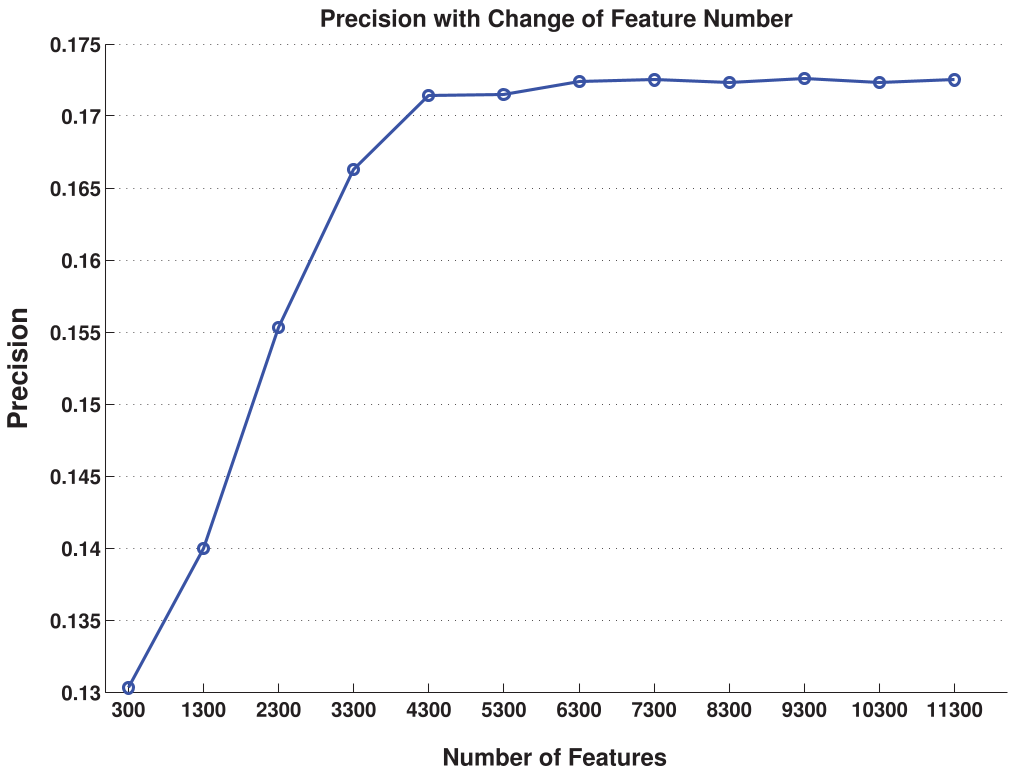 Fig 4 & 5: Demonstrating how precision stabilizes after a specific feature threshold and the benefits of weighting those features.
| Selected Important Features | Discarded/Noisy Features |
|---|---|
| Specific locations (Manhattan, Rome) | Camera brands (Nikon) |
| Distinct hobbies (Tank, Eiffel) | Generic adjectives (Beautiful, Outdoor) |
Critical Analysis & Future Outlook
The NC-based SFR model successfully mathematically formalizes the "Intuitive Role" theory. By selecting specific features like "Historical Buildings" over "Street Views," the model mirrors how humans actually find kindred spirits.
Limitations:
- The current model relies heavily on WordNet for semantic similarity, which might struggle with modern internet slang or rapidly evolving tag trends.
- While computationally efficient for millions of users (due to its dependence on feature count rather than node count), the initial eigenvector decomposition of the Laplacian remains a heavy pre-processing lift.
Conclusion: This work shifts the focus from "User Similarity" to "Structural Correlation." It provides a robust blueprint for multi-network recommendation that can theoretically scale to include geo-data, visual features, and even cross-platform behaviors (e.g., linking Twitter interests to LinkedIn connections).