
Social Gene: Decoding the Latent DNA of Academic Success
Social gene — A new method to find rising stars
This paper introduces Social Gene, a novel method for identifying "rising stars" in academic social networks using Factor Analysis, Neural Networks, and the Analytic Hierarchy Process (AHP). Unlike traditional graph-based algorithms, it focuses on intrinsic individual characteristics to predict future scholarly impact.
TL;DR
Predicting which junior researcher will become the next Nobel laureate or "rising star" is notoriously difficult because traditional metrics (like h-index) favor time over talent. This paper proposes the Social Gene method—a hybrid approach using Factor Analysis, Neural Networks, and the Analytic Hierarchy Process—to identify high-potential scholars by looking at the "intrinsic traits" hidden within their early publication data.
The Problem: The "Rich Get Richer" Bias in Academia
In academic social networks, we usually identify "stars" using graph-based metrics like PageRank or cumulative indices like the h-index. However, these methods have two fatal flaws:
- Data Dependency: They require the entire global citation network to be processed, which is computationally exhausting.
- Time Bias: A brilliant PhD student with three ground-breaking papers will always rank lower than a mediocre senior professor with 100 average papers, simply because the latter has had more time to accumulate citations.
The authors argue that "talent" is an invariant trait—a "Social Gene"—that manifests in early activities like co-author selection, research breadth, and citation velocity long before the total citation count reflects it.
Methodology: From Features to Social Genes
The paper treats the "Rising Star" problem not as a social network analysis (SNA) problem, but as an Operations Research optimization problem.
1. Feature Extraction and Factor Analysis
The authors collect 14 explicit features, including co-author "strong ties," research range (vocabulary diversity in titles), and citation patterns. Since these features are often correlated, they use Factor Analysis to reduce dimensionality into "Common Factors" or Social Genes.
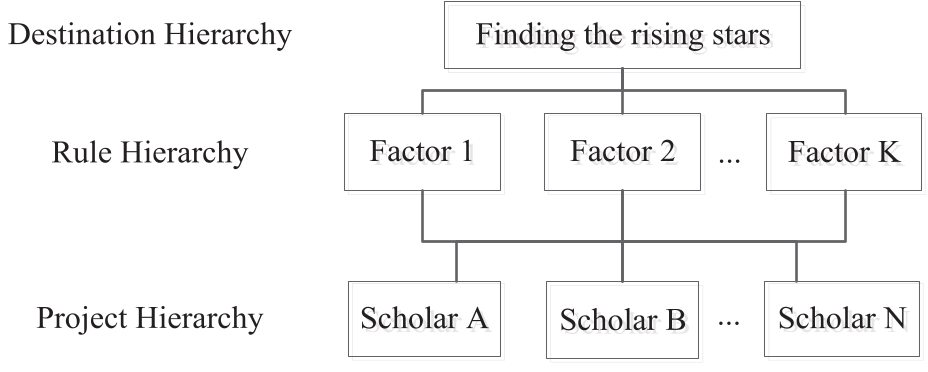
2. The AHP-Neural Network Hybrid
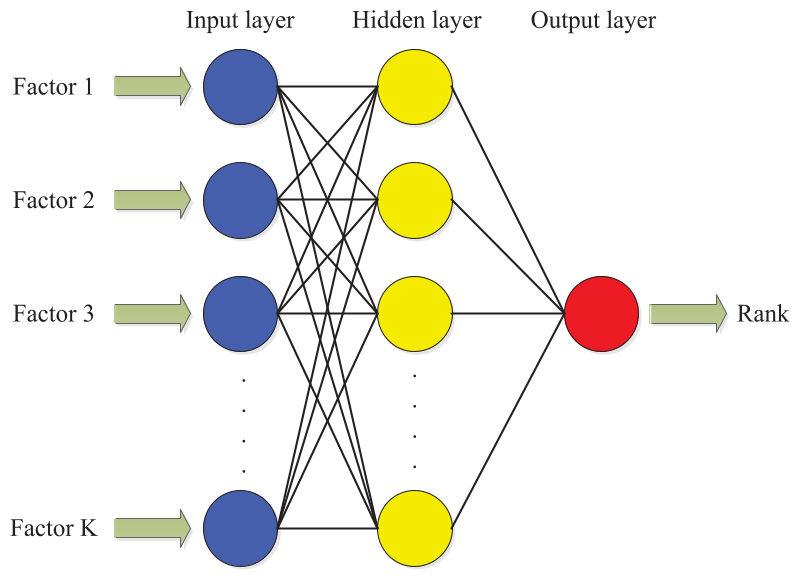
Traditionally, the Analytic Hierarchy Process (AHP) requires human experts to assign weights to different factors. To remove subjectivity, the authors used a fully-connected Neural Network. They trained the network to map social genes to existing rankings (like PubRank), effectively "learning" what weights a domain expert typically assigns to specific traits.
3. Linear Dependency and Partial Correlation
To ensure the model only considers factors that genuinely contribute to success, they applied Partial Correlation Coefficients. This filters out "noisy" features that might have high weights but little actual predictive power regarding the scholar's future rank.
Experiments: Proving the Future
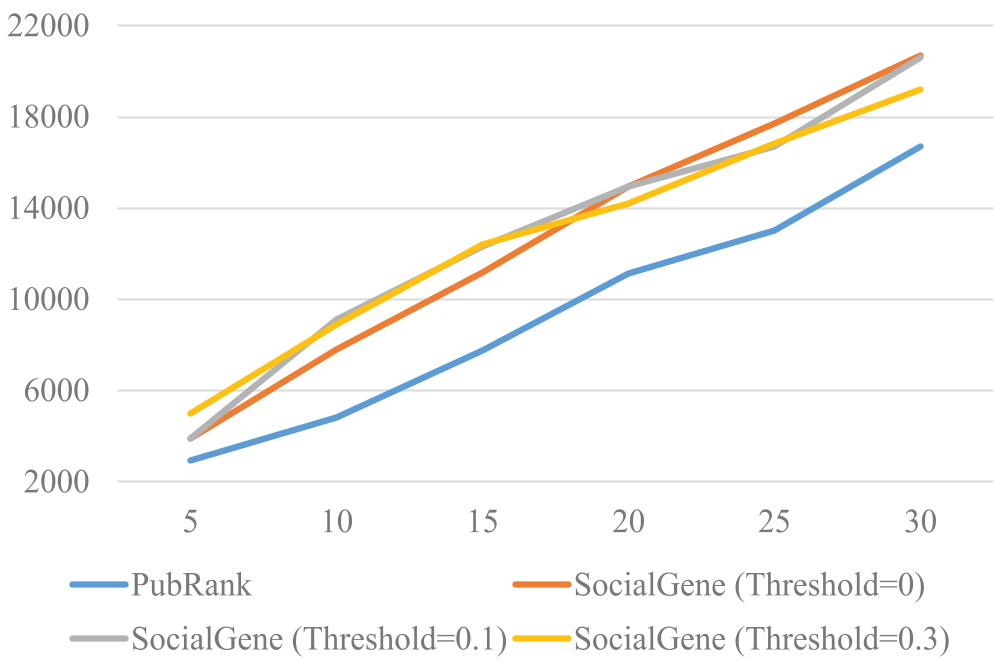
Using the APS (American Physical Society) dataset, the authors tested their ability to predict the citation success of scholars 10 years into the future. By comparing their "Social Gene" rankings from 1980 with actual citation counts in 1990, they validated the model.
Key Findings:
- Higher Predictive Accuracy: The Social Gene method consistently identified scholars who went on to earn more citations than those chosen by the baseline PubRank algorithm.
- Threshold Effectiveness: Implementing a threshold for partial correlation (e.g., 0.1 or 0.3) helps refine the selection of rising stars, as seen in the experimental curves below.
Critical Insight: Why it Works
The "Social Gene" approach works because it captures the qualitative side of a researcher's early career—such as the strength of their collaborations and the diversity of their research interests—rather than just the quantitative output. By using Neural Networks to automate AHP weights, the authors bridged the gap between subjective expert intuition and objective data processing.
Conclusion & Future Outlook
This work demonstrates that "talent" in a social network leaves a distinct signature in data and that we don't need the entire world's data to find the brightest minds. Future iterations could move beyond linear dependency models to use Kernel Functions or Graph Convolutional Networks (GCNs) to capture the non-linear "inter-gene" interactions that lead to academic breakthroughs.
For institutions and PhD applicants alike, these "genes" might soon be the new standard for identifying who will truly be the "shining stars" of tomorrow.