
Scaling Privacy: High-Utility Social Graph Publishing via Random Matrices
Social Graph Publishing with Privacy Guarantees
The paper introduces a random matrix approach for publishing Online Social Network (OSN) graphs with differential privacy. By combining random projection to reduce dimensions and random perturbation with Gaussian noise, the method preserves the spectral utility (top eigenvectors) of massive adjacency matrices while satisfying ()-differential privacy.
TL;DR
Researchers from Michigan State University have developed a scalable framework for publishing massive social network graphs without compromising individual privacy. By using Random Projections to shrink the adjacency matrix before adding noise, they achieve a "best of both worlds" result: rigorous ()-Differential Privacy and high utility for spectral tasks like community detection and node ranking.
The Scalability-Privacy Paradox
Analyzing Online Social Networks (OSNs) is vital for understanding everything from epidemiology to viral marketing. However, social graphs are a privacy minefield. Traditional anonymization (removing names) fails against linkage attacks.
Differential Privacy (DP) is the gold standard for protection, but applying it to matrices faces two hurdles:
- Computation: For a graph with millions of nodes, an perturbed matrix is too large to store or process.
- Utility: Adding enough noise to the original large matrix to satisfy DP often "drowns out" the structural signals, making the eigenvectors (and thus the clusters) useless.
Methodology: The Random Matrix Insight
The core innovation is Algorithm 1, which treats the adjacency matrix not as an object to be directly blurred, but as a high-dimensional structure to be projected.
The Two-Step Defense:
- Random Projection (): The matrix is multiplied by an Gaussian matrix. This reduces the dimension while preserving the "skeleton" of the graph (the top eigenvectors). Crucially, the projection itself provides a baseline of privacy.
- Random Perturbation (): A small Gaussian noise matrix is added to the projected result. Because the projection already narrowed the sensitivity of the data, the amount of noise required to meet DP standards is significantly reduced.
 Algorithm Overview: Scaling DP to the dimensions of real-world networks.
Why it Works: Theoretical Guardrails
The authors provide a rigorous proof (Theorem 1) showing that the required noise variance is only , which is independent of the absolute magnitude of the graph's complexity.
From a utility perspective (Theorem 2), they prove the approximation error for eigenvectors scales with . In simpler terms: the larger the graph, the more accurate the private version becomes, a rare win for big data.
Experimental Battleground
The team tested the approach against LNPP (formerly SOTA) on real datasets like Facebook (3M+ nodes).
Node Clustering
Using Spectral Clustering, they measured how well the private clusters matched the original ones (Normalized Mutual Information).
- Proposed Method: Maintained an NMI of ~0.7 to 0.8 even under high noise.
- LNPP: The noise required for DP was so high that it essentially "randomized" the clusters, making the NMI near zero.
 Performance across Facebook, LiveJournal, and Pokec datasets: The proposed method (m=200) consistently tracks the ground truth (O).
Node Ranking
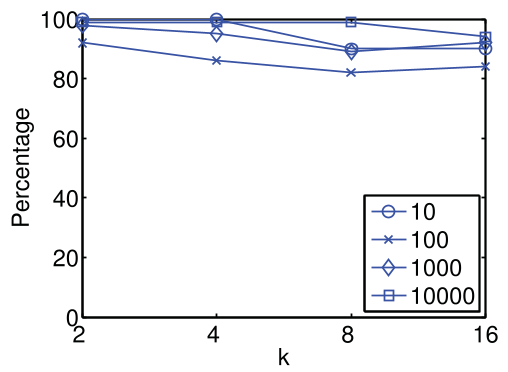
When identifying the top 10,000 "influencers" (Principal Component Centrality):
- The Random Matrix Approach correctly identified over 80% of the top nodes.
- LNPP identified less than 1%.
Critical Insight & Conclusion
This paper demonstrates a fundamental shift in privacy-preserving data publishing. Instead of fighting the "curse of dimensionality" by adding massive noise to large datasets, we can use the "blessing of dimensionality"—specifically, the stability of random projections in high-dimensional spaces—to embed privacy directly into the computation.
Takeaway: For large-scale graph analysis, the future of privacy lies in dimensionality reduction. By reducing the surface area of the data, we make it easier to defend.