
Collective Intelligence: Boosting Social Group Suggestions via Sparse Label Propagation
Social group suggestion from user image collections
This paper introduces a novel social group suggestion framework for photo-sharing platforms like Flickr by analyzing entire user image collections rather than individual photos in isolation. The core method, Sparse Label Propagation (SLP), leverages collection-based context and multi-modal features (visual and textual) to achieve a 12.7% relative improvement in classification accuracy over standard SVM baselines.
TL;DR
Assigning photos to social groups (like Flickr "Architecture" or "Sunset" groups) is a manual burden for users. This paper proposes a system that suggests groups by analyzing entire user collections rather than single images. By combining SVM-based initial classification with a novel Sparse Label Propagation (SLP) method, the researchers achieved a 12.7% relative accuracy boost, proving that the context of "who else is in the photo album" matters as much as the pixels themselves.
The Blind Spot in Traditional Tagging
Most image recommendation systems treat each photo as an island. If you upload a series of photos from a wedding, a standard classifier might correctly identify "Portrait" for one and "Flower" for another, but it misses the overarching context: all these images belong together.
The authors identify two major pain points:
- The Manual Tax: Users often refuse to tag or group photos because it's too time-consuming.
- Contextual Isolation: Ignoring the relationship between images in a collection leads to "noisy" predictions where similar photos are suggested for wildly different, inconsistent groups.
Methodology: Sparse Graphs and Label Propagation
The researchers' approach is a two-stage pipeline designed to mimic human visual interpretation.
1. Initial Multi-Modal Prediction
The system extracts four visual descriptors (Tiny Image, Color Histogram, GIST, and CEDD) plus textual annotations (LDA-based topic modeling). An SVM provides the first "guess" at the appropriate group category.
2. The Core Innovation: Sparse Label Propagation (SLP)
Instead of accepting the SVM output as final, the authors build a Sparse Graph.
- The Insight: Similar images within the same user collection should likely share the same group label.
- The Math: They minimize reconstruction loss to find a weight matrix , but they enforce sparsity. This ensures that an image is only influenced by its most similar neighbors, reducing noise from irrelevant images.
- Refinement: They use an iterative propagation formula: Here, represents the "confidence" of the initial prediction. High-confidence labels stay put, while low-confidence ones are "pulled" toward the labels of their similar neighbors in the collection.
 Figure 1: Social groups on Flickr serve as the ground truth for common interests and image topics.
Experimental Performance
The study tested 11 categories (Animal, Architecture, Seashore, etc.) using data from 767 Flickr users.
Key Findings:
- SLP vs. SVM: SLP raised accuracy from 55% to 62%.
- Superiority over LNP: Compared to Linear Neighborhood Propagation, the sparse approach was far more robust, as it avoided "over-smoothing" labels across unrelated images.
- Architecture Challenge: Interestingly, Architecture was the one category where performance dipped slightly, likely due to the visual diversity of buildings and high background noise (e.g., street clutter) in those specific collections.
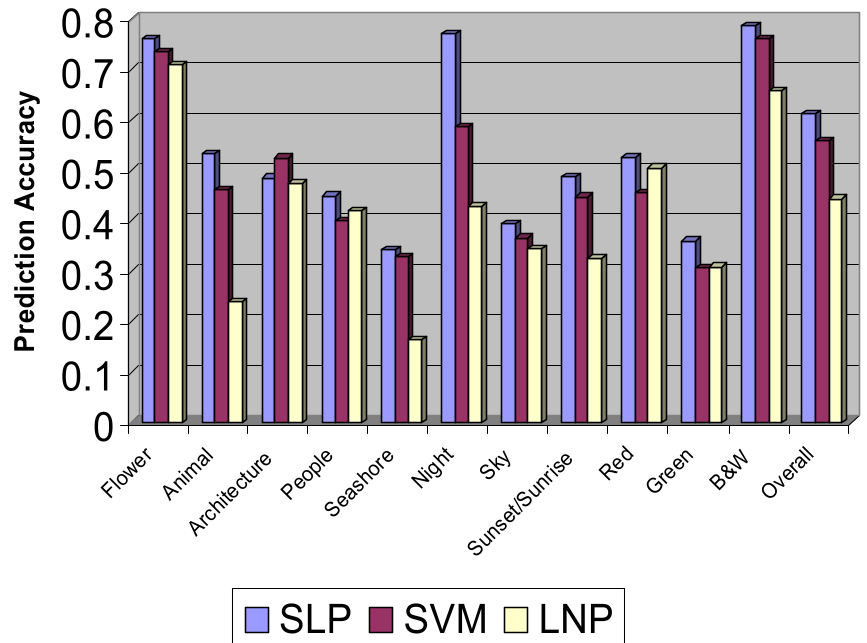 Figure 2: Performance comparison showing SLP (Blue) consistently outperforming SVM and LNP across most categories.
Critical Analysis & Conclusion
The value of this work lies in its Inductive Bias: the assumption that user collections are semantically coherent. While the 2010-era features (GIST, Color Histograms) are now surpassed by Deep Learning (CNNs, ViTs), the logic of Sparse Label Propagation remains highly relevant for semi-supervised learning and "few-shot" refinement today.
Limitations
- Scale: The study used 24 groups; modern platforms have millions.
- Temporal Context: The paper focuses on visual similarity but doesn't explicitly weight images taken at the same timestamp more heavily, which is a common signal in modern smartphone "Memories" features.
Future Outlook
This research laid the groundwork for modern "album-level" auto-tagging. Today, we might replace the SVM with a Transformer-based encoder, but the fundamental idea—using the relationship between images in a session to refine individual labels—is still a cornerstone of high-performance media management systems.