
Leveraging Altruism: How Social Ties Solve the Location Privacy Dilemma
10680_From Social Group Utility Maximization to Personalized Location Privacy in Mobile Networks.
This paper introduces a Socially-Aware Pseudonym Change Game (SA-PCG) framework to enhance personalized location privacy in mobile networks. By leveraging a Social Group Utility Maximization (SGUM) model, the authors incentivize users to update pseudonyms collectively through social ties, achieving significantly higher social welfare than traditional selfish models.
TL;DR
In the world of Location-Based Services (LBS), "hiding in a crowd" by changing pseudonyms is essential for privacy. However, doing so is costly (service interruption). This paper shifts the paradigm from selfish individual utility to Social Group Utility Maximization (SGUM). By modeling social ties as incentives, the authors demonstrate that friends helping friends stay private can lead to a more secure and efficient network for everyone.
Background: The Selfishness Trap
In standard anonymity models, we assume users are rational agents who only care about their own privacy gain vs. cost. This often leads to a "Socially-Oblivious" state where fewer people participate in pseudonym changes, shrinking the anonymity set for everyone.
The core insight of this work is that human behavior isn't purely selfish. In mobile networks, devices are carried by humans with social ties. If my participation in a pseudonym change helps my friend stay anonymous, I am more likely to accept a small personal cost.
Methodology: The Socially-Aware Pseudonym Change Game (SA-PCG)
1. The Personalized Anonymity Model
Unlike prior work, this paper allows for Personalized Privacy. Each user defines an "Anonymity Range." User A might only feel safe if obfuscated by users within 50 meters, while User B might accept 100 meters. This creates a directed graph of physical proximity.
2. The SGUM Utility Function
The utility for user is defined as: Where:
- is the individual utility (Anonymity set size minus cost).
- represents the strength of the social tie (altruism factor).
- is the set of "friends" who benefit from user 's participation.
3. The Greedy Algorithm
Finding the "Best" Nash Equilibrium is NP-hard. The authors solve this with a clever two-phase greedy algorithm that ensures the resulting state is Coalition-Proof.
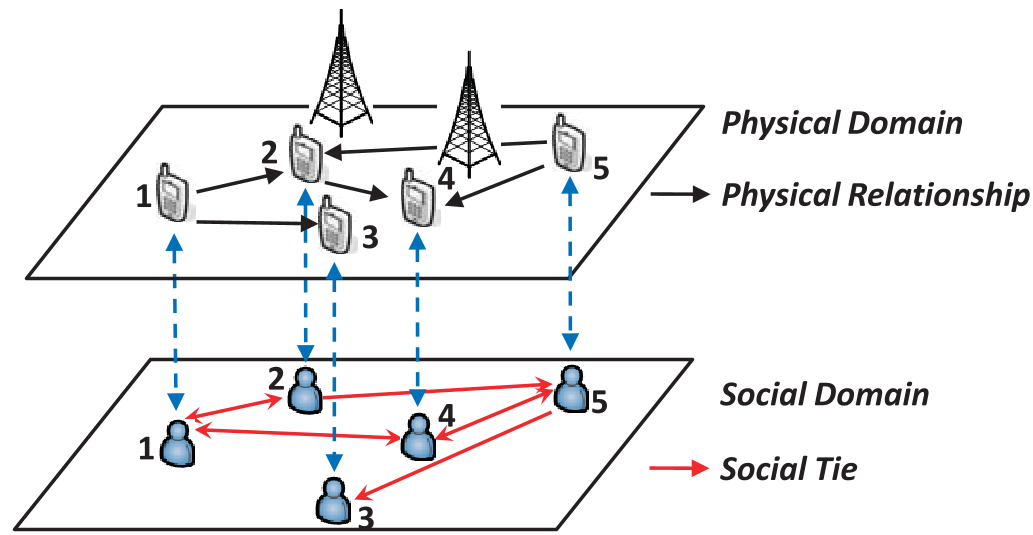 Fig 1: Illustration of the general anonymity model where different users have overlapping but distinct anonymity ranges (dashed circles).
Experiments and Insights
The researchers tested their framework against two benchmarks:
- Socially-Oblivious (SO-PCG): Standard selfish game.
- Social Optimal: The theoretical "perfect" maximum (centralized).
Key Findings:
- Performance Gain: Socially-aware users achieved a 16-20% boost in social welfare over selfish users.
- Altruism as a Catalyst: As social tie probability () increases, the network effectively "migrates" from a fragmented non-cooperative game toward a highly efficient social optimum.
- Scalability: While the theoretical complexity is , empirical tests show it functions closer to , making it viable for real-world mobile deployments.
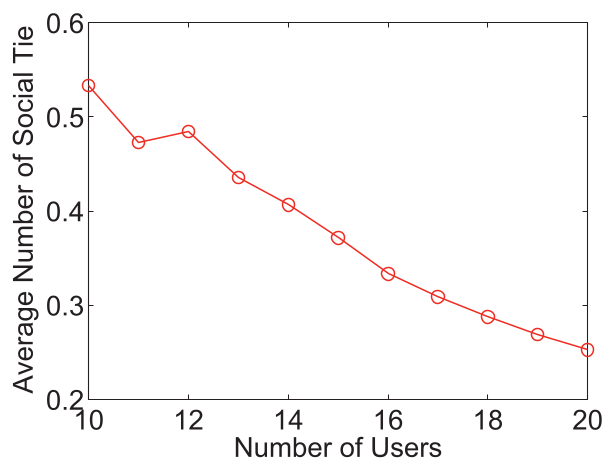 Fig 2: Impact of Social Tie Probability () on social welfare. As ties strengthen, the SNE (red line) approaches the Social Optimal (blue stars).
Critical Analysis: Is it Practical?
One might ask: Does this compromise identity privacy since we are using social information? The authors address this with a Privacy-Preserving Protocol. By using private matching and proximity detection (via encrypted message exchanges), users can confirm social ties and proximity without ever revealing their actual GPS coordinates or real identities to one another.
Limitations: The current model assumes "Positive Ties." In real life, "Negative Ties" (enemies) exist, where a user might intentionally not participate to hurt someone else's anonymity. The authors suggest this as a future research vector.
Conclusion
This paper provides a rigorous mathematical bridge between sociology and network security. It proves that by engineering LBS protocols to account for human social structures, we can solve technical efficiency problems that selfish models cannot.
Key Takeaway: In decentralized privacy, your friends are your best assets.