
SGA: Reimagining Multicast through Social Fairness and Cooperative Ad-Hoc Networks
Social Groupcasting Algorithm for Wireless Cellular Multicast Services
The paper proposes the Social Groupcasting Algorithm (SGA), a cooperative multicasting framework where members of a social personal network group (SNG) use a cellular link to download content and a short-range ad-hoc network (e.g., WiFi Direct) for local distribution. SGA dynamically selects a "leader" for each content segment to maximize throughput while balancing energy consumption and social fairness.
TL;DR
The Social Groupcasting Algorithm (SGA) breaks the "bottleneck of the weakest link" in traditional cellular multicasting. By allowing a social group to elect a single "downloader" based on channel quality and then sharing data via local WiFi/Bluetooth, it achieves high throughput while using a mathematical Friendship Index to ensure no single user's battery or data plan is unfairly exhausted.
Problem & Motivation: The "Lowest Common Denominator" Trap
In standard cellular multicasting (like eMBMS in LTE), the Base Station (BS) must transmit at a rate that the user with the absolute worst signal can receive. This is incredibly inefficient—if one person is in a basement, everyone's download speed suffers.
The authors identify a massive opportunity in Social Personal Networks (SNGs). Since friends or colleagues are often physically close, why not have the person with the best signal download the data and then "groupcast" it to the others via free, high-speed short-range (SR) links? The challenge, however, is fairness: Who wants to be the one wasting their battery and data quota for the group?
Methodology: The Math of Friendship
The core innovation of SGA is the balancing act between opportunistic scheduling (picking the best channel) and social equity.
1. The Fairness Function
The algorithm tracks the Contribution Index (), which is the fraction of total content terminal has downloaded so far. To decide who is next, it uses: Where is the Friendship Index.
- High : Close friends/family. The system prioritizes the best channel, assuming members don't mind sacrificing battery for the group.
- Low : Acquaintances. The system aggressively forces the "freeloaders" (those with low ) to take their turn downloading, even if their signal isn't the best.
2. Architecture: Centralized vs. Distributed
The paper proposes two deployment modes:
- Centralized: The BS tracks SNR and energy of all users.
- Decentralized: A local "leader" within the group calculates the next downloader and tells the BS where to send the next packet.
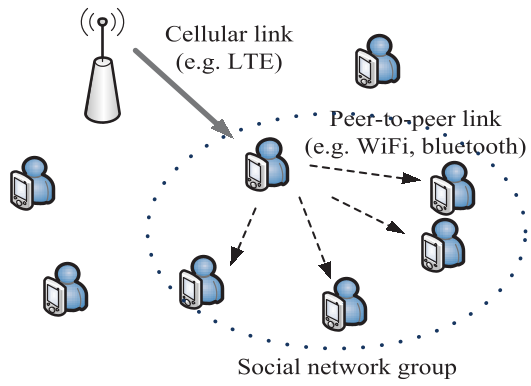
Experiments & Results: Efficiency without Sacrificing Equity
The researchers tested SGA against conventional multicasting. The results were clear: as the group size grows, traditional multicasting throughput drops (because the probability of having one user with a terrible signal increases), while SGA throughput rises (because the probability of having one user with an excellent signal increases).
Fairness vs. Throughput
By adjusting , the system can perfectly tune the trade-off. In scenarios with 25 terminals and highly uneven signals, a low (0.1) brought the Jain’s Fairness Index up to 0.805, ensuring nearly everyone contributed equally to the download effort without significant loss in total throughput.
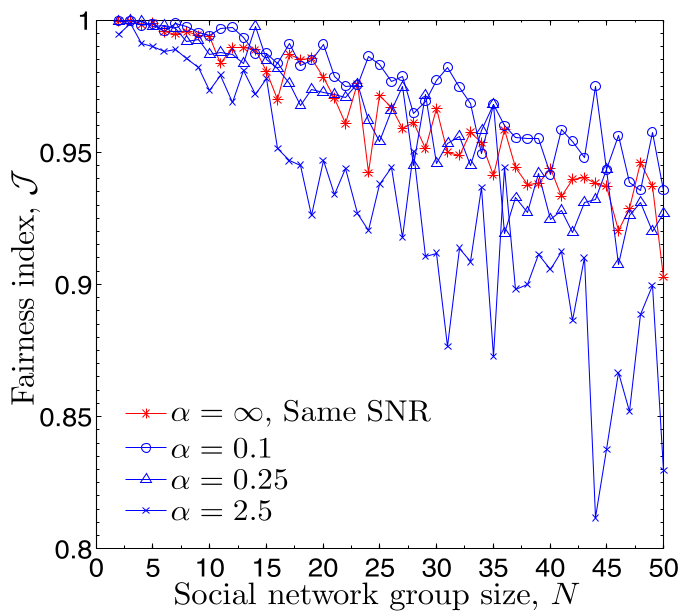 Figure: SGA maintains high fairness even as the group grows, whereas pure opportunistic scheduling would ignore the "cost" to individual users.
Critical Analysis & Conclusion
Key Takeaway
SGA proves that cooperative P2P networking is not just a technical challenge but a social one. By incorporating energy levels () and contribution history into the scheduling loop, the authors created a protocol that is "economically" sustainable for the participants.
Limitations & Future Work
One notable drawback is the SR dissemination delay: while the cellular download is faster, the local hop via WiFi Direct adds latency. Future iterations of this work could explore MIMO Unicasting, where the BS sends different blocks to multiple "sub-leaders" simultaneously to further parallelize the process.
SGA stands as a foundational piece for D2D (Device-to-Device) communication, shifting the focus from "BS-to-User" to a more organic "BS-to-Community" model.