
Integrating Social Grouping: A High-Level Contextual Breakthrough for Inter-Camera Tracking
Integrating Social Grouping for Multitarget Tracking Across Cameras in a CRF Model
This paper introduces a novel online Conditional Random Field (CRF) framework for Multi-Target Tracking (MTT) across nonoverlapping cameras. By Integrating high-level "social grouping behavior" with traditional appearance and spatiotemporal cues, the method achieves state-of-the-art performance, notably improving Multicamera Tracking Accuracy (MCTA) by up to 0.46 on complex datasets.
TL;DR
Tracking people across nonoverlapping cameras is a "blind-spot" problem where appearance cues often fail. This paper solves it by observing that humans rarely walk alone—they form social groups. By encoding these group consistencies into a Conditional Random Field (CRF) model and learning target-specific features online, the authors achieve a massive boost in tracking accuracy (MCTA) across challenging real-world surveillance networks.
The "Blind Area" Problem: Why Low-Level Cues Fail
In wide-area surveillance, cameras don't see everywhere. When a person leaves Camera A and enters Camera B minutes later, two things happen:
- Appearance Drifts: Different lighting and sensor angles make the same person look like a stranger.
- Motion Uncertainty: The "blind area" makes trajectory prediction unreliable.
Most SOTA methods try to fix this with better Brightness Transfer Functions (BTFs) or Re-Identification (Re-ID) metrics. However, these are still low-level features. This paper pivots to a sociological insight: up to 70% of people walk in groups. If Person A and Person B are walking together in Camera 1, they are extremely likely to reappear together in Camera 2.
Methodology: The Socially-Aware CRF
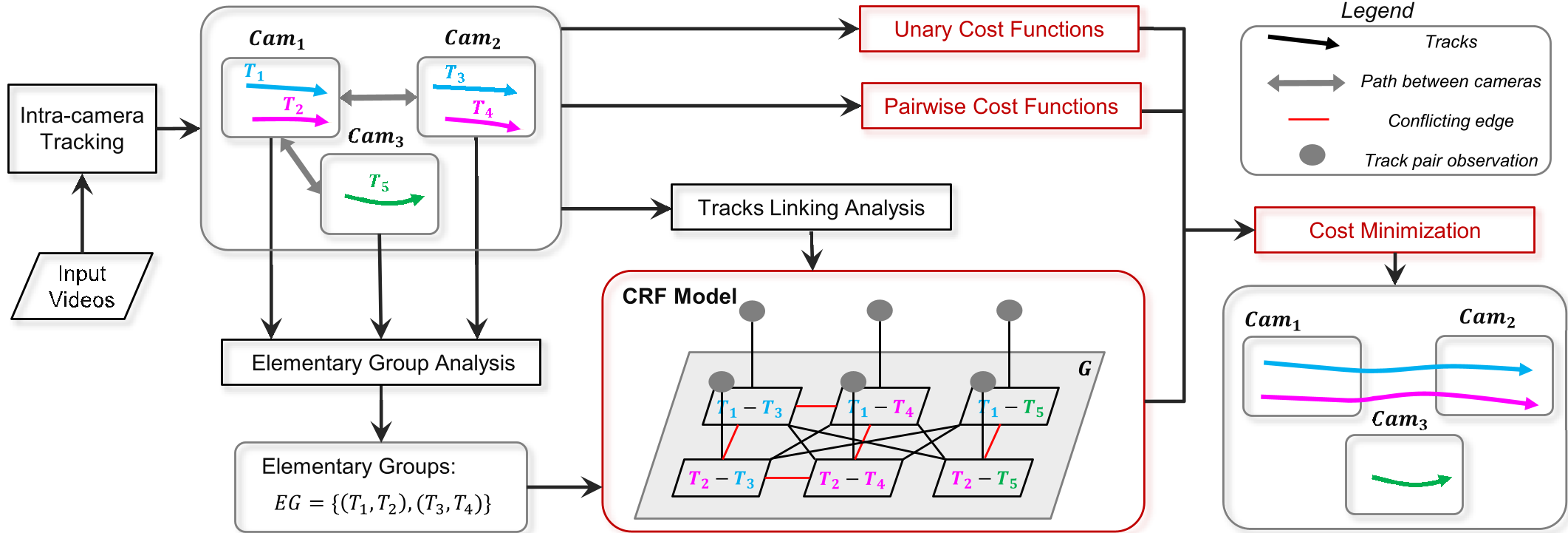
The authors propose an online learned CRF model. In this setup, a node represents a potential link between two tracks from different cameras, and an edge represents the correlation between two different track associations.
1. Identifying Elementary Groups
The system first detects "elementary groups" (pairs of tracks with similar motion and temporal proximity) within a single camera. This information becomes the "edge cost" in the CRF. If two people move as a group, the model lowers the energy cost for associating both of them simultaneously across the network.
2. Online Target-Specific Learning
Rather than using a static feature extractor, the model uses AdaBoost to learn what makes each specific target unique on the fly. It extracts 60 features (HSV, LBP, HOG, Color Names) and weighs them based on the current scene's context.
3. Solving the Energy Puzzle
Because the model includes "conflicting edges" (a track cannot be linked to two different people), the energy function is non-submodular. Traditional Graph Cuts won't work. The authors developed an Iterative Approximation Algorithm that starts with a Hungarian match and greedily refines the labels to lower the global energy while respecting the "one-to-one" association constraint.
Experiments: Performance Analysis
The method was tested on the NLPR_MCT dataset, featuring diverse indoor and outdoor scenarios.
Key Results:
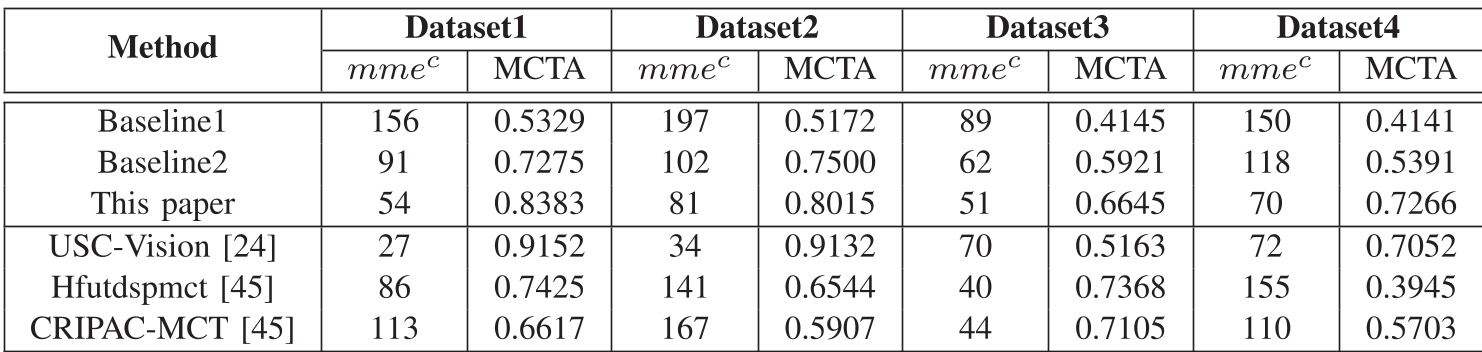
- Dataset 4 Achievement: MCTA jumped from 0.41 (Baseline) to 0.72.
- Group percentage impact: In Dataset 4, where 44.5% of associations involved groups, the model showed its strongest advantage.
- Robustness: Even when using noisy, automated single-camera tracks instead of ground truth, the model maintained high performance (0.81 MCTA on Dataset 1).
Deep Insight: Beyond Individual Re-ID
The core takeaway is that Inter-camera tracking is not just Re-ID. While Re-ID treats every detection as an isolated image, tracking provides temporal trajectories. These trajectories allow us to model "Social Force" and "Grouping Consistency."
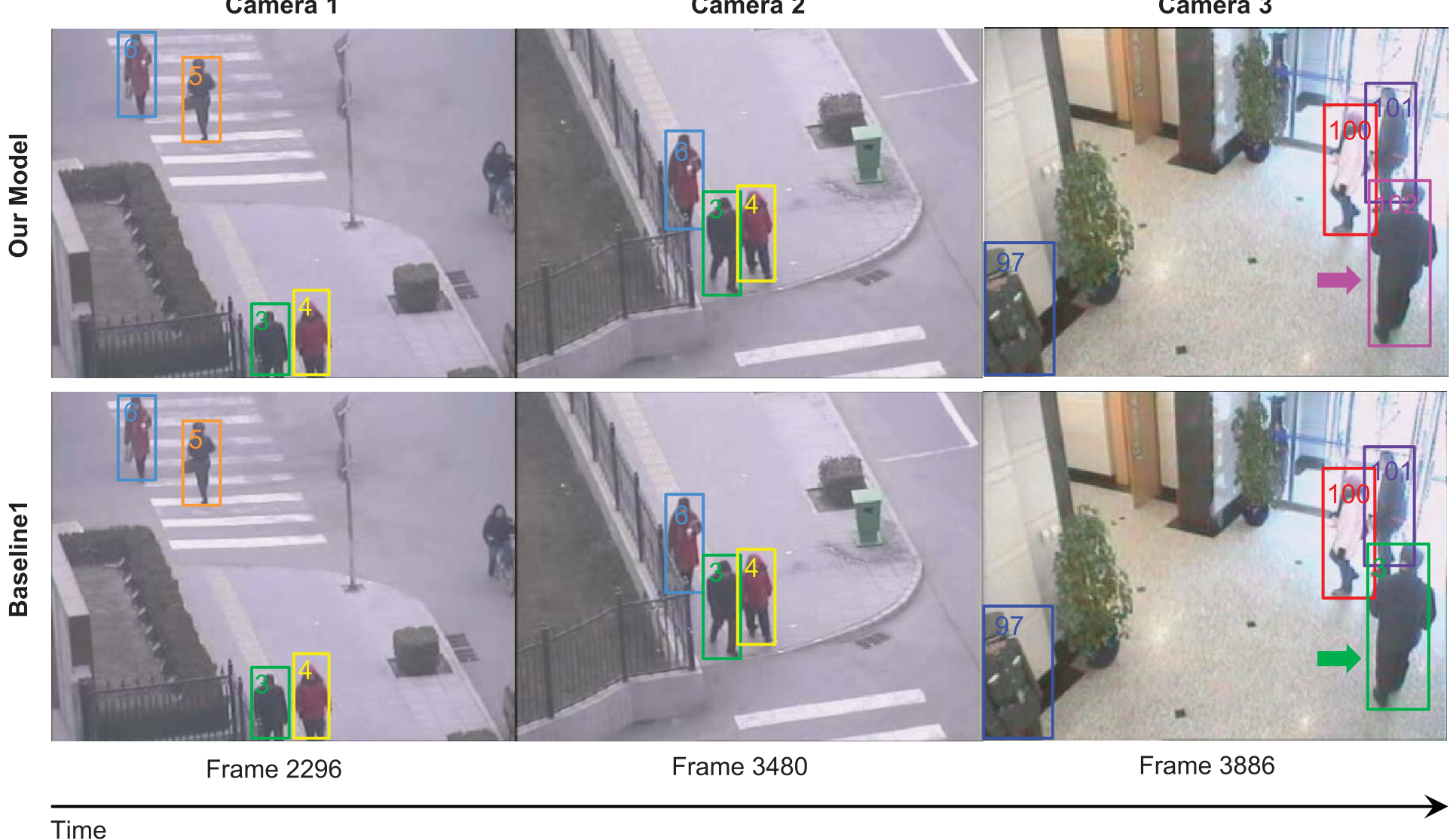
As shown in the figure below, the individual appearance of Target 3 and 4 changes significantly in Camera 3. A standard appearance-only model (Baseline 1) fails. However, the CRF model recognizes the group structure, using the "Social Link" between 3 and 4 to maintain their identities correctly.
Conclusion and Limitations
The integration of social behavior into a CRF framework provides a robust "High-Level" anchor for tracking. However, the model has limits:
- Short Dwell Times: In Dataset 3, where tracks averaged only 3.9 seconds, grouping was harder to detect, leading to lower performance.
- Complexity: Online learning via AdaBoost for every track pair is computationally heavier than simple feature matching.
Future Outlook: Combining this social grouping logic with modern Deep Learning-based embeddings (like Triplet Loss features) could likely set a new ceiling for wide-area surveillance accuracy.