
Bingo: Maximizing Edge Cache Hits via Implicit Social Community Discovery
Social Groups Based Content Caching in Wireless Networks
The paper proposes Bingo, a proactive edge caching scheme for mobile networks that leverages social interest groups to optimize content placement. By approximating community structures from user-request logs, Bingo achieves a 30%–34% improvement in cache hit ratio compared to traditional baselines like LRU and LFU.
TL;DR
Mobile data traffic is no longer just about individual requests; it's driven by social "circles." Bingo is a proactive caching engine that doesn't need your private friend list to work. By analyzing the "who-requests-what" patterns in base station logs, it reconstructs social interest groups and caches content that groups (rather than just individuals) want. The result? A 34% boost in cache hit ratios over standard industry methods like LRU.
The Persistence of the Backhaul Bottleneck
Despite the rollout of 5G, the mobile backhaul network remains under immense strain. The culprit isn't just "more users," but the way we consume content: shared in groups, forwarded in circles, and trending within specific interest communities.
Current caching strategies typically fall into two camps:
- Reactive/Standard: (LRU, LFU, FIFO) These treat every request as an isolated event or look only at global popularity, ignoring the social context.
- Social-Graph Dependent: These require the Mobile Network Operator (MNO) to have full access to a user’s social media graph—a privacy nightmare and technically difficult to obtain.
Bingo bridges this gap by asking: Can we infer the social graph just by looking at the request timing and content overlap?
Methodology: Turning Logs into Social Insights
The core innovation of Bingo lies in its ability to transform raw request logs into a structured community map without any external metadata.
1. The Weighted Graph Construction
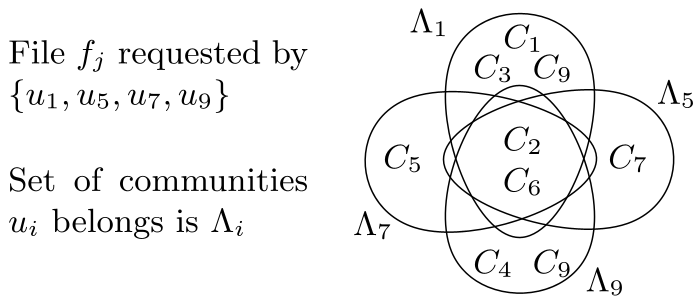
Bingo treats users as nodes. If two users request the same file within a certain window, an edge is created between them. The more files they share, the "heavier" the edge. This creates a user-user network where clusters naturally represent interest groups.
2. Community Identification & Scoring
Once clusters (communities) are detected using a conductance-based algorithm, Bingo applies a clever scoring logic for caching:
- Identify: When a user requests a file, Bingo checks which community they belong to.
- Score: A file's cache priority is roughly proportional to (the size of the community interested in it).
- Decay: As more members of that group download the file, the score decrements, eventually making room for new "trending" content.
Hierarchical Deployment
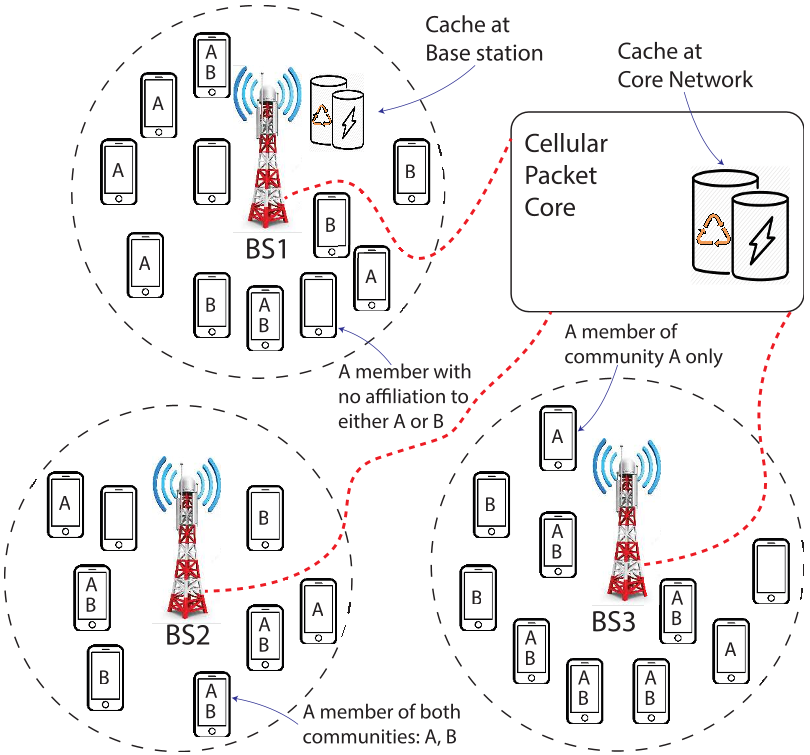
One of the most practical aspects of Bingo is its flexibility in the network topology. It can be deployed:
- At the Base Station (BS): For hyper-local, low-latency caching.
- At the Packet Core: To serve communities that are geographically spread across multiple cells.
Performance: Leaving Baselines in the Dust
The researchers tested Bingo against Five industry standards: FIFO, LFU, LRU, MPC (Minimum Popularity Caching), and Random.
The findings were conclusive:
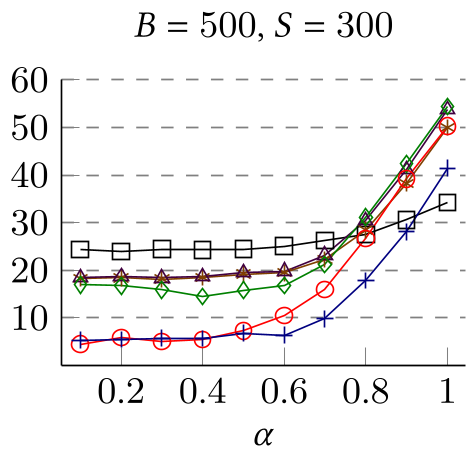
- Hit Ratio: Bingo consistently outperformed LRU (the strongest baseline) by 30%-34%.
- Scalability: As cache capacity increases, the performance gap between Bingo and traditional methods widens, meaning Bingo utilizes available memory much more efficiently.
- Robustness: Even when file popularity becomes more uniform (harder to predict), Bingo's use of "social locality" provides a stable performance floor.
Critical Insight: Why it Works
The "magic" of Bingo is its exploitation of the Inductive Bias found in social networks. In the real world, if three people in a 50-person WhatsApp group download a video, the probability that the other 47 will eventually download it is extremely high. While LRU waits for the 4th, 5th, and 6th request to "prove" popularity, Bingo sees the community membership and caches the file after the very first few hits, effectively "pre-fetching" for the rest of the group.
Conclusion & Future Outlook
Bingo proves that you don't need to violate user privacy to offer a faster, more efficient network. By looking at the structural patterns of requests, MNOs can stay ahead of the traffic curve.
Future Work: The next frontier for Bingo is likely the integration of Temporal Dynamics—predicting not just what a community wants, but when they want it (e.g., during a live sporting event or a viral news break). Additionally, moving the community detection to the "on-the-fly" stream processing would reduce the need for background batch processing.
Disclaimer: This analysis is based on the paper "Social Groups Based Content Caching in Wireless Networks" (MobiWac ’21).