
Beyond Simple Contagion: Modeling Social Hotspots via Evolutionary Games and Multidimensional User Attributes
Social hotspot propagation dynamics model based on multidimensional attributes and evolutionary games
This paper introduces a social hotspot propagation dynamics model that integrates user multidimensional attributes and Evolutionary Game Theory (EGT) with the traditional Susceptible-Infected-Recovered (SIR) epidemic framework. By quantifying both internal drivers (user network and historical behavior) and external drivers (perceived popularity and payoff-driven strategies), the model effectively simulates the complex evolution of information diffusion in real-world social networks.
TL;DR
Information in social networks doesn't just "infect" people like a biological virus—it spreads through a complex calculus of personal interest and social pressure. This paper presents a novel propagation model that upgrades the classic SIR epidemic model by injecting Multidimensional User Attributes and Evolutionary Game Theory (EGT). By doing so, it captures the "Why" behind information cascades, achieving a 0.98 correlation with real-world Tencent Microblog data.
Problem & Motivation: The Flaw in Fixed Probabilities
Traditional models treat users as passive nodes that transition between states (Susceptible Infected Recovered) based on fixed probabilities. However, social network users are rational and heterogeneous:
- Internal Bias: A user's decision to retweet depends on their historical interests and their position in the network (e.g., an "Influencer" vs. a casual observer).
- External Context: The perceived popularity of a topic and the social "payoff" of joining the conversation influence a user's willingness to participate.
The authors recognize that infection rates are dynamic, not static. They sought to bridge the gap between epidemic mathematics and behavioral psychology.
Methodology: The Dual-Driving Mechanism
The core of this research is the fusion of two distinct driving forces into the SIR differential equations.
1. Internal Driving Factors (The "Who")
Using multivariate linear regression, the authors quantify the internal drive of a node :
- Network Attributes: User Degree () and Betweenness ().
- Historical Attributes: Interest Similarity () via Jaccard coefficients and User Activity ().
2. External Driving Factors (The "Environment")
The paper introduces Perceived Popularity (). Users are modeled as players in a game choosing between a Positive Strategy (actively participating) and a Passive Strategy (ignoring the topic). The transition between these strategies is governed by the Replicator Dynamics equation: Where is the payoff difference. Essentially, if a topic becomes popular enough to yield a social benefit, users "evolve" their strategy to participate.
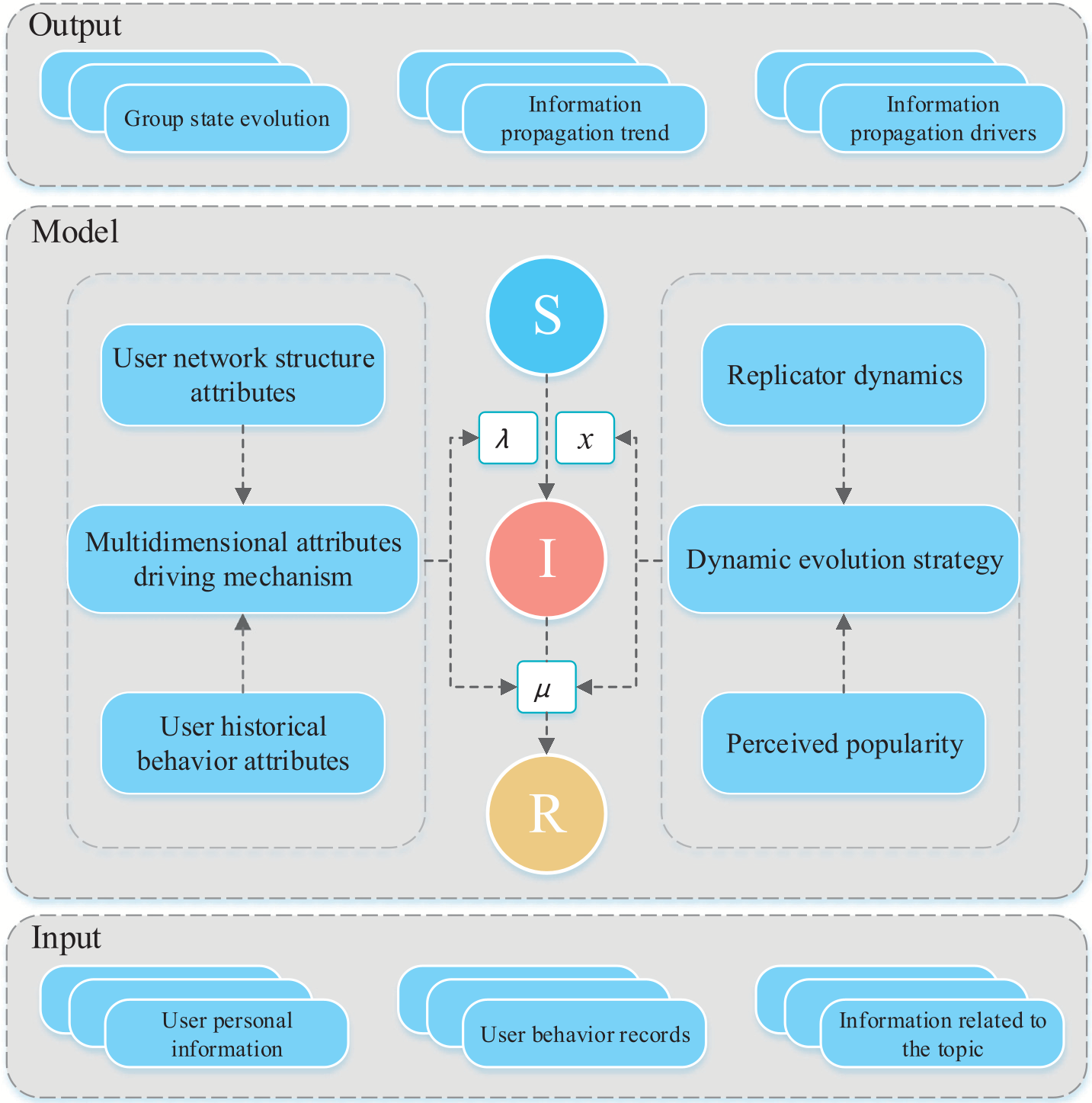 Figure 1: The proposed model framework integrating attribute extraction, EGT strategy adjustment, and the SIR process.
Experiments: Real-World Validation
The authors tested the model on three major Chinese social media hotspots. The most impressive result is the Dynamic Infection Rate analysis. Unlike standard SIR models where the infection rate is a flat line, this model's rate fluctuates, mimicking the actual growth and decay of public interest.
SOTA Comparison & Correlation
The Pearson correlation coefficient between the model’s predicted "infected" users and real-world data reached 0.96 to 0.98, proving that the dynamic adjustment mechanism significantly outperforms static epidemic models.
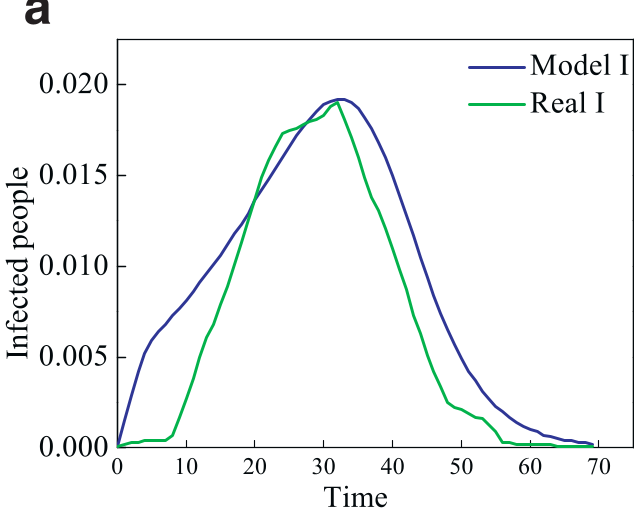 Figure 2: Comparison of the model's infection trend vs. real-world data for "Topic B" (Where Are We Going, Dad?).
Key Sensitivity Insights
Through orthogonal design experiments, the authors discovered:
- Strategy Change Speed (): This is the most critical factor for determining the "Peak Time" of a hotspot.
- Popularity Threshold (): Lowering the "cost" of participation (making it easier to join a trend) significantly increases the final scale of the "Infected" population.
Deep Insight & Conclusion
This paper shifts the paradigm from Passive Contagion to Adaptive Participation. It highlights that a topic's lifespan is a tug-of-war between the internal authority of the spreaders and the external perceived "payoff" for the audience.
Takeaway for Industry: For social media marketers, the research suggests that "seeding" a topic among high-authority nodes (Internal Drive) is only half the battle. One must also manufacture high "Perceived Popularity" early on to lower the payoff threshold, triggering the evolutionary strategy switch in the mass user base.
Limitations: The model assumes users are somewhat rational actors seeking payoffs, which might not account for purely emotional or irrational "panic" spreading. Future work could integrate emotional contagion theory into the EGT payoff matrix.