
Deciphering Digital Tribes: A Social Hypertext Model for Blog Communities
A social hypertext model for finding community in blogs
The paper introduces a "Social Hypertext Model" for identifying and measuring virtual communities within the blogosphere. By integrating McMillan and Chavis' "Sense of Community" (SOC) psychological framework with Social Network Analysis (SNA), the authors demonstrate how structural patterns like centrality can automatically detect community strength in interconnected blogs.
TL;DR
In the mid-2000s, the explosion of the blogosphere created a new type of "virtual settlement." This paper proposes a methodology to quantify these communities by aligning Social Network Analysis (SNA) with the psychological Sense of Community (SOC) index. By analyzing link frequencies and "star" patterns, the researchers proved that structural centrality in a network is a direct reflection of a user's psychological belonging.
The "Sense of Community" Gap
Why is it that some online groups feel like a tight-knit family while others feel like a shouting match in a void? Behavioral scientists McMillan and Chavis defined community through four pillars: Membership, Influence, Reinforcement of Needs, and Shared Emotional Connection.
However, measuring these usually requires tedious surveys. On the other hand, purely mathematical "hub and authority" algorithms (like PageRank) treat blogs as documents, not people. The authors argue that blogs are Social Hypertext—an amalgam of person and document—and that the bridge between math and psychology lies in the structure of interactions.
Methodology: Mapping Math to Mind
The core innovation of this paper is the Social Hypertext Model, which creates a direct mapping between psychological feelings and network metrics:
- Membership Degree Centrality: If you have many direct connections (Degree), you feel like a member. Visually, this looks like a Star Network.
- Influence Betweenness: Those who act as "bridges" (Brokers) between different groups have the highest influence on the flow of information.
- Needs Closeness: Highly efficient paths to others allow for better reinforcement of mutual needs.
- Emotion k-cores: Intense, completely connected triangles of users indicate a "spiritual bond" or shared emotional history.
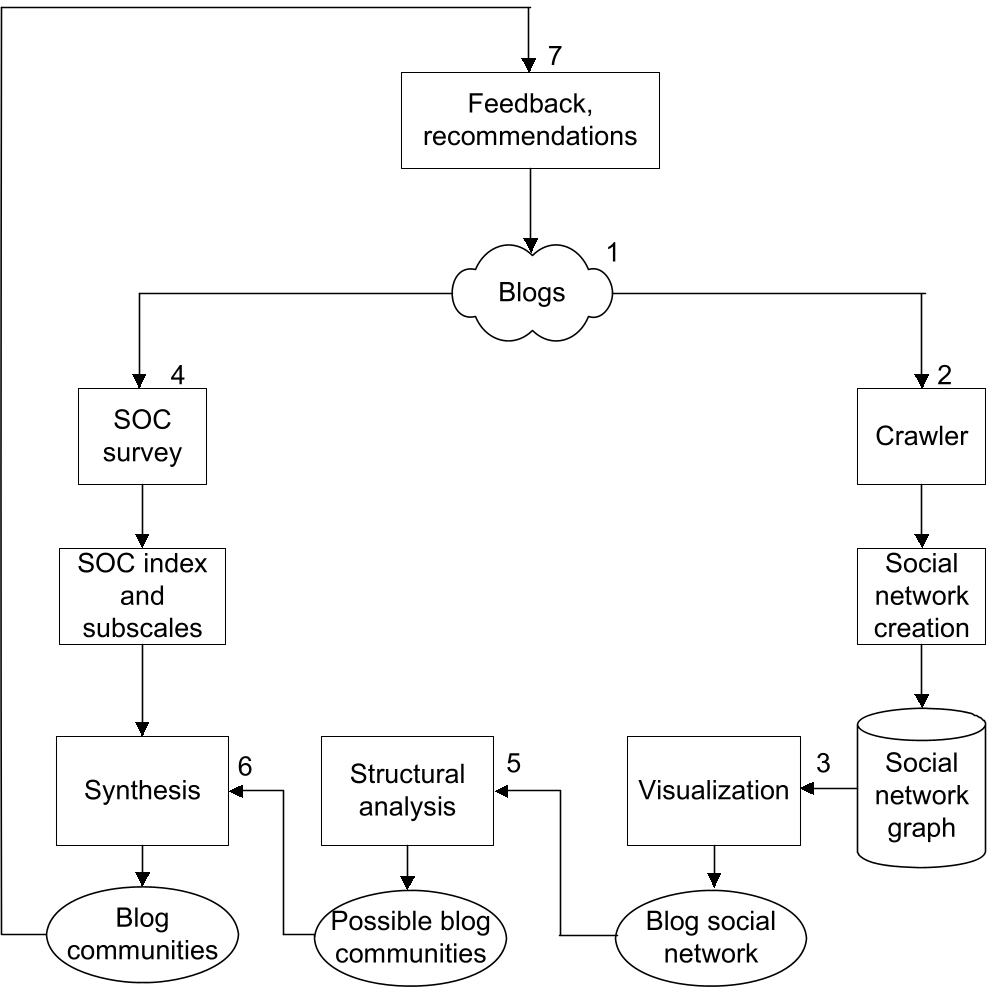 The model aligns visualization indicators (like star networks) with social network analysis indicators (like centrality measures).
Case Study: The Indie Music Blog
The authors tested their model on a Canadian independent music blog network. By crawling RSS feeds to two degrees of separation, they mapped a social universe of 604 blogs.
Key Structural Findings
Using Pajek for visualization, they identified that most users (~83%) had only a single connection, representing a "long tail" of casual readers. However, the "core" community emerged through Reciprocal Links—where Blogger A comments on B, and B comments back on A.
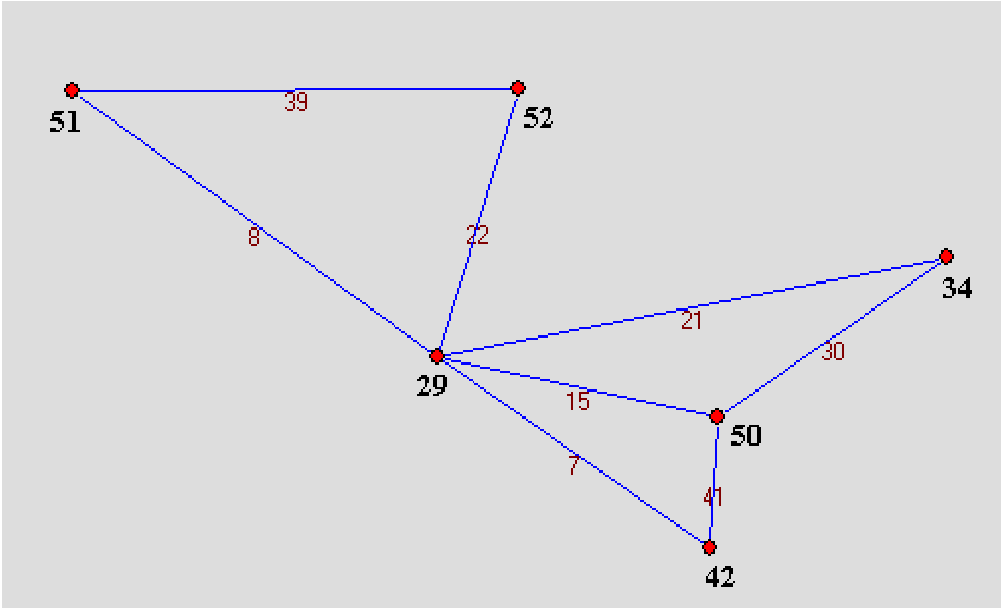 Figure 10: The extracted network after hierarchical reduction reveals the "star" patterns of core members surrounding the central indie music blog (Node 29).
The Synthesis: Does the Math Hold Up?
The researchers compared survey results from 15 participants against their centrality rankings. The results were striking:
- Blogger 34 & 50: High SOC scores (44-48) matched their roles as "Brokers" with high Betweenness Centrality.
- Blogger 45: Had a moderate SOC score (36); the math showed they were part of a "star" but were not brokers, marking them as a "weak" community member.
- Passive Readers: Users who read but never commented had the lowest SOC scores and were structurally invisible.
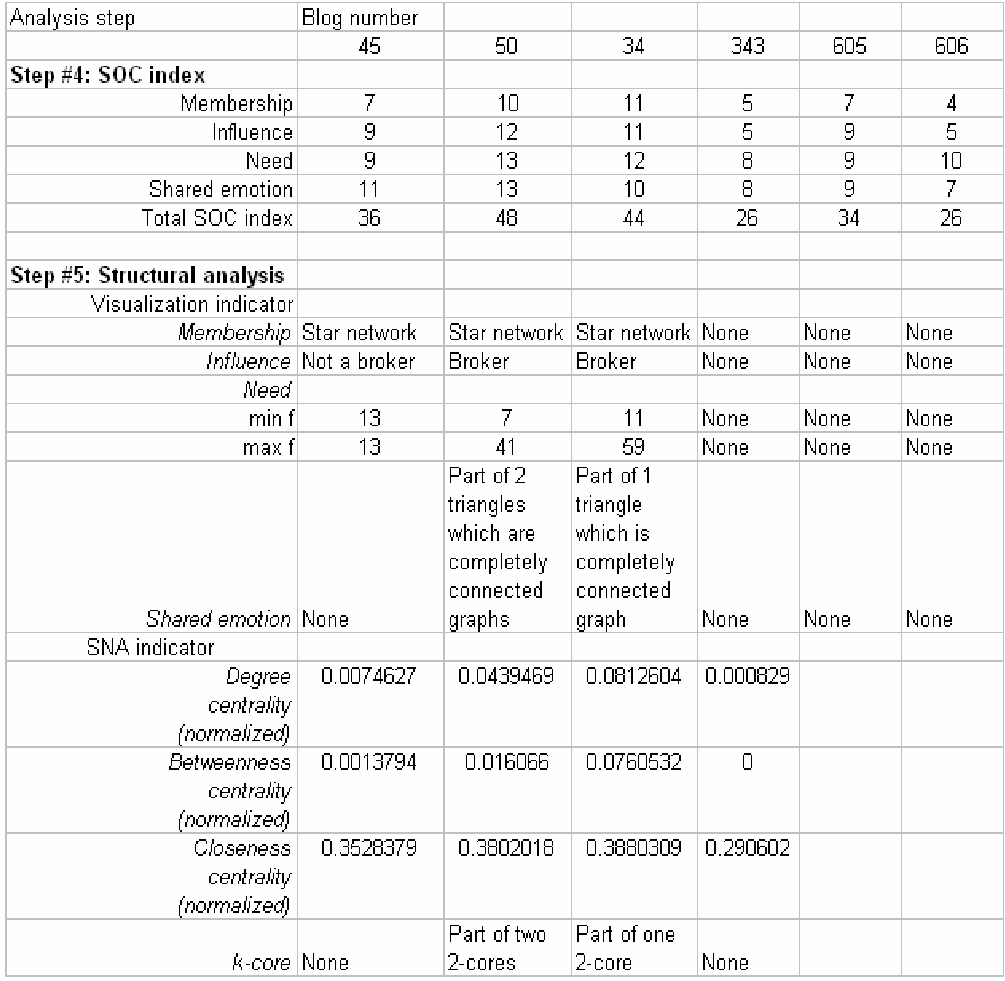 Table 3: Validating structural metrics against the psychological SOC index.
Final Insight: The Scalability of Belonging
The value of this paper lies in its calibration mechanism. By using a small, high-fidelity survey to find the "threshold" centrality scores (e.g., Normalized Degree > 0.04), researchers can then run automated scanners over millions of blogs to identify thriving communities without ever asking a single question.
While the 2006 "blogosphere" has evolved into the "social media" of 2024, the fundamental physics of the Social Hypertext remain: communities are built on reciprocity and brokerage. To build a lasting platform, don't just count clicks—build stars and triangles.