
Designing for the Digital Self: A Reference Framework for Social Identity Management
Analyzing settings for social identity management on Social Networking Sites: Classification, current state, and proposed developments
The paper proposes a provider-independent reference framework for Social Identity Management (SIdM) on Social Networking Sites (SNS). It categorizes existing and desirable privacy settings into four high-level requirements and evaluates the SIdM capabilities of major platforms like Facebook and Google+.
TL;DR
In the physical world, we act differently around our bosses than our best friends. Online, this "Impression Management" collapses. This paper provides a theoretical and technical roadmap for Social Identity Management (SIdM)—the art of selectively disclosing pieces of ourselves to specific social circles. By analyzing sites like Facebook and Google+, the authors highlight a massive gap between current settings and what we actually need to protect our "Digital Personas."
The Core Conflict: Context Collapse
The author's primary insight stems from Goffman’s Identity Theory: we are not one single person, but a collection of roles. On Social Networking Sites (SNS), these roles collide—a phenomenon known as Context Collapse.
The problem isn't just about hiding data from "The Big Operator"; it's about hiding your weekend party photos from your professional network while still sharing them with your friends. Existing tools are often too blunt, forcing a "one size fits all" identity that leads users to share only the "least common denominator" of information.
The SIdM Reference Framework
The paper breaks down SIdM into four high-level requirements, transforming social science into a technical checklist:
- Unrestricted Identity Creation: Total control over attribute values and the ability to see a "Privacy Mirror" (how others see you).
- Multiple Representations of Self: The ability to create "Personas" (subsets of your profile) and even present different values for the same attribute (e.g., a formal bio for LinkedIn contacts and a funny one for friends).
- Multiple Social Circles: Mechanisms to group contacts, including overlapping circles and AI-assisted grouping.
- Granular Permission Assignment: Precise mapping between attributes and circles, including "forward-looking" controls like expiration dates.
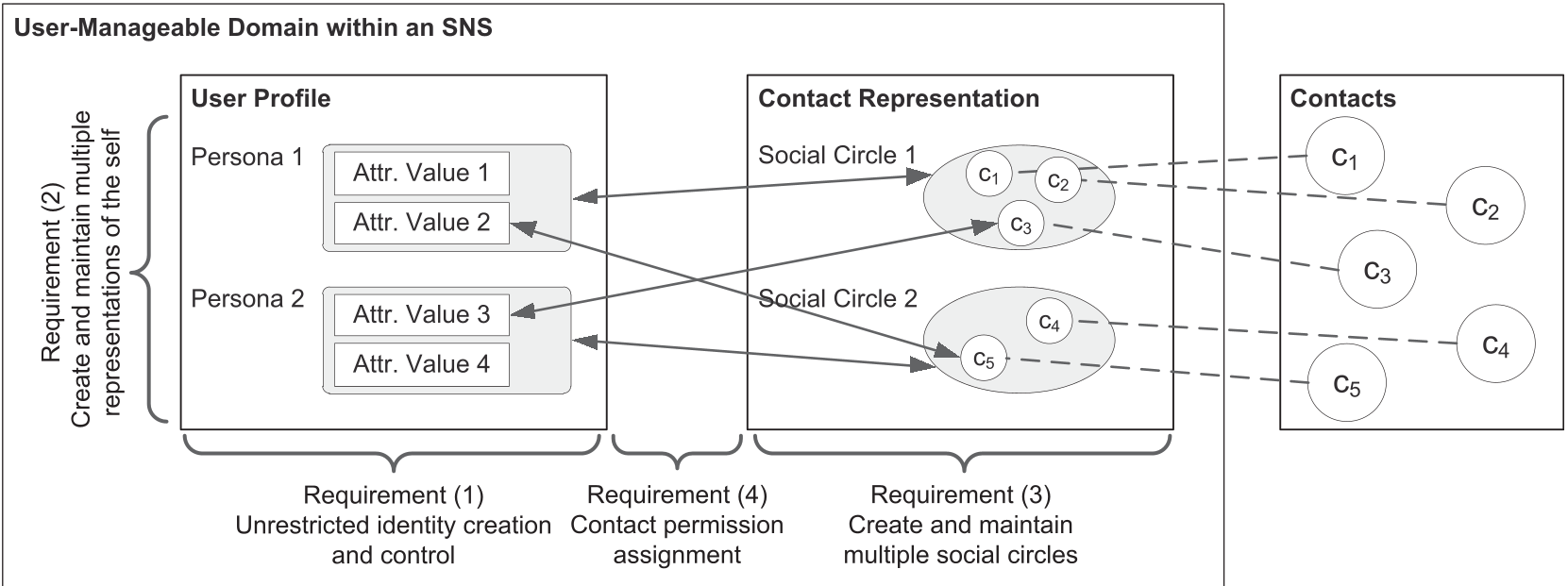 Figure 1: The scope of SIdM requirements, focusing on the user-manageable domain of profiles and permissions.
Methodology: From Requirements to Settings
The authors don't just list what's there; they list what should be there. They introduce "Advanced Controls" that are still radical by today's standards:
- Time-based Sharing (Setting 4e): Digital content that "fades" or expires, mimicking the human tendency to forget past versions of people.
- Access Limits (Setting 4f): Allowing someone to view a profile for identification once, but preventing repeated "monitoring" or stalking.
Survey Results: The Leaderboard
The authors stress-tested Facebook, Google+, Twitter, LinkedIn, and Diaspora against this framework.
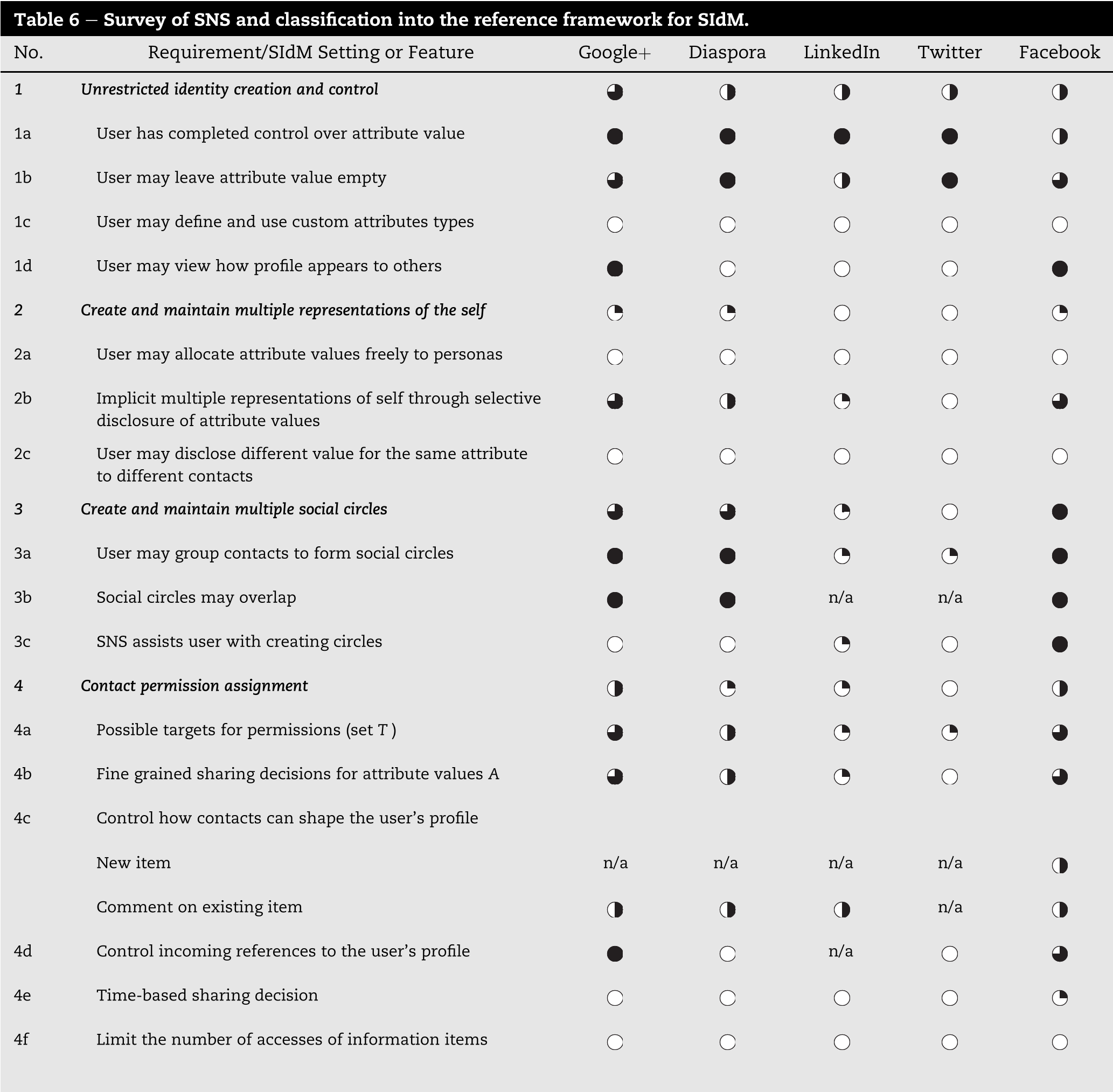 Figure 2: Survey of SNS classification. Note the high fulfillment in Facebook/Google+ compared to the minimal SIdM support in Twitter.
Key Findings:
- Google+ was the leader in "Circles" management, offering the most intuitive drag-and-drop interfaces at the time.
- Facebook provided the best "Privacy Mirror" (View As) and the most automated assistance for grouping family/friends.
- The "Persona Gap": No site truly allowed a user to have one account but show different birthdates or job titles to different groups. You had to create entirely separate accounts, which breaks the social graph.
Toward an Objective Metric
The final contribution of the paper is a proposal for a Quantitative SIdM Metric. The authors argue that we can't just count buttons; we need to weight them based on:
- Attribute Sensitivity: A setting for your "Religious Views" is more critical than a setting for your "Favorite Books."
- User Usage: If a user never posts photos, the lack of photo-privacy settings shouldn't penalize the site's SIdM score for that specific user.
Critical Analysis & Conclusion
While this paper was written in 2013, its logic is more relevant than ever in the era of "Contextual Integrity." The authors correctly identified that usability is the bottleneck. If grouping friends is "tedious," users won't do it, and SIdM fails.
Limitations: The study focuses on user-to-user privacy but ignores how the site operator uses this granular data. Ironically, more granular social circles provide better training data for advertisers to profile us.
The Future: As we move toward Web3 and decentralized identities, this framework provides the "Requirements Document" for the next generation of social platforms where identity isn't a monolith, but a faceted diamond.