
Social Identity Management: Balancing Your Explicit Profile and Implicit Digital Footprint
Social Identity Management in Social Networks
The paper introduces a formal framework for Social Identity Management (SNI) in the era of Web 2.0. It distinguishes between explicit user-provided data and implicit inferred behavior, proposing a quantitative model to measure and manage privacy risks and digital footprints across social networks.
TL;DR
In the hyper-connected world of Web 2.0, your digital identity is no longer just the profile you fill out. This paper proposes a formal framework for Social Network Identity (SNI), categorizing data into Explicit Attributes (what you share) and Implicit Attributes (what the network infers). By quantifying the gap between these two, the authors provide a roadmap for moving from "Unmanageable" identities to a state where users regain control over their digital shadows.
Background: The Identity Gap
The surge of social sites like Facebook, LinkedIn, and others has created a "new old brand" channel of knowledge management. While users believe they are in control through "inner circles" and privacy filters, the reality is that information spreads uncontrollably. The core problem is that existing identity protocols (like OpenID) manage access, not reputation or semantics.
The authors' central insight is that Privacy is the delta between what you want known and what the network actually knows.
Methodology: The Math of Social Identity
The authors define the Social Network Identity (SNI) using a set-theoretic approach.
1. The Composition of Identity
An individual's identity is split into:
- Explicit Attributes (EA): The persona you curate.
- Implicit Attributes (IA): The data inferred from your behavior, tags by friends, and network position.
The authors use a semantic function to identify privacy breaches when an inferred attribute () matches or contradicts an explicit one ().
2. Measuring Impact: The NIVI Formula
One of the most profound contributions is the Network Impact Value for Information (NIVI). It determines how much a specific piece of data (like a leaked photo) harms your SNI:
- Information Relevance (IR): High if the info comes from a powerful node (a "celebrity" in your circle).
- Deviation from Exposed Attributes (DEA): High if the info contradicts your public profile (e.g., claiming to hate sports but spending hours on football forums).
- Information Control (IC): Your ability to delete or suppress the data, influenced by your Centrality (Betweenness and Closeness) in the network.
 Figure 1: The migration paths between different SNI states, from Unmanageable to Managed.
Scenarios: From "Unmanageable" to "Managed"
The paper categorizes users into a 2x2 matrix based on the size of their EA and IA sets:
- Unmanageable: You say one thing, but your actions (IA) reveal the exact opposite. Your digital footprint is high and conflicts with your profile.
- Managed (The Ideal): You provide rich explicit data (EA), and your network behavior (IA) is either low-volume or consistent with your profile, leading to low privacy risk.
To move from Unmanageable to Managed, the authors suggest "Migration Paths": reducing the size of the inferred attribute set or aligning behavior with stated claims to reduce semantic intersection.
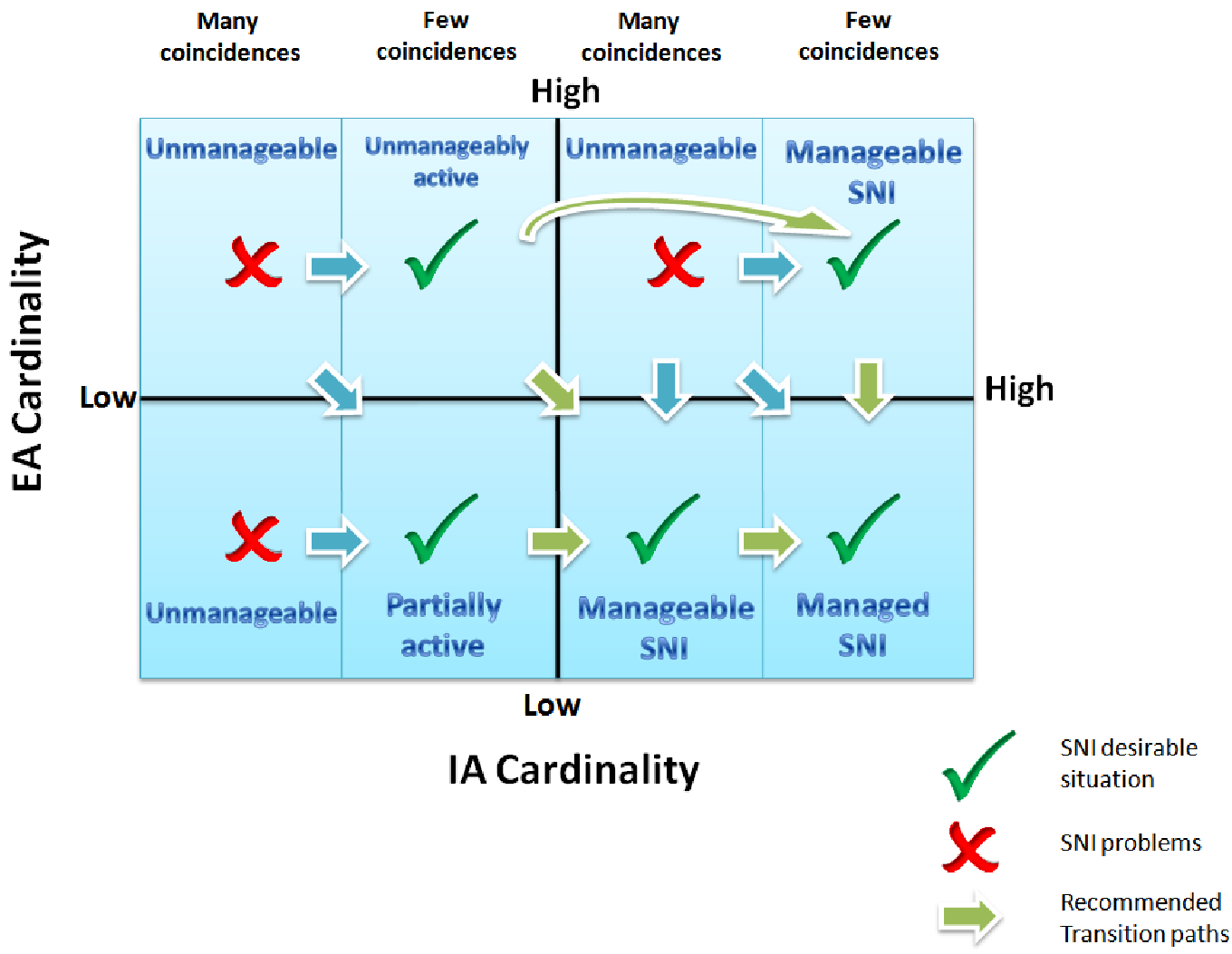 Figure 2: The conceptual mapping of EA vs IA cardinality and the degree of manageable privacy.
Experiments and Insights: The Role of Social Logic
The authors explain that Information Control (IC) is not just a button; it is a function of graph theory. Using metrics like Eigenvector Centrality, they argue that a user's "node value" determines how effectively they can manage information spreading.
For example, the DEA Analysis shows that a photo alone has low Semantic Relevance (SR), but once tagged with a location and year, its power to generate new Implicit Attributes (like age, education, and social associations) grows exponentially.
Critical Analysis & Conclusion
Takeaway
The paper successfully moves digital identity from a vague social concept to a quantifiable technical framework. It highlights that the "digital footprint" is a dynamic negotiation between the user and the network topology.
Limitations
While the mathematical framework is robust, it assumes we can easily calculate the "Semantics" of an attribute. In 2008, when this was written, large-scale semantic analysis was difficult. Today, with LLMs, the ability of a network to infer is significantly higher than the authors might have even feared, making this framework more relevant than ever.
Future Outlook
Future identity management systems must go beyond "password management" and move toward "reputation and footprint management," perhaps using AI agents to monitor a user's NIVI across various platforms in real-time.