
Social Inference: The Hidden Privacy Trap in Web 2.0 and Mobile Apps
Social Inference Risk Modeling in Mobile and Social Applications 1
This paper introduces a theoretical framework for modeling Social Inference Risk in Ubiquitous Social Computing (USC). It utilizes information entropy to quantify the probability of unwanted identity disclosure in Computer-Mediated Communication (CMC) and location-aware applications, validating the model through field studies and large-scale simulations.
TL;DR
Even if you never "leak" your name, the combination of your location, your soccer hobby, and your chat style can identify you with startling accuracy. This paper defines Social Inference Risk, a framework that uses Information Theory (Entropy) to predict when you've shared just enough "safe" info to lose your anonymity. Research shows that in typical online chats, about 50% of users unknowingly cross the line into identifiable territory.
The "Jigsaw Puzzle" Problem in Privacy
Traditional security is like a locked door: if you have the key (access control), you get the data. But social computing creates a "jigsaw puzzle" effect. You might share Piece A (I'm a Hispanic female) and Piece B (I play soccer) on an anonymous app. To a stranger with background knowledge—someone who saw the local women’s soccer team play yesterday—these pieces snap together to reveal your exact identity.
Current privacy tools like P3P or basic k-anonymity are static. They don't account for:
- Background Knowledge: What the attacker knows outside the app.
- Historical Context: Patterns of being in the same place at the same time.
- Non-Deductive Logic: Guesses based on style, slang, or behavior.
Methodology: Measuring "Uncertainty" with Entropy
The authors argue that privacy isn't binary; it's a measure of Uncertainty (Entropy).
If an inferrer knows nothing, entropy is at its maximum (). As they gather info (), the number of possible people you could be () shrinks. The social inference happens when entropy drops below a specific Risk Threshold.
The logic is elegant: your privacy is a function of how "predictable" you become to an observer.
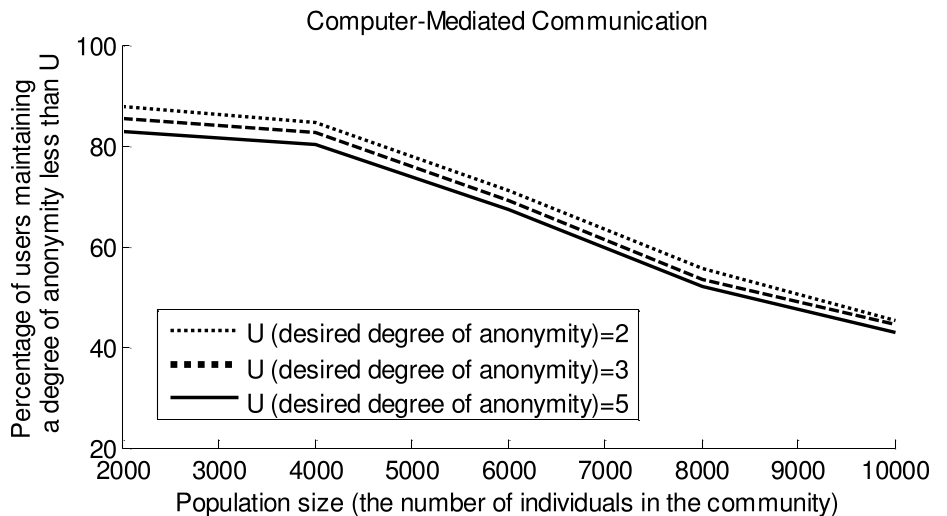 Figure 1: The percentage of users at risk of being identified decreases as the population grows, but remains alarmingly high (50%) even in large groups.
Experiments: CMC vs. Location-Based Apps
The researchers conducted two studies: a 292-subject chat study and a 165-user mobile field study.
1. Computer-Mediated Communication (CMC)
In anonymous chats, users often reveal "safe" profile items. However, the simulation proved that in a community of 10,000, half of the users revealed enough distinct traits to be uniquely identified. Entropy was the only metric that accurately predicted identity discovery.
2. Location-Aware Applications
Using a "Nearby" app on campus, the study found that 46% of cases allowed subjects to narrow down a nickname to just 1 or 2 real people.
- Instantaneous Inferences: "I see two people; it must be one of them."
- Historical Inferences: "I see this nickname every time I'm at the gym at 2 PM; it must be the trainer."
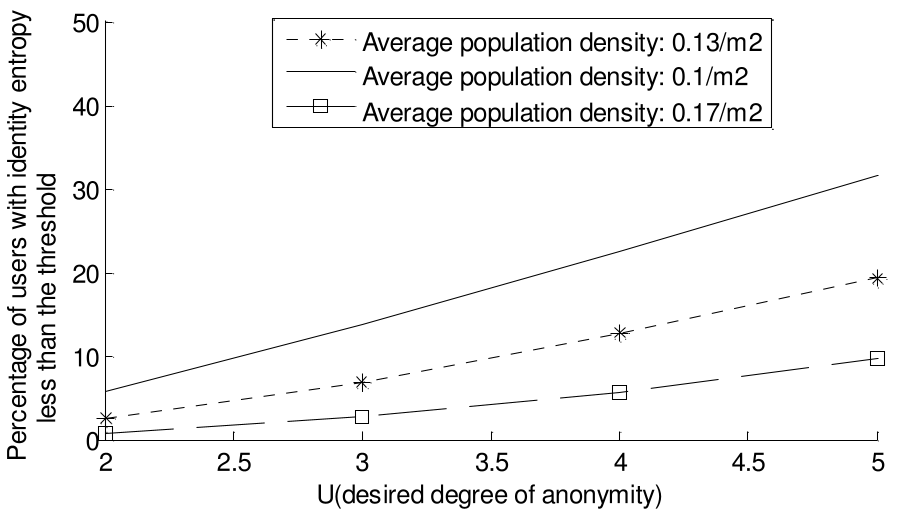 Figure 2: Risk in location-based apps is highly sensitive to crowd density. In sparse environments, your "anonymity set" vanishes quickly.
Real-World Design Implications
The paper concludes with three critical shifts for tech developers:
- Dynamic Anonymity Settings: Users shouldn't just toggle "Private/Public." They should set a "Degree of Anonymity" (e.g., "I want to be indistinguishable from at least 5 people").
- Risk Visualizations: Instead of blocking data, apps should show a "Privacy Meter." When you're about to send a message that makes you too unique, the app warns you: "This info makes you 90% identifiable."
- Adaptive Granularity: For location apps, if the population is sparse, the app should automatically "blur" your location (e.g., showing you in a building rather than a specific room) to maintain your entropy.
Conclusion
This work highlights a sobering reality: in the age of Ubiquitous Social Computing, control over shared data does not equal control over privacy. Because social inference relies on information outside the system's walls, our only defense is to monitor the mathematical "uniqueness" of our digital footprint in real-time.