
Dynamic Topology Potential: Bridging Physics and Social Networks for Influence Analysis
Social Influence Analysis Based on Modeling Interactions in Dynamic Social Networks: A Case Study
The paper introduces a novel approach for social influence analysis titled Dynamic Topology Potential. It combines mathematical topology with physical field theory to model individual interactions, achieving a 27.62% improvement in identifying influential users compared to Weighted PageRank on the AMiner academic dataset.
TL;DR
Quantifying who is "influential" in a shifting social landscape is a moving target. This paper introduces Dynamic Topology Potential, a method that treats social networks like physical force fields. By accounting for node "mass" (activity) and ensuring "temporal smoothness" between snapshots, the authors outperform traditional metrics like PageRank by over 27% in identifying critical nodes in academic networks.
Problem & Motivation: The Static Trap
Most social influence metrics (like Degree or PageRank) treat networks as a "frozen" snapshot. However, human interactions are transient. A scholar might be influential this year but inactive the next.
The authors identify three missing links in current research:
- Individual Activity: Not all nodes are created equal; some have more "mass."
- Local Effects: Influence decays rapidly with distance (the Small World effect).
- Evolutionary Smoothness: Influence changes shouldn't be erratic; a node's potential at time should relate to its state at .
Methodology: Social Networks as Physical Fields
The core innovation is the adaptation of Field Theory. Imagine every user in a network is a particle generating a potential field.
1. Topology Distance via "Circuits"
Instead of simple hops, the authors use a "shunt-wound circuit" analogy. Reachable paths act like parallel resistors. The "Topology Distance" is derived from the equivalent resistance, providing a more robust measure of "closeness" than shortest paths.
2. The Gaussian Potential Function
The influence of node on node is modeled as: where is the node's mass (e.g., number of papers published) and is an influence range factor.
3. Dynamic Smoothing
To prevent noise from jumping between snapshots, they add a temporal regularization term to the optimization objective:
 This ensures that the topology potential values evolve smoothly, satisfying a first-order Markov assumption.
Experiments: Testing Robustness
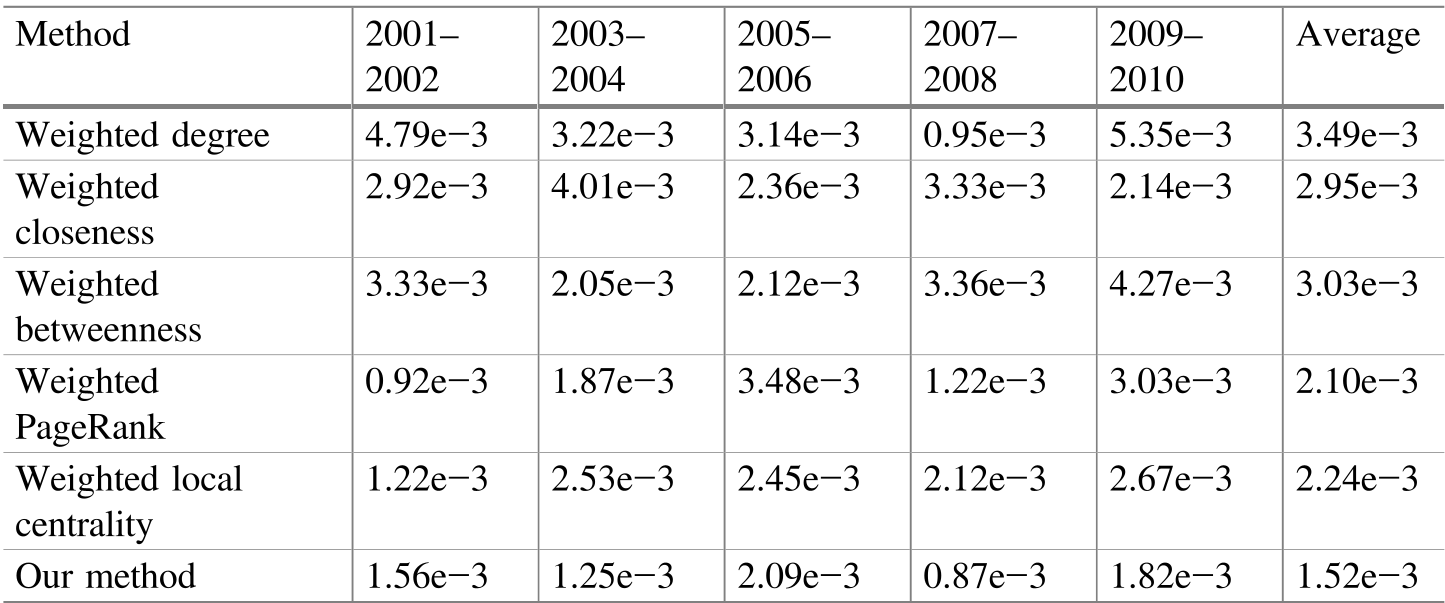
The authors used the AMiner dataset (2001–2010) to build a co-author network. They defined "influence" as the ability to break the network—if you remove the most influential nodes and the network collapses into tiny fragments, the identification method was successful.
Key Findings
- SOTA Performance: The proposed method achieved an average robustness score of 1.52e-3, significantly lower (meaning better at finding critical nodes) than Weighted PageRank (2.10e-3).
- Real-World Alignment: The model consistently identified top-tier researchers (e.g., Jiawei Han and Philip S. Yu) whose influence in the Data Mining community is objectively verified by citations and awards.
Critical Analysis & Conclusion
Takeaway
The shift from discrete graph theory to continuous field theory allows for a more "organic" modeling of influence. By treating "Activity" as Mass and "Pathways" as Resistance, the researchers have created a blueprint for dynamic social analysis.
Limitations
- Time Slice Selection: The choice of 2-year windows is arbitrary. The authors admit that an automated "time-interval configuration" is needed for different rates of evolution.
- Computational Complexity: Calculating potential across all pairs in dynamic snapshots can be heavy, likely requiring optimization for massive-scale networks (billions of edges).
Future Outlook
This work lays the groundwork for predictive analysis. If we can model the "potential field" today, we can likely predict where the next "high-potential" community will emerge tomorrow.