
Social Influence Analysis: Navigating the Ocean of Big Data
8182_Social Influence Analysis in Social Networking Big Data Opportunities and Challenges.
This paper provides a comprehensive investigation into social influence analysis within the context of social networking big data. It defines the core properties of social influence, proposes a systemic architecture for its analysis, and evaluates the symbiotic relationship between big data technologies (like Cloud Computing and Hadoop) and influence quantification.
TL;DR
Social influence analysis has evolved from a niche sociological study into a critical big data challenge. This paper maps out the landscape of identifying "who influences whom" across massive, fast-moving networks like Twitter and Facebook. By defining the unique properties of influence—such as its asymmetry and dynamic nature—the authors provide a roadmap for building scalable architectures that can handle the sheer volume of modern social interactions.
Background: The Shift to Social Big Data
We are no longer in the era of small-scale group studies or manual interviews. With platforms like Facebook generating billions of data points daily, the challenge is no longer just "calculating" influence, but doing so within the constraints of the 5V characteristics of Big Data. The authors argue that social influence analysis is the key to unlocking viral marketing, public opinion guidance, and even epidemic tracking.
The Anatomy of Social Influence
To analyze influence, we must first understand what it is. The paper identifies several "physical" properties of social influence that make it computationally difficult:
- Asymmetry: If user A influences user B, the reverse is not necessarily true.
- Dynamic Evolution: Influence decays or shifts over time and context.
- Heterogeneity: Influence happens across different types of links (mentions, likes, follows) and different platforms.
Methodology: A Scalable Architecture
The authors propose a systematic workflow to transform raw social data into actionable insights:
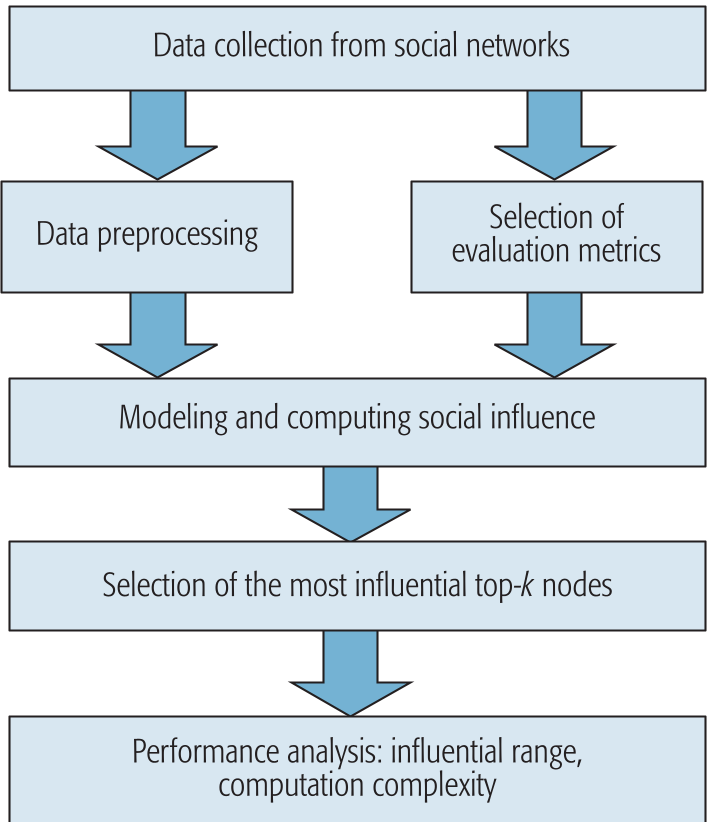
- Data Collection & Preprocessing: Leveraging cloud storage to aggregate diverse data types while filtering for privacy.
- Metric Selection: Moving beyond simple degree centrality to include interaction frequency and sentiment.
- Modeling & Computation: Using parallel processing (e.g., MapReduce) to calculate influence values.
- Top-k Node Identification: Solving the Influence Maximization (IM) problem to find the most effective "seeds" for information spread.
The Scalability-Efficiency Dilemma
One of the core insights of the paper is the Scalability-Efficiency Dilemma. While the greedy algorithm provides a proven approximation for finding influential nodes, it is often too slow for networks with billions of edges.
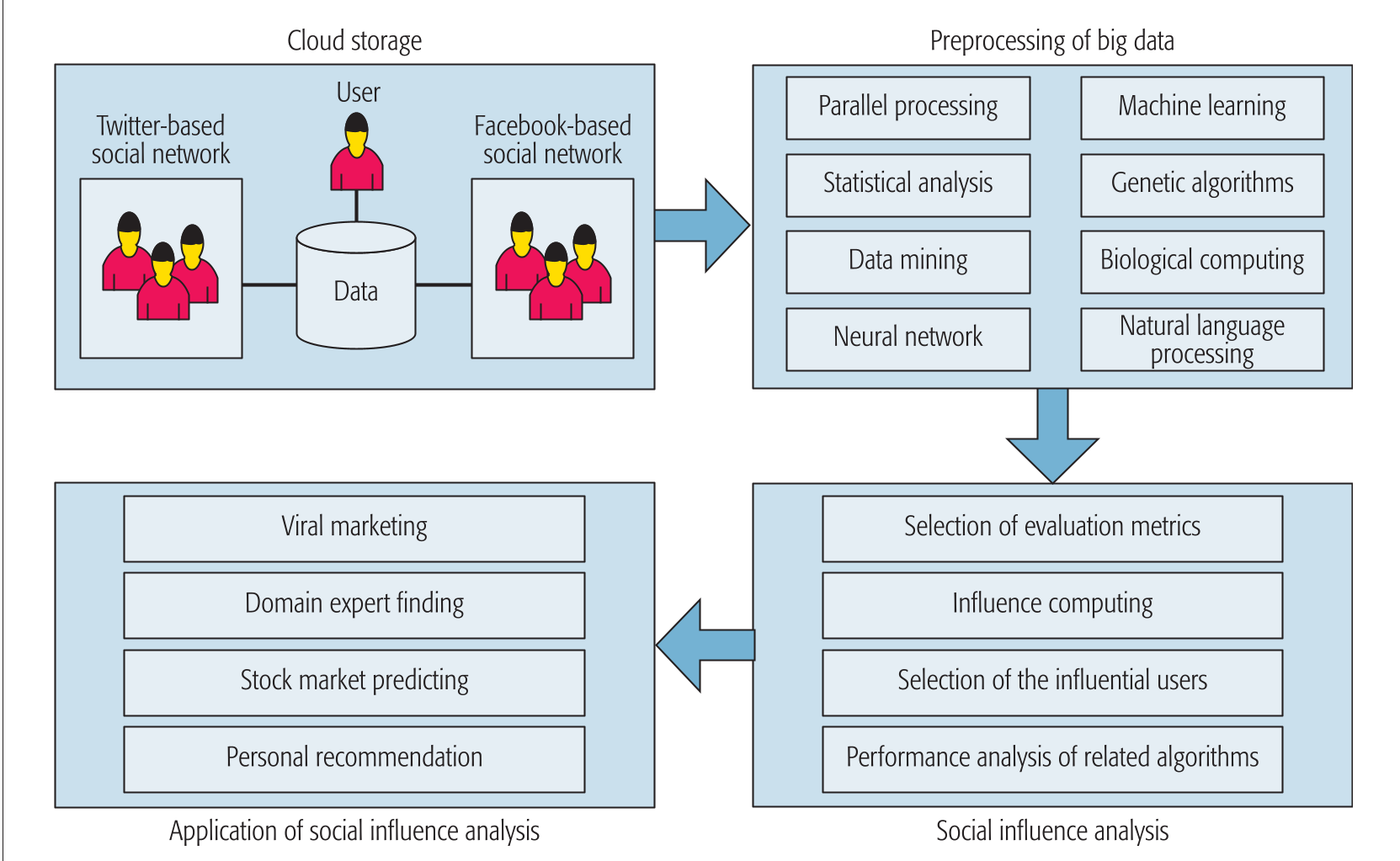
The authors highlight that the path forward involves Parallel Processing and Heuristic Designs. Instead of treating the network as a static graph, we must view it as a living organism where causal relationships (e.g., "what caused this user to retweet?") are analyzed via tools like Transfer Entropy.
Critical Analysis & Future Outlook
While the paper provides a strong structural foundation, it acknowledges several unresolved frontiers:
- Network Heterogeneity: How do we weigh a "Like" on Facebook against a "Professional Endorsement" on LinkedIn?
- Controversy Influence: Distinguishing between someone who is influential because they are trusted versus someone who is influential because they are polarizing (negative/controversy influence).
- Privacy: The tension between the need for deep data and the increasing demand for user anonymity.
Conclusion
This work serves as a high-level guide for researchers to move beyond traditional graph theory and embrace the complexities of the Big Data era. For practitioners, the takeaway is clear: the most effective influence models are those that are dynamic, account for causality, and are built on scalable distributed frameworks.