
SI-CLUSTER: Decoding Social Influence for Large-Scale Network Clustering
Social Influence Based Clustering and Optimization over Heterogeneous Information Networks
The paper introduces SI-CLUSTER, an innovative framework for clustering Heterogeneous Information Networks (HINs) by measuring social influence through heat-diffusion kernels. It integrates social connection-based influence (self-influence) and activity-based influence (co-influence) into a unified similarity matrix to partition nodes into K clusters.
TL;DR
The researchers from Georgia Tech have developed SI-CLUSTER, a high-performance framework that clusters social networks not just by "who you know" (topological ties), but by "how you influence" (activity patterns). By treating social influence as a physical heat-diffusion process and optimizing the heavy matrix math via diagonalization, they successfully clustered nearly a million nodes with superior semantic accuracy.
Background & Motivation: Beyond Simple Links
Traditional graph clustering algorithms often suffer from "structural myopia." They see direct edges but miss the subtle, latent similarities forged through shared activities—like two authors who never co-write a paper but influence the same niche conference.
The authors argue that a robust model must distinguish between:
- Self-Influence: Direct/indirect connections in a single collaboration network.
- Co-Influence: Patterns derived from interactions across heterogeneous activity networks (e.g., conferences, product categories).
The challenge? Combining these into a single metric without introducing bias and solving the complexity wall of global similarity measures.
Methodology: The Core Mechanics
1. The Heat-Diffusion Kernel
The authors model influence propagation using the physical intuition of heat flowing from high-temperature nodes (influencers/experts) to low-temperature nodes. Where is the non-propagating kernel (Laplacian-like) and the exponential captures multi-hop influence. This allows the model to identify similarity between nodes that aren't directly connected.
2. Unified Similarity & Dynamic Weighting
Instead of manually picking weights for structure vs. activities, SI-CLUSTER treats weight assignment as a Nonlinear Fractional Programming Problem (NFPP). It dynamically adjusts weights () at each iteration to maximize the ratio of intra-cluster similarity to inter-cluster similarity.
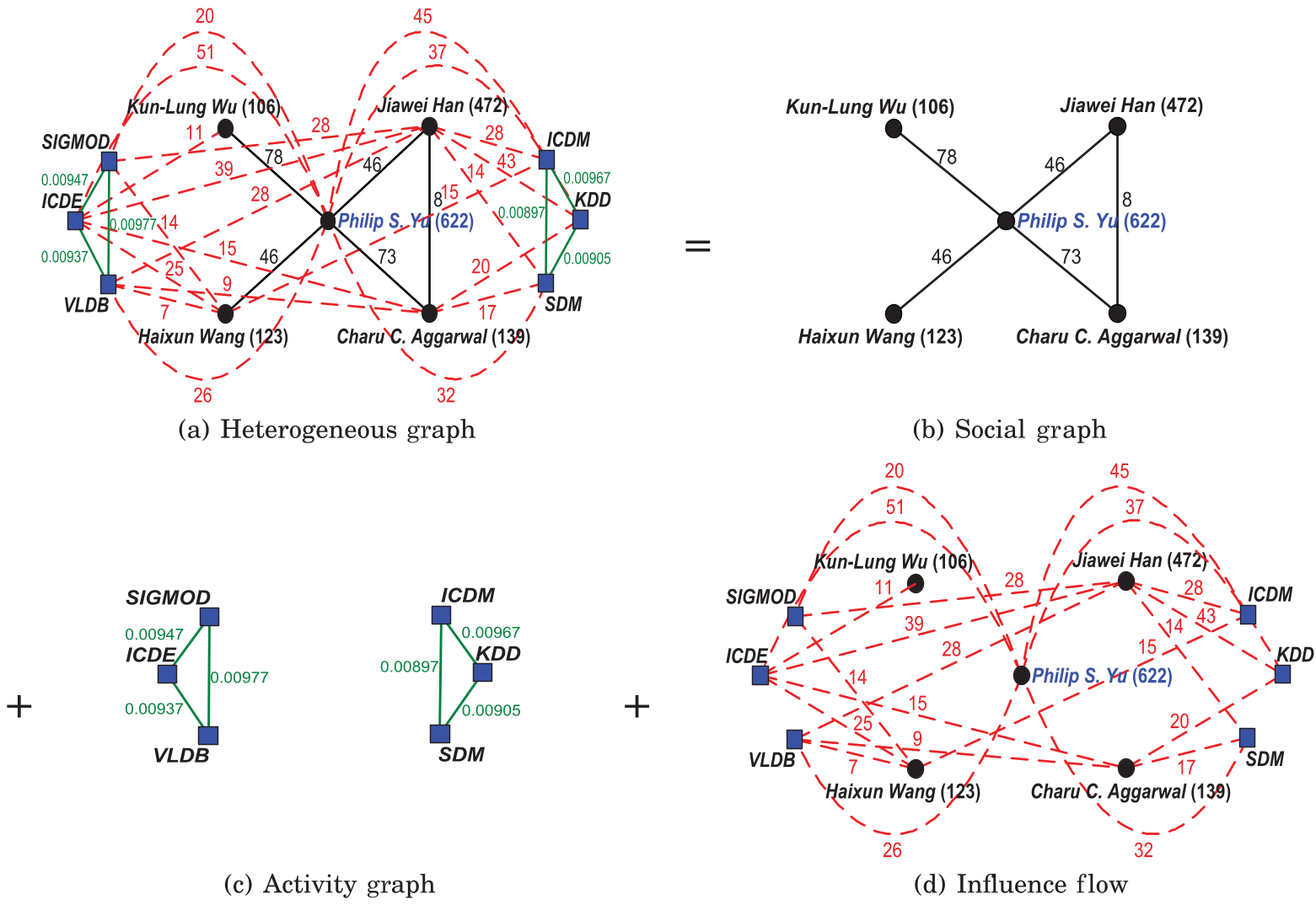 Figure 1: Reorganizing a heterogeneous network into social, activity, and influence graphs.
3. SI-CLUSTER-OPT: The Diagonalization Trick
Computing requires calculating (Taylor series), which is computationally suicidal for large graphs. SI-CLUSTER-OPT solves this by:
- Similarity Transformation: For symmetric graphs, decomposing into .
- Diagonalizable-Matrix Approximation: For asymmetric directed graphs, finding a nearby diagonalizable matrix to approximate the non-diagonalizable . This reduces the complexity from to a single operation (or better for sparse blocks).
Experiments & Results
The framework was tested on the massive DBLP dataset and Amazon product networks.
- Efficiency: While SA-Cluster and BAGC ran into "Out of Memory" errors on the full DBLP author set, SI-CLUSTER-OPT processed it in ~3,000 seconds.
- Quality: The clusters achieved a much lower Davies-Bouldin Index (DBI), suggesting they were significantly more distinct and compact than those produced by attribute-only or structure-only methods.
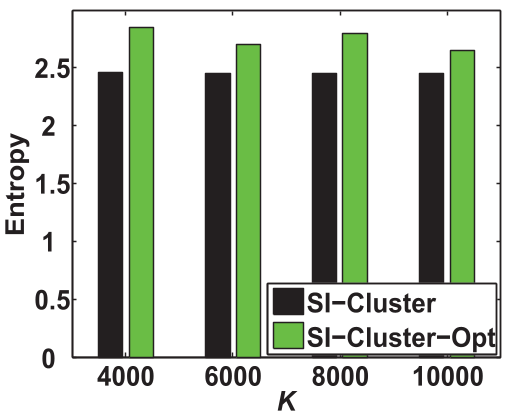 Figure 2: Performance comparison across different datasets. SI-CLUSTER-OPT maintains quality while slashng runtime.
Critical Insight & Conclusion
The brilliance of this work lies in the mathematical bridge between physical diffusion and socio-economic influence. By transforming a complex fractional programming problem into a single-variable parametric problem, the authors ensured fast convergence (usually within 3 iterations).
Limitations: Despite the optimizations, the initial matrix operations still scale cubically with the number of nodes in the densest sub-blocks. Future work might involve applying randomized SVD or sketch-based methods to further push the boundaries of .
The Takeaway: If you want to understand a network, don't just look at the edges; look at how "heat" flows through them. SI-CLUSTER provides the thermal map for the modern HIN.