
SIR: Decoding Social Influence and Human Mobility in LBSNs
Exploring Social Influence on Location-Based Social Networks
The paper introduces SIR (Social Influence-based User Recommender), a novel framework designed to identify influential users in Location-Based Social Networks (LBSNs). By modeling interactions across virtual communities, physical mobility, and time through a heterogeneous graph and a diffusion-based mechanism, it achieves SOTA performance in personalized top-k user recommendation.
TL;DR
When you visit a cafe because your favorite traveler posted about it, you are part of a "geo-social following" chain. This paper presents SIR (Social Influence-based User Recommender), a framework that treats social influence like heat diffusing through a network. By combining who you follow with what you like, SIR accurately predicts who will influence your next check-in, outperforming traditional recommendation algorithms.
Problem & Motivation: Beyond "Similarity"
Most recommendation systems view social relationships as a static weight: if you and I are friends, we are "similar." However, the authors argue this is a fundamental misunderstanding of Social Influence.
- Influence is Directional: An idol influences a fan, but rarely vice versa.
- Influence Propagates: You might visit a spot recommended by a friend-of-a-friend (2nd-degree influence).
- The Follower Effect: True influence is evidenced by a "geo-social following relation"—the act of visiting a location after a friend has checked in.
Previous works often concluded that social factors were secondary to geography. The authors of SIR prove that if modeled correctly through diffusion, social influence is a primary driver of mobility.
Methodology: The Heat of Influence
The core of SIR lies in its representation of the LBSN as a Heterogeneous Graph (HG) and the use of Diffusion Equations.
1. The Heterogeneous Graph
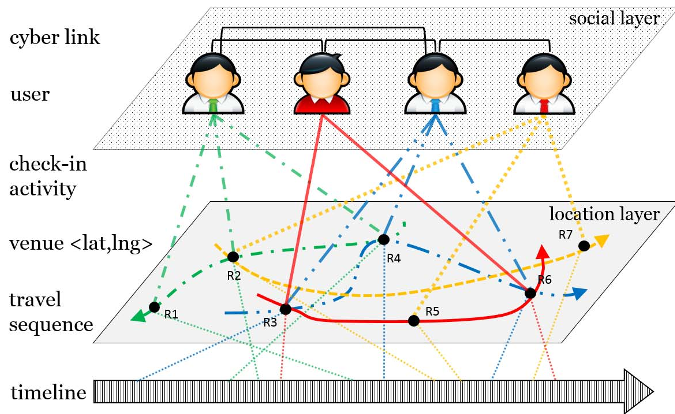
The framework constructs a graph with three distinct layers:
- Social Layer (S): Virtual friendships and followers.
- Location Layer (L): Physical venues and travel sequences.
- Timeline (T): Temporal check-in logs.
2. The Diffusion Model
The authors model influence as a physical heat diffusion process. Imagine a user as a "heat source." Their check-in activity radiates influence to their neighbors.
- Following Graph Diffusion: Captures direct and indirect social influence.
- Bipartite Social-Attribute Diffusion: Captures "Inter-factor" influence—how your interests (e.g., a love for sushi) make you susceptible to influence from others with the same preference.
3. Unified Follow Probability (UFP)
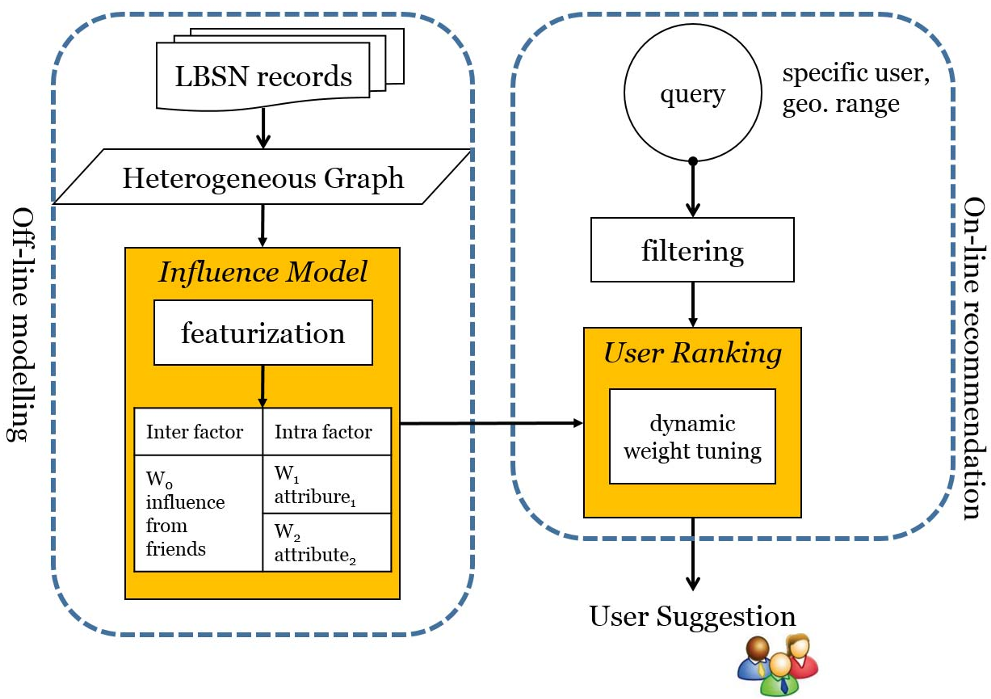
SIR doesn't just rely on friends. It uses a Dynamic Weight Tuning mechanism to fuse two factors:
- Inter-factor: Influence from your social circle.
- Intra-factor: Your own inherent interest in specific categories (e.g., "Museums").
Experiments & Results
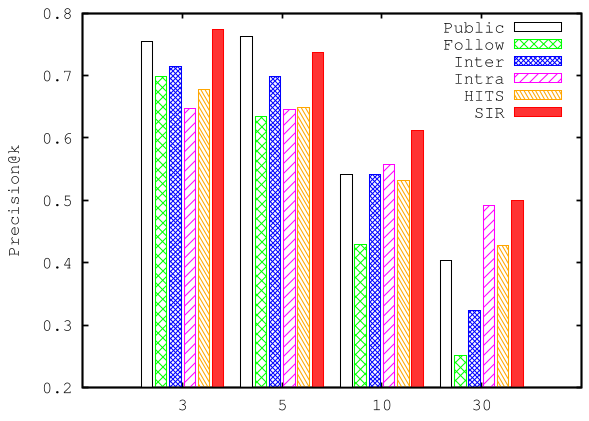
The researchers tested SIR on the Gowalla and Flickr datasets, comparing it against HITS (a popular ranking algorithm) and various baselines.
- Social vs. Self: The experiments revealed that the Inter-factor (Social) generally had a more significant impact than the Intra-factor (Self-interest), validating the core hypothesis that social influence is a powerful motivator in LBSNs.
- Global vs. Regional: SIR maintained high precision whether the query was for a specific city or a global recommendation.
- Metric Dominance: SIR consistently stayed at the top for Precision@k, MAP, and nDCG, showing that its ranking of "influential users" was highly aligned with actual future check-ins in the test data.
Critical Analysis & Conclusion
Takeaway: The strength of SIR is its shift from "who you know" to "who moves you." By defining influence through active following behavior and modeling it via diffusion, it captures the temporal and structural nuances of human behavior.
Limitations:
- Computational Expense: Heat diffusion on massive graphs can be computationally heavy for real-time applications.
- Cold Start: The model relies on existing check-in history; new users without "geo-social following" traces might not benefit as much.
Future Outlook: The authors suggest incorporating more complex temporal patterns. In an era where "influencer marketing" is a billion-dollar industry, the mathematical modeling of influence presented in SIR provides a rigorous foundation for future social-aware AI systems.