
SIMPH: Beyond Pairwise Influence – Maximizing Crowd Power in Hypergraphs
Social Influence Maximization in Hypergraph in Social Networks
This paper introduces the Social Influence Maximization Problem in Hypergraph (SIMPH), a novel framework that models "crowd influence" using directed hyperedges within social networks. The authors propose a Sandwich Approximation Framework and a D-SSA based algorithm to navigate the non-submodular nature of hypergraph influence, achieving efficient solutions on real-world datasets.
TL;DR
While most social influence research focuses on one-to-one interactions, real-world persuasion often happens through "crowd psychology." This paper formalizes the Social Influence Maximization Problem in Hypergraph (SIMPH). By moving beyond submodular functions and simple graphs, the authors provide a "Sandwich Approximation" method that captures collective influence without sacrificing theoretical guarantees.
Background: The Limits of Pairwise Thinking
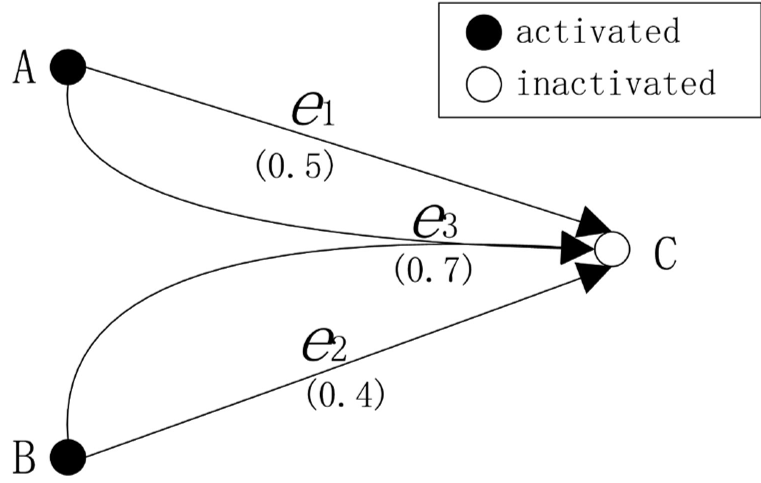
In a standard social network graph, if Alice and Bob both know Charlie, their influences on Charlie are typically treated as independent events. But psychology tells us a different story: the "crowd effect" of Alice and Bob acting together is often much stronger than the sum of their individual parts.
To model this, the authors use Directed Hyperedges , where a set of nodes (the head) collectively influences node (the tail).
The Mathematical Wall: Non-Submodularity
The core challenge is that once you introduce crowd influence, the nice mathematical property of Submodularity (the law of diminishing returns) vanishes.
- Not Submodular: Adding a node to a large set might suddenly complete a "head set" of a hyperedge, triggering a massive influence spike that wouldn't happen in a smaller set.
- Not Supermodular: Standard optimization tools fail because the function behaves unpredictably.
Methodology: The Sandwich Framework
Since the objective function is "wild," the authors hem it in using two manageable, submodular functions.
1. The Upper Bound ()
They create an auxiliary graph where hyperedges are decomposed into multiple standard edges. If a crowd influences with probability 0.7, the upper bound might treat and as independent high-probability links.
2. The Lower Bound ()
They construct a more "conservative" version of the network by deleting hyperedges where the head nodes cannot be activated simultaneously by a common source. This results in a simplified graph that is guaranteed to under-calculate the true influence.
3. The D-SSA Algorithm
To solve these bounds efficiently, they employ a Reverse Influence Sampling (RIS) approach called D-SSA. It uses a "Stop-and-Stare" strategy to determine the minimum number of samples needed to guarantee a approximation, even on billion-scale networks.
Experimental Validation
The authors tested SIMPH on datasets ranging from scientific collaborations to corporate interlocking directorates.
Key findings include:
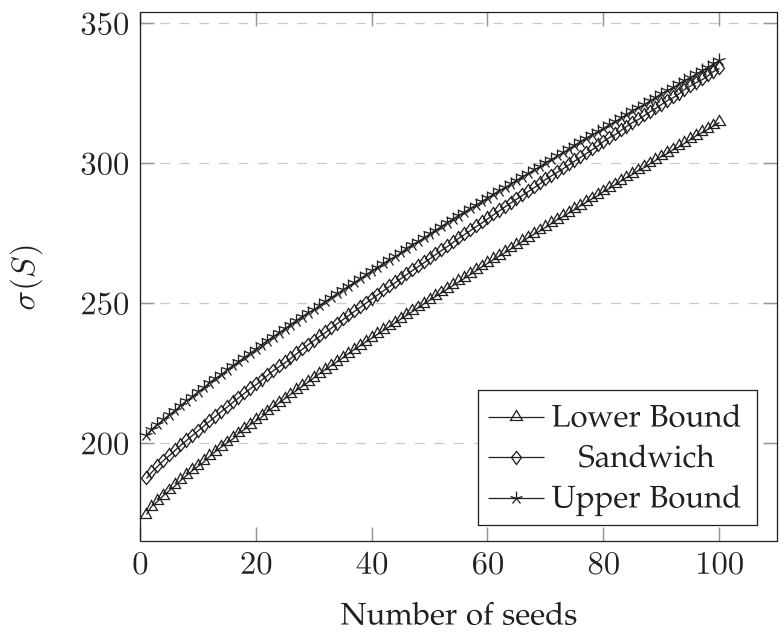
- Effective Bracketing: The Sandwich Framework (Algorithm 5) consistently produced influence spreads that were tighter and more accurate than standard heuristics.
- Optimal for Small Scales: In node tests, the algorithm matched the optimal results found via exhaustive enumeration.
- Scalability: The use of RIS sampling allowed the method to handle thousands of hyperedges with high efficiency.
Insightful Analysis
The real value of this work is the bridge it builds between Social Psychology and Hard Combinatorics. Most IM papers ignore the "tipping point" effect of groups. By using hypergraphs, we can finally model phenomena like "groupthink" or "viral trends" where the context of who else is already convinced matters more than the individual connections.
Limitations: The construction of the lower bound depends heavily on the graph's structure. In extremely sparse hypergraphs, the lower bound might become too loose (approaching zero), though the authors note this is rare in real-world social data.
Conclusion
SIMPH proves that we don't have to ignore the complexity of crowd influence just to keep our math "clean." By using submodular bounds to sandwich a non-submodular reality, we can model the messy, collective nature of human society with the precision of modern algorithmic theory.