
Beyond Connections: Quantifying Social Influence in Mobile Networks via Information Theory
Social influence modeling using information theory in mobile social networks
2016-08-12
Summary
Problem
Method
Results
Takeaways
This paper introduces an information-theoretic framework for measuring social influence in Mobile Social Networks (MSNs) using real-world SMS/MMS communication data. It proposes an evaluation model that quantifies both direct and indirect influence by integrating "friend entropy" and "interaction frequency entropy" to capture the complexity and uncertainty of social ties.
## TL;DR
Social influence modeling in mobile networks has long been a challenge because simple "follower counts" don't capture the intensity or quality of real-world interactions. This paper presents a novel approach using **Information Entropy** to measure influence through SMS/MMS communication patterns. By calculating **Friend Entropy** and **Interaction Frequency Entropy**, the researchers can identify "super-spreaders" far more accurately than standard degree-based methods.
## The Motivation: Why Degree Centrality is Not Enough
In the era of big data, identifying who holds the most sway in a network is vital for viral marketing, public opinion guidance, and even stopping mobile malware. Most prior work focused on the *structure* of the network (who is connected to whom). However, in mobile social networks, a user might have hundreds of contacts but only interact meaningfully with five of them.
The authors argue that social influence is inherently fuzzy and uncertain. To solve this, they move away from deterministic counts and toward **Information Theory**, using entropy to measure the "uncertainty" and "complexity" of a user's social reach.
## Methodology: The Entropy Framework
The authors break down the problem into three specific tiers:
### 1. Constructing the Relationship Graph
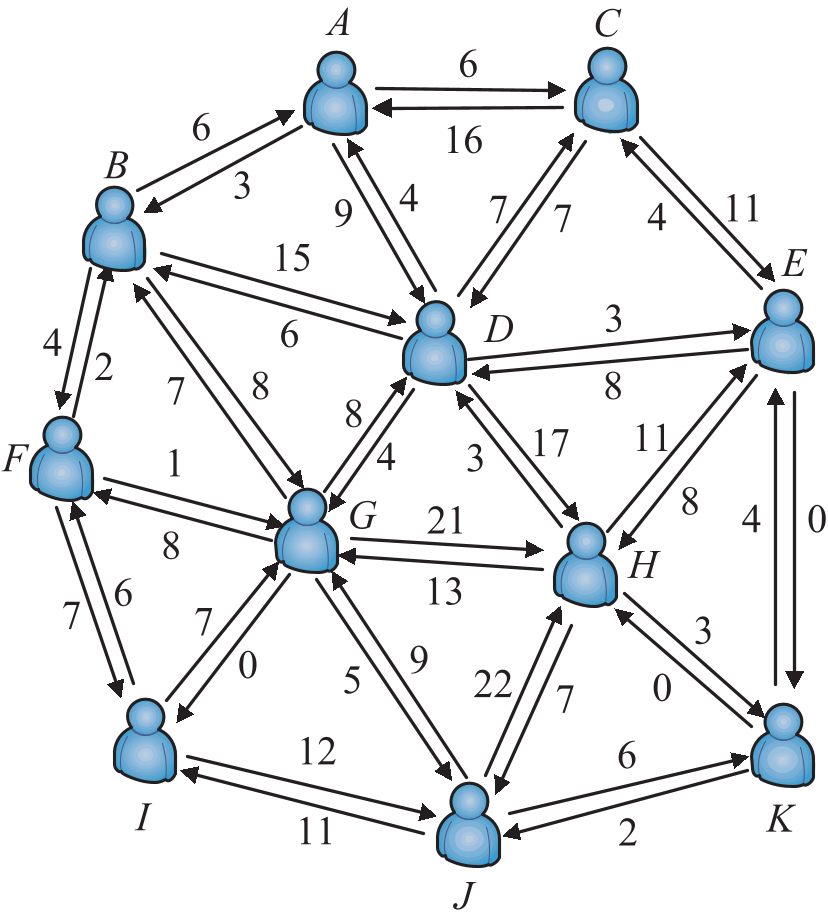
They don't just look at who sent a message. They define **Effective Interactions** as bi-directional communication. If Node A sends many messages to Node B, but B never replies, the "influence" is deemed low.
### 2. Direct Influence (DI)
This is calculated using two types of entropy:
* **Friend Entropy ($I^f$):** Describes the complexity of a user's immediate circle.
* **Interaction Frequency Entropy ($I^c$):** Measures the distribution of communication. A user who interacts heavily with a diverse set of people has higher entropy (and influence) than one who only talks to one person.
### 3. Indirect Influence (II)
One of the paper's key contributions is the mathematical formalization of indirect influence (the "friend of a friend" effect). If User A influences User B, and User B influences User C, User A exerts a measurable **Indirect Influence** on C.

## Experiments: Proving the Theory
The researchers tested their model against a dataset from one of China's largest cellular networks (20 million messages). They compared their **Entropy-based** algorithm against a **Random** selection and a **Degree-based** selection (selecting nodes with the most connections).
### Performance Results
The results were conclusive: the entropy-based model consistently identified nodes that could spread information (or "infections" in the SI model) faster and wider.
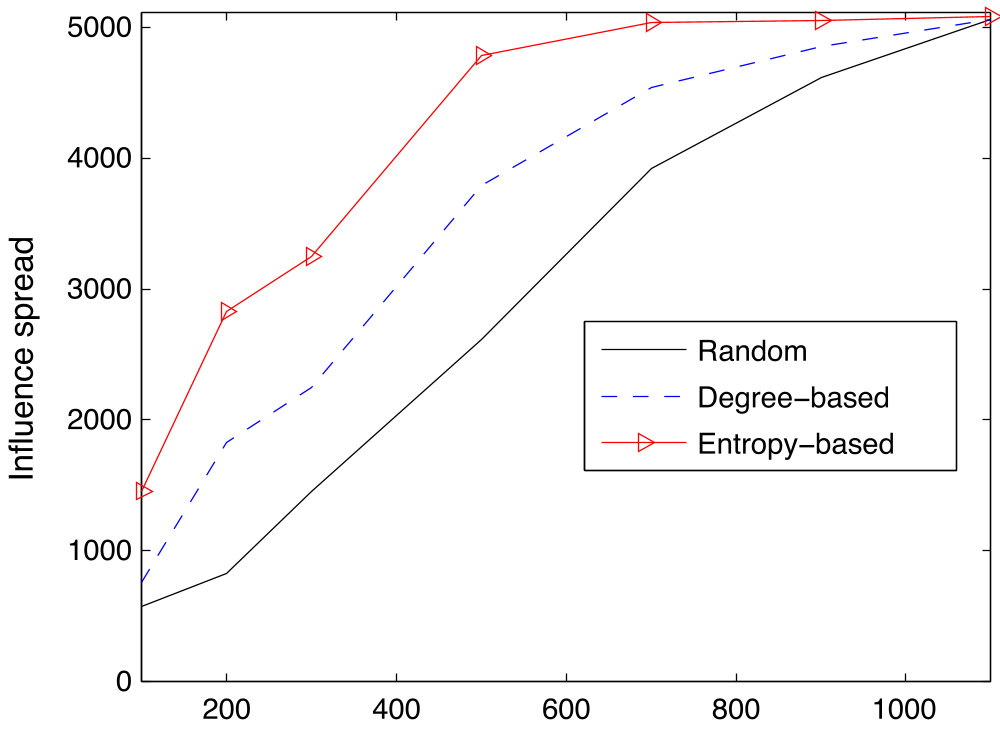
As shown in the data, as the number of seed nodes ($k$) increases, the gap between the entropy model and the degree-based model remains significant. Relying solely on structural properties (node degree) misses the nuance of *how* those connections are utilized.
## Critical Analysis & Takeaways
The genius of this work lies in its use of **bi-directional interaction** as a filter for influence. In a world of "noise," entropy serves as a perfect filter to find the "signal" of true social leadership.
**Limitations:**
* The model assumes a "positive" spread. In reality, influence can be negative or casual.
* The dataset (SMS/MMS) is slightly dated compared to modern App-based communications (WhatsApp/WeChat), though the mathematical principles remain highly applicable.
**Future Outlook:**
This framework paves the way for more sophisticated "weighted" social graphs. For developers and researchers, the takeaway is clear: if you want to find the most influential nodes in a network, look at the **entropy of their interactions**, not just the size of their contact list.