
Shapley vs. SNI: Decoding the Interplay Between Social Influence and Network Centrality
13453_Interplay between Social Influence and Network Centrality A Comparative Study on Shapley Centrality and Single-Node-Influence Centrality.
This paper introduces a comparative framework for network centrality based on dynamic social influence models, specifically defining and analyzing Single Node Influence (SNI) and Shapley Centrality. The authors provide both axiomatic characterizations to distinguish these measures and scalable, sample-based approximation algorithms (ASV-RR and ASNI-RR) that achieve state-of-the-most-art performance on massive networks.
TL;DR
This research bridges the gap between static graph theory and dynamic influence propagation. By integrating cooperative game theory (Shapley Values) with modern randomized algorithms (RR-sets), the authors provide a scalable way to measure a node's "irreplaceable power" in a social network. Unlike traditional metrics, these measures reflect how ideas actually spread.
Motivation: Why Topology Isn't Enough
For decades, we ranked nodes by their "location"—how many neighbors they have (Degree) or how often they sit on the shortest path (Betweenness). However, in a world of viral marketing and fake news, topology is just the stage; the influence process is the play.
Existing influence metrics like Single Node Influence (SNI)—which simply counts how many people one person can reach—fail to consider redundancy. If two influencers reach the same audience, their individual value is high, but their marginal value to a group is low. This paper seeks to quantify that marginality using the Shapley Value.
Methodology: The Magic of Shapley and RR-Sets
The core of the paper is the Shapley Centrality. Mathematically, it's defined as: This measures the average change an individual brings to every possible coalition.
The Algorithmic Breakthrough
Computing this is normally a nightmare ( permutations). The authors solve this using Reverse Reachable (RR) Sets.
- Pick a random "root" node .
- Traverse backward to find all nodes that could influence .
- The "Identity" discovered: A node 's Shapley value is exactly .
 The algorithm uses Phase 1 to estimate the number of samples needed and Phase 2 to compute the precise centrality estimates.
Axiomatic Battle: Shapley vs. SNI
The authors prove that these metrics are the only ones satisfying specific logic:
- Shapley Centrality satisfies Efficiency (total centrality = total nodes) and Bargaining with Critical Sets. It values nodes that are essential to a "bottleneck."
- SNI Centrality focuses on Uniform Sink Nodes. It treats every leaf node as having a baseline influence of 1, regardless of who influences it.
In "Critical Set" scenarios (where you need a whole group to trigger an effect), SNI fails because it realizes individuals have 0 influence alone. Shapley correctly identifies their collective power.
Experimental Validation
Testing on the LiveJournal (4.8M nodes) and Flixster datasets, the authors compared the "Influence Maximization" performance of top-ranked nodes.
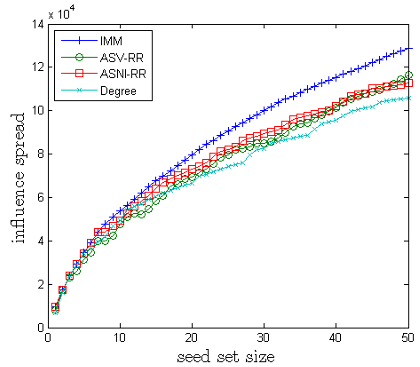 As shown here, both Shapley and SNI rankings are highly effective for seed selection, often rivaling specialized algorithms like IMM, but Shapley consistently provides better "marginal" utility.
Key Quantative Performance:
- Scalability: ASV-RR handles 69M edges.
- Accuracy: In the Flixster dataset, Shapley-ranked nodes achieved an average 8.3% higher influence spread than SNI-ranked nodes.
- Insights: PageRank-based influence and degree-based influence often diverge significantly when transition probabilities are learned from real-world "action traces."
Deep Insight & Conclusion
The true takeaway of this work is the "Replaceability Factor." In a symmetric network (where influences as much as influences ), Shapley Centrality collapses to a uniform 1 for all nodes. Why? Because in a perfectly symmetric world, everyone is equally replaceable in a random sequence.
Limitations: While scalable, the Shapley computation still takes longer than SNI (as it requires tracking instead of a simple counter).
Future Work: The next frontier is "Relative Centrality"—finding the sweet spot between an individual's raw reach (SNI) and their group-contribution (Shapley) to model intermediate social dynamics.