
SIL-CCNN: Moving Beyond Simulations to Predict Social Influence via Community Intelligence
Social Influence Prediction by a Community-Based Convolutional Neural Network
This paper introduces SIL-CCNN, a deep learning framework for social influence prediction that treats influence diffusion as a classification problem rather than a simulation task. By integrating propagation traces with local community structures via a specialized Convolutional Neural Network, it identifies specific individuals likely to be influenced.
TL;DR
Predicting who will be "infected" by a viral trend has long relied on heavy simulations or simple growth statistics. This paper introduces SIL-CCNN, a deep learning architecture that combines historical diffusion traces with the power of Convolutional Neural Networks applied to local community structures. By treating influence as a high-dimensional classification problem, it bypasses the need for Monte Carlo simulations while delivering superior accuracy in identifying future active nodes.
The "Simulation Bottleneck" in Social Networks
For decades, the Independent Cascade (IC) and Linear Threshold (LT) models have been the gold standard. However, they suffer from a fundamental paradox: to get an accurate prediction, you need to run thousands of Monte Carlo simulations, yet these simulations are only as good as the influence probabilities you've manually assigned to each edge. In the messy, sparse world of real social media, these parameters are nearly impossible to guess correctly.
Furthermore, newer regression-based models might tell you that a "meme" will reach 1,000 people, but they can't tell you which 1,000 people. This granularity is essential for targeted marketing, public health messaging, or counter-misinformation campaigns.
Methodology: Community-Aware Learning
The authors' core insight is that social influence is not just a global phenomenon; it is deeply rooted in local structural clusters (Communities). People in the same community influence each other more rapidly and reliably.
1. The SIL-DNN Foundation
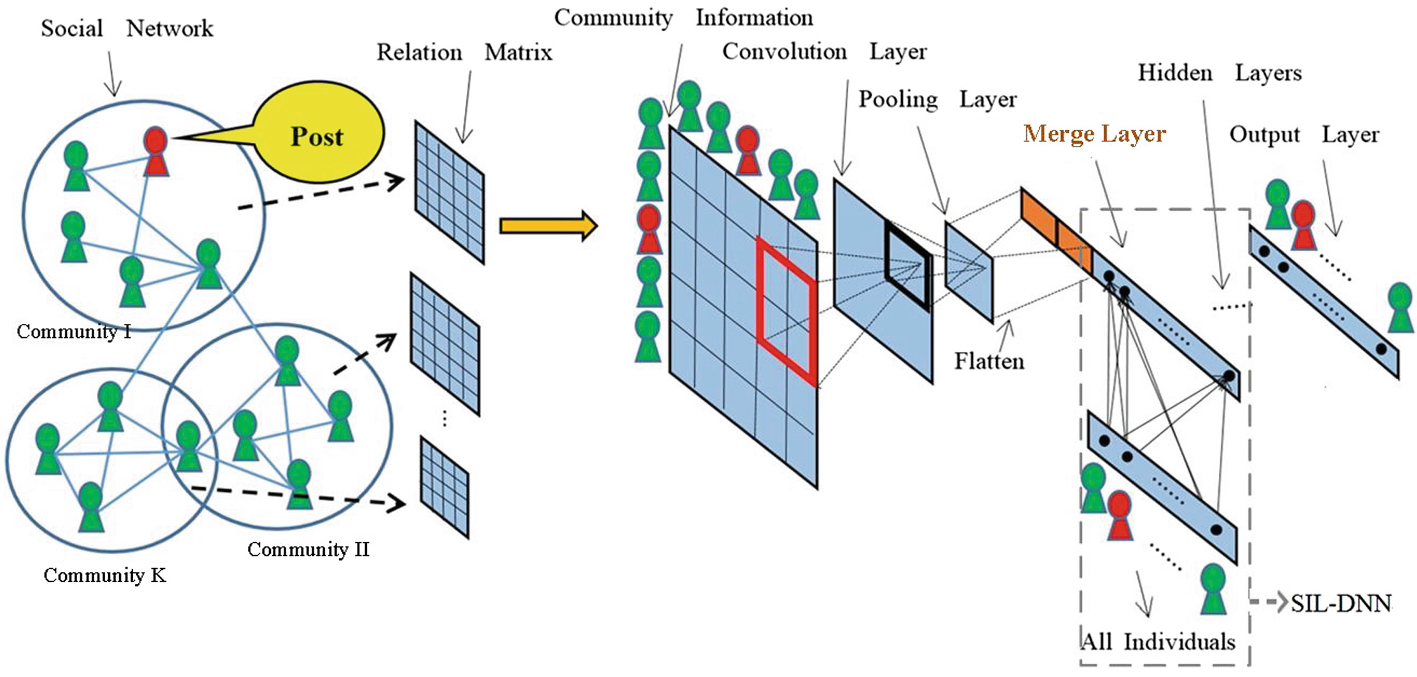
The model starts with a baseline Social Influence Learning on Deep Neural Network (SIL-DNN). It takes an input vector representing the "source nodes" (who started the trend) and maps them to an output vector representing the "final influenced nodes."
2. The Community-Based CNN (CCNN)
The real innovation lies in the CCNN module.
- Community Detection: Using the SLPA algorithm, the network is partitioned into communities, allowing for overlapping memberships.
- Relation Matrices: For each community, a relation matrix is formed. To solve the problem of node ordering in matrices (which usually lacks spatial meaning for CNNs), the authors rank nodes by degree centrality. This ensures the "strongest" nodes are always positioned at a consistent "top-left" coordinate, allowing the CNN kernels to learn meaningful local patterns.
- Architecture:
Experiments & Performance
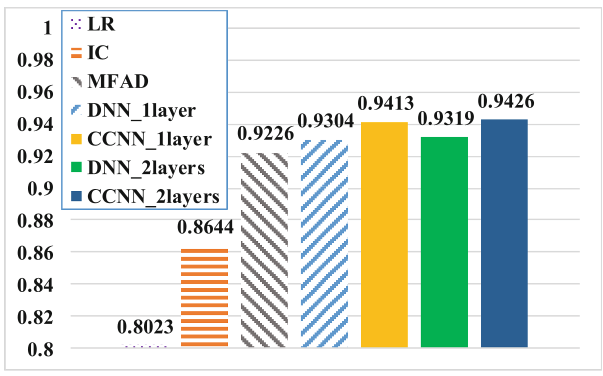
The researchers tested SIL-CCNN against traditional IC models and the Multiple Factor-Aware Diffusion (MFAD) model using both synthetic LFR benchmark data and a massive Twitter dataset (20,453 users).
Key Findings:
- Structural Advantage: SIL-CCNN consistently beat SIL-DNN, proving that just having the "traces" isn't enough; the model needs to understand the local community structure to make better predictions.
- Depth Matters: Moving from 1 to 2 hidden layers in the CCNN provided a performance boost, though the authors noted diminishing returns likely due to the size of the training traces.
- Real-World Robustness: On Twitter data, where cascades are often "shallow" and sparse, the community-based approach proved significantly more resilient than traditional probability-based models.
Critical Analysis & Outlook
SIL-CCNN represents a significant shift from "simulating" physics-like diffusion to "learning" structural representations. However, there are two areas for future exploration:
- Node Ranking Sensitivity: While degree-based ordering helps CNNs, it might overlook "bridge" nodes (high betweenness) that connect communities.
- Content Integration: As the authors admit, influence is not just who speaks, but what they say. Integrating NLP (Natural Language Processing) to represent the "item" being shared would likely be the next frontier for this model.
Conclusion
By leveraging the local topology of social networks through CNNs, the SIL-CCNN framework offers a scalable, simulation-free alternative for identifying the ripple effects of information. It paves the way for more intelligent, community-aware social analytics.