
Weaponizing the Feed: How Social Influence Compromises Security Choices
Can social influence be exploited to compromise security: An online experimental evaluation
This study investigates whether social influence can be weaponized to manipulate users into making suboptimal cybersecurity decisions. Using a controlled online experiment with 357 participants, the authors demonstrate that specific temporal patterns of "social signals" can effectively trick users into abandoning optimal security technologies for less effective ones.
TL;DR
In a world where we look to "trending" topics or "peer reviews" to judge technology, can an adversary trick us into choosing the wrong shield? This paper presents a chilling experimental evaluation showing that by carefully timing social signals from bots, attackers can convince nearly 50% of users to abandon an optimal security solution in favor of a weaker one—even after the users have already discovered the better option.
The Motivation: When Trust Becomes a Vulnerability
We often think of social influence as a force for good—like a viral campaign for two-factor authentication. However, the authors of this study point out a critical blind spot: transitive trust. If I trust my peers, and my peers seem to trust a specific software, I am likely to adopt it even if my own intuition suggests otherwise.
The researchers set out to answer a fundamental question: Does the timing and quantity of peer signals matter more than our own hands-on experience? Or, more bluntly: Can an enemy "flood the zone" with bad advice to make us less secure?
Methodology: The "Security Officer" Game
The team at Arizona State University and Sandia National Laboratories built a controlled environment (CLOSE platform) where 357 participants played the role of a bank's security officer.
- Phase 1 (Learning): For 12 rounds, participants chose from 6 providers. They learned through trial and error that one provider prevented 7 attacks (Optimal), while the others prevented 6 (Suboptimal).
- Phase 2 (The Attack): At Round 13, social signals were introduced. Participants saw what their "peers" (actually pre-programmed bots) were choosing.
The researchers tested several Exposure Patterns:
- Uniform (UM): Steady, low-level peer signal.
- Early Cascade (EC): A massive burst of suboptimal peer signals at the start of Phase 2.
- Delayed Cascade (DC): A gradual buildup, peaking at the very end.
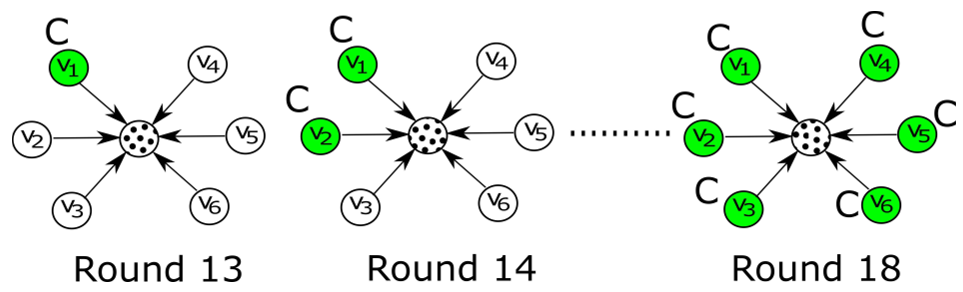 Figure 1: The Linear Cascade (LC) model where peer signals for a suboptimal technology (C) increase over time.
Crucial Findings: Timing is Everything
The results revealed a fascinating tug-of-war between Individual Experience and Social Pressure.
1. The Power of "Delayed" Deception
The Delayed Cascade (DC) group was the most compromised. By the end of the game, nearly 50% of participants were on a suboptimal provider. Because the social pressure peaked late, participants had less time to "snap out of it" and return to the optimal choice.
2. The Resilience of Exploration
While the Early Cascade (EC) group saw a huge initial spike in people following the crowd, many users eventually returned to the optimal choice. Why? Because after the shock of the initial peer signal, they had several rounds to realize, "Hey, my original choice was actually better."
3. Social Signals vs. Cognitive Logic
Using a Cox Proportional Hazards Model, the researchers found that the number of peer signals was the only statistically significant factor in predicting why someone switched to a worse technology. Factors like "computer confidence" or "neuroticism" mattered far less than the sheer volume of "people" (bots) doing the wrong thing.
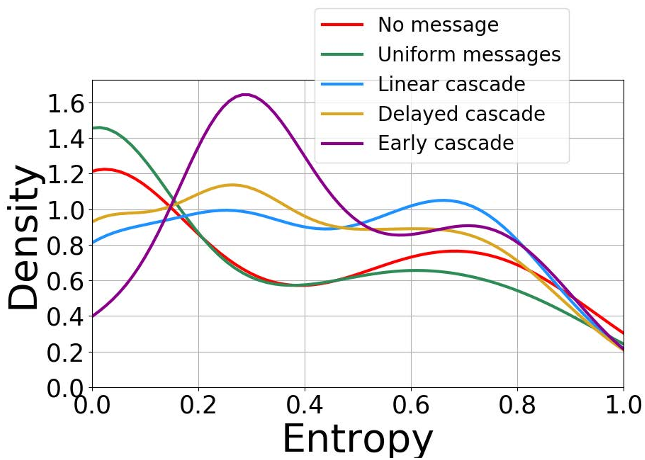 Figure 3: Hazard of adoption for DC and EC groups, showing the dominance of peer signal counts.
Critical Analysis: Why This Matters for the Future
This paper provides empirical evidence for what we've seen in "Information Operations":
- Exploiting the Exploration Period: Social influence is most dangerous when it prevents someone from settling on the truth or disrupts them right as they think they've found it.
- Quantifying the Crowd: The "Quantity over Quality" effect is real. Even when users had financial incentives ($0.02 per attack prevented) to be right, the psychological pressure of a "majority" choice overrode their wallets.
The Limitation: The experiment used a simple utility difference (7 vs 6 attacks). In the real world, the difference between a "good" and "bad" security tool might be much higher—or much subtler—which might change the "price" of following the crowd.
Conclusion
If an adversary can control the temporal flow of information on social media or within a professional network, they don't need to hack your firewall—they just need to convince you to buy a weaker one. This study proves that "Social Influence" is a legitimate security vector that requires the same level of rigorous defense as our networks and code.