
Social Cybersecurity: Why Your Friends are the Secret to Better Security
The Role of Social Influence in Security Feature Adoption
This study investigates the social diffusion of cybersecurity features among 1.5 million Facebook users. By analyzing features like Login Approvals, Notifications, and Trusted Contacts, the authors demonstrate that social influence significantly predicts adoption, with "Trusted Contacts" showing the strongest positive social contagion.
TL;DR
Is cybersecurity contagious? A massive study of 1.5 million Facebook users reveals that you are significantly more likely to adopt security features if your friends do—but only if those friends come from different parts of your life (e.g., one from work, one from high school). Crucially, "invisible" security features can actually suffer from negative social proof, where seeing only a few "paranoid" early adopters discourages the average user.
The "Paranoia" Problem: Why Security is Different
In most tech adoption (like joining a new social app), more users usually mean more value. Security is different. Because security features are often seen as a burden or a tool for the "tech-savvy and paranoid," early adoption can create an illusory correlation. If you only see your "one weird IT friend" using two-factor authentication, you might label the feature as "only for experts," actually making you less likely to use it.
The authors call this the Threshold Effect:
- Below the threshold: A few adopters look like outliers (Negative Social Proof).
- Above the threshold: Many adopters make the behavior look like a norm (Positive Social Proof).
Methodology: Battling Homophily
To prove that friends actually influence each other rather than just being similar, the researchers used Matched Propensity Sampling. They compared "exposed" users (who have adopting friends) with "unexposed" users who were statistically identical in every other way (age, activity, account length).
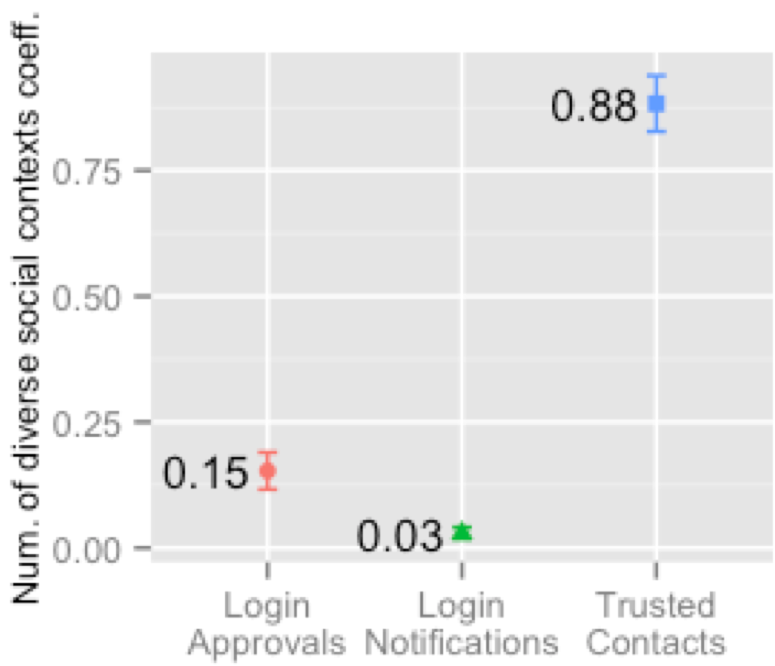 Figure 1: The impact of diverse social circles on adoption. Trusted Contacts, the most "social" and "observable" feature, shows the strongest effect.
Key Insight 1: Structural Diversity Over Raw Numbers
The study found that it’s not just how many friends use a feature, but where they come from. If two of your high school friends use a feature, it's a signal. But if one high school friend and one work colleague use it, it's a stronger signal. This "structural diversity" provides a redundant, independent validation that the technology is useful across different contexts of your life.
Key Insight 2: Observability is King
The researchers compared three features with varying visibility:
- Trusted Contacts: Highly visible (you have to pick friends to help you).
- Login Approvals (2FA): Semi-visible (friends might see you enter a code).
- Login Notifications: Low visibility (private alerts).
As shown in the graph below, Trusted Contacts (the red line) starts with a positive effect almost immediately. In contrast, Login Notifications actually shows a "penalty" for exposure at lower levels—proving that hidden security features struggle to spread naturally.
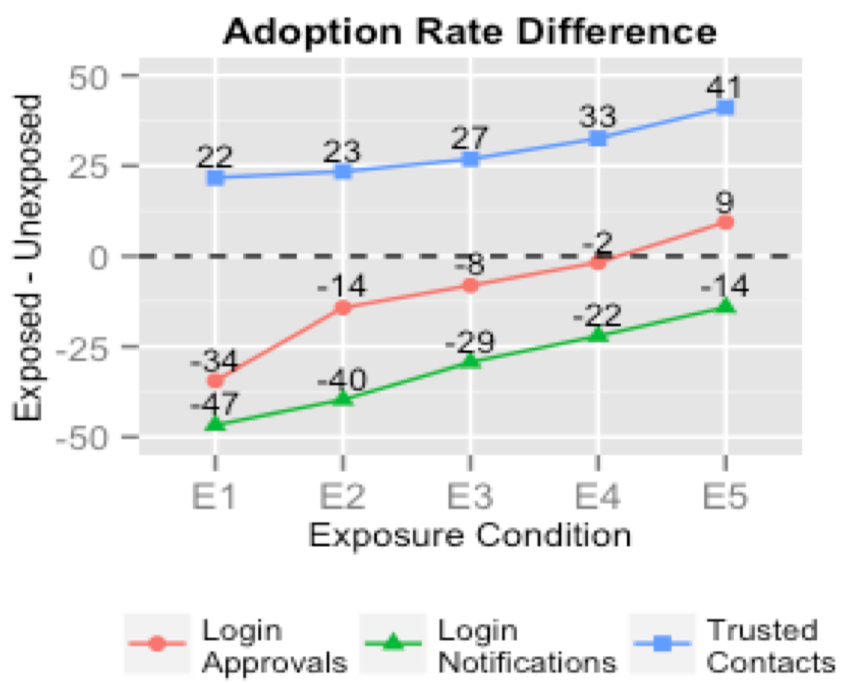 Figure 2: The "Threshold" shift. Note how Login Approvals (blue) starts negative and crosses the zero-line as exposure increases.
Deep Insight: Designing for "Social" Security
The takeaway for the industry is profound. We focus too much on making security "frictionless" and "invisible." However, by making security invisible, we kill the social proof necessary for it to go viral.
Future Outlook:
- Targeted Seeding: Instead of blasting all users with ads, platforms should identify users in distinct social clusters to trigger a "multi-pronged" social influence.
- Collaborative UX: Features like "Trusted Contacts" succeed because they are built on trust and interaction, not just locks and keys.
- Normalization: To beat the "paranoia" stigma, we must push adoption past the critical threshold where it becomes a social norm rather than an expert niche.
Conclusion
This Facebook study proves that cybersecurity is a social science as much as a computer science. By understanding the "why" and "how" of social diffusion, we can move away from blaming users for "bad habits" and start building systems that naturally encourage a safer internet through the power of our social networks.