
SMART-TMT: Bridging Social Trust and Semantic Knowledge for Medical Tourism
Using Social Interaction Between Friends in Knowledge-Based Personalized Recommendation
The paper introduces SMART-TMT, a knowledge-based personalized recommender system for Tunisian medical tourism. It integrates a time-sensitive trust calculation model from social networks with domain-specific ontologies to generate high-precision tourist recommendations while achieving SOTA performance in mitigating cold-start and data sparsity issues.
TL;DR
Recommending a medical clinic isn't like recommending a movie; it requires deep trust and precise domain knowledge. The SMART-TMT system solves the "cold-start" problem by analyzing your Facebook interactions through a time-sensitive trust lens and matching your social persona with a specialized Tunisian Medical Tourism ontology.
Background & Motivation
Most recommendation engines fail when they don't have enough data (the Sparsity Problem) or when a new user joins (the Cold-Start Problem). In the context of Medical Tourism, these failures are costly. People don't trust anonymous ratings for surgery; they trust their friends. However, "trust" isn't a permanent state. A friend you interacted with five years ago shouldn't influence your profile as much as someone you talked to yesterday.
The authors identify a critical gap: prior systems ignore the temporal factor of social interactions and lack the semantic depth to understand the relationship between a user’s social "likes" and actual medical needs.
Methodology: The Two Pillars of SMART-TMT
1. The Time-Sensitive Trust Metric
Instead of a binary "friend/not friend" relationship, the system calculates a dynamic trust score. It monitors social activities (comments, likes, tags) and applies a weight that degrades over time.
- Implicit Data Mining: No more tedious surveys. The system extracts interests from your Facebook wall and inbox.
- Activity Weighting: Video tags and wall posts are weighted higher than simple "likes."
2. Dual-Ontology Architecture
The system doesn't just look for keywords; it understands meaning through two distinct ontologies:
- User Interest Ontology: A semantic graph of what you and your trusted friends care about.
- TMT Ontology: A specialized knowledge base of Tunisian clinics, thalassotherapy centers, and surgical acts.
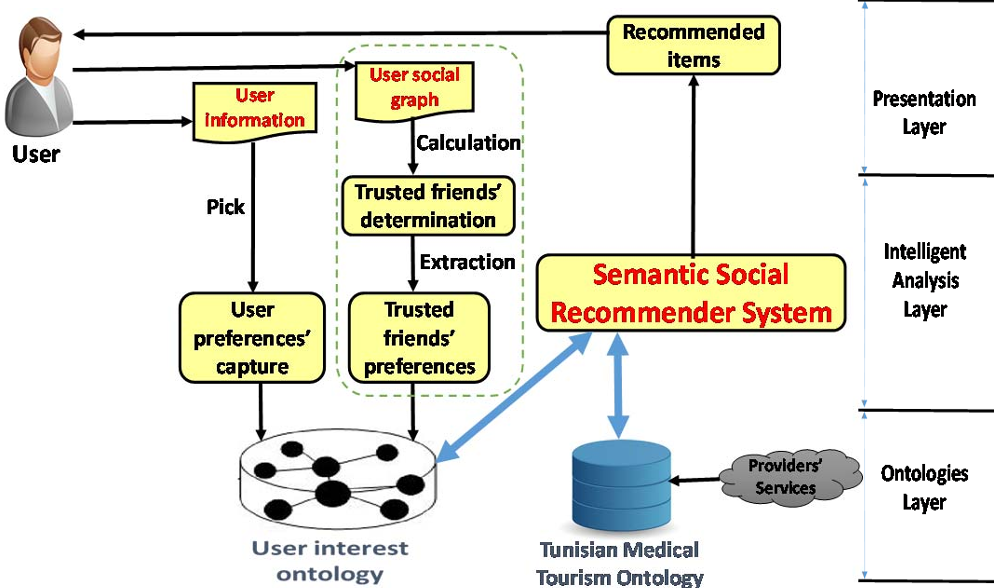 The functional architecture showcases the flow from social data extraction to semantic matching between the User Interest and TMT ontologies.
Experiments and Results
The authors validated their trust model via a custom Android application. By comparing manually selected "trusted friends" with the algorithm's output, they found that:
- Precision Gains: Incorporating time-varying weights and multi-type interactions (like video) significantly outperformed static models.
- Semantic Matching: The use of WordNet and TF-IDF for term weighting allowed the system to bridge the gap between casual social language and formal medical terminology.
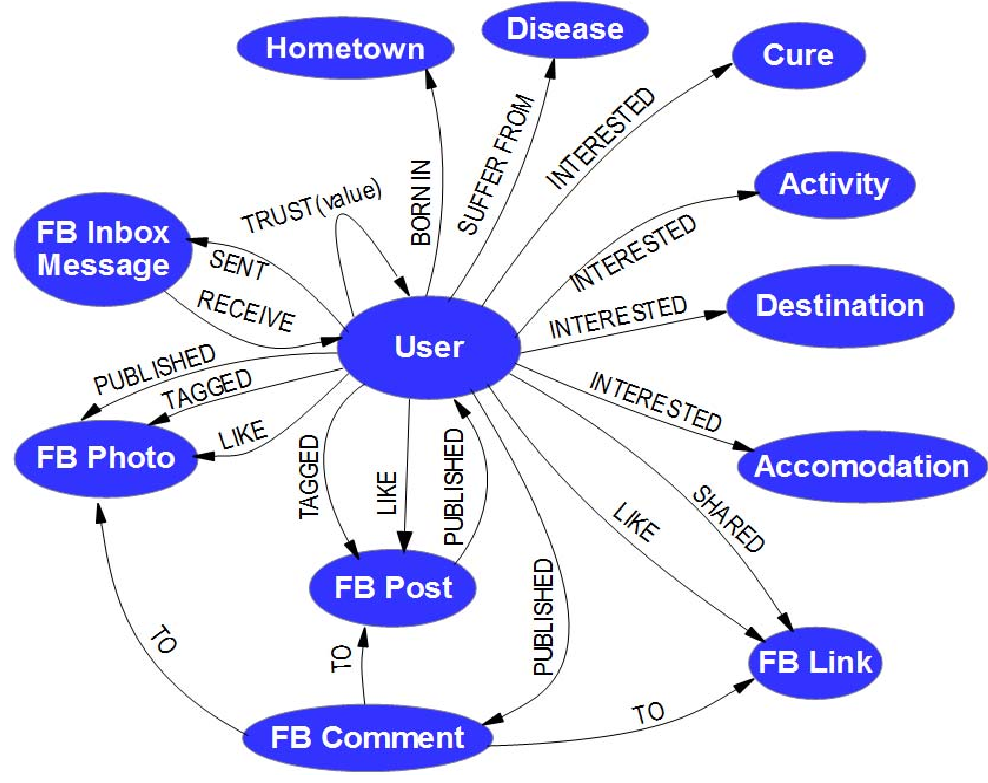 A partial view of the User Interest Ontology, illustrating how personal preferences are linked to the preferences of trusted social connections.
Critical Insight: Why This Works
The brilliance of SMART-TMT lies in its Inductive Bias. It assumes that if your current inner circle is interested in "wellness" or "spa treatments," you likely share those latent preferences. By mapping these social signals into a structured OWL (Web Ontology Language) format, it transforms messy social data into high-quality inputs for a Knowledge-Based Recommender.
Conclusion & Future Outlook
SMART-TMT proves that the fusion of Social Graph Analysis and Semantic Web technologies is the key to solving the cold-start problem in specialized domains. While the current prototype relies heavily on Facebook’s Open Graph API—which faces stricter privacy constraints today—the underlying logic of Temporal Trust remains a gold standard for social computing.
Future Work: The authors aim to move toward a mobile-first "on-trip" assistant that updates the User Interest Ontology in real-time as the traveler explores Tunisia.
Keywords: Recommender Systems, Ontology, Social Trust, Medical Tourism, Semantic Web Mining.