
Social Internet of Things: Decoding Human Dynamics via the IoT Ecosystem
Social Internet of Things: The Potential of the Internet of Things for Defining Human Behaviours
This paper explores the "Social Internet of Things" (SIoT), a framework that integrates IoT, Big Data, and Smart Cities to model and understand human behaviors. It proposes a transition from machine-centric interactions to human-centric "Human Dynamics" using real-time data from personal wearables and urban sensors.
Executive Summary
TL;DR: This paper redefines the Internet of Things (IoT) not merely as a network of communicating machines, but as a sophisticated tool for measuring and influencing human behavior. By leveraging the triangle of Big Data, Smart Cities, and Wearable Computing, the authors move beyond the "machine-to-machine" paradigm toward an Internet of People (IoP) that uses real-time feedback loops to improve quality of life.
The work is positioned as a visionary framework that bridges statistical physics (Human Dynamics) with modern cloud infrastructure, transforming passive citizens into active "prosumers."
The Shift: From Machine-to-Machine to Human Dynamics
For years, the IoT was the domain of M2M (Machine-to-Machine) communication—sensors talking to gateways. However, the authors argue that the true potential of the "Future Internet" lies in understanding Human Dynamics.
Historical models, like the Poisson Distribution, assumed human activities occurred at random, regular intervals. However, modern observations suggest that human behavior is "bursty"—we engage in intense bursts of activity (checking emails, exercising, shopping) followed by long periods of inactivity. Capturing these "heavy-tailed" distributions requires the ubiquitous sensing capabilities of a Smart City.
Methodology: The IoT Ecosystem and the Awareness Loop
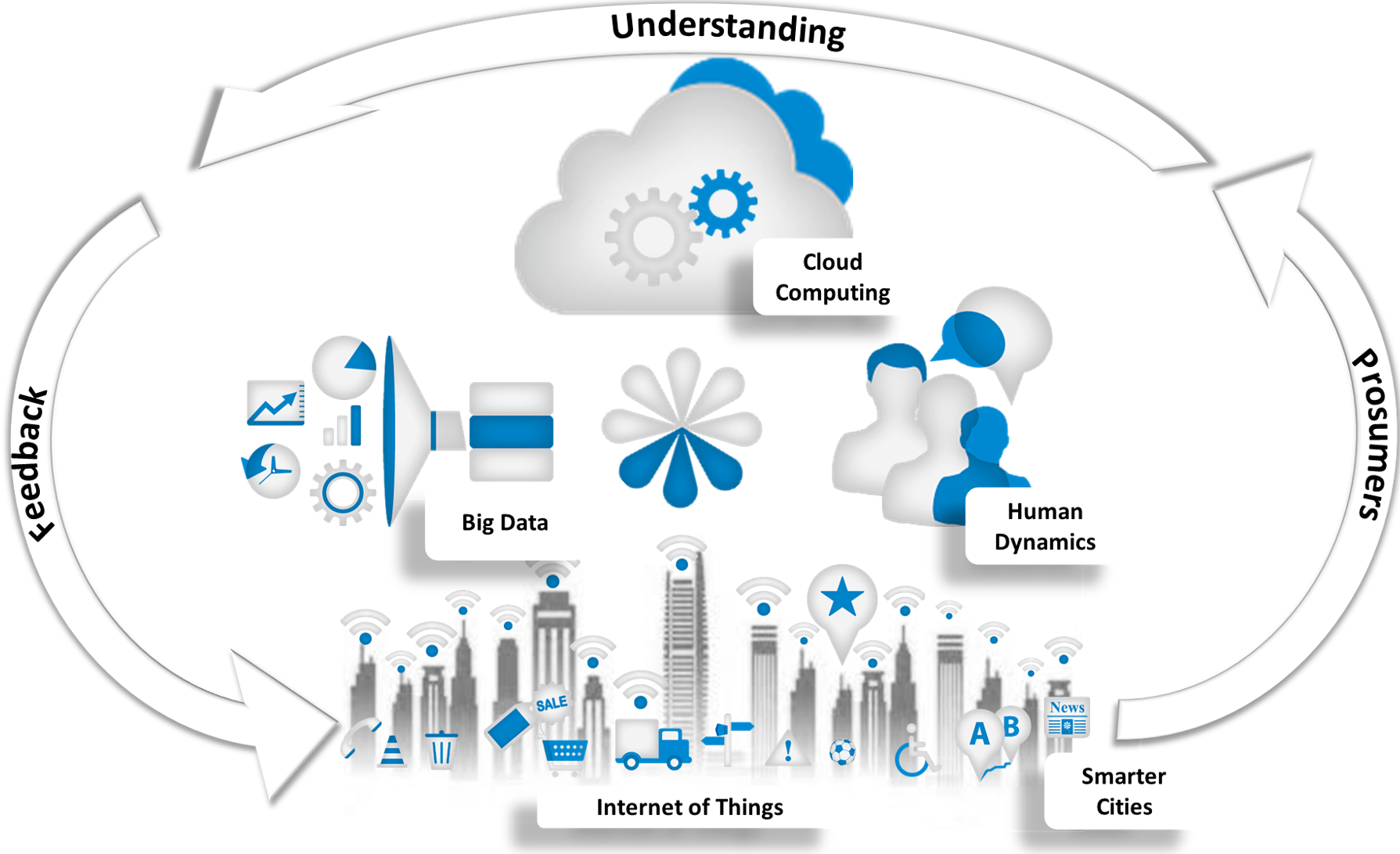
The authors propose a symbiotic architecture where data flows through a centralized cloud to generate actionable insights.
1. The Prosumer Model
Citizens are no longer just consumers of city services; they are "Prosumers" (Producer + Consumer). Through Participatory Sensing, a user's smartphone becomes a mobile sensor node that reports everything from GPS location and magnetic fields to subjective reports of potholes or traffic accidents.
2. System Architecture
The ecosystem relies on a multi-layer stack:
- Big Data Integration: Using REST and Linked Data to merge heterogeneous sources.
- Cloud Orchestration: Platforms like Xively or Paraimpu manage the deluge of measurements.
- Human Dynamics Analysis: Applying statistical physics to raw data to find regularities in daily patterns.
From Understanding to Influencing: The Awareness Loop
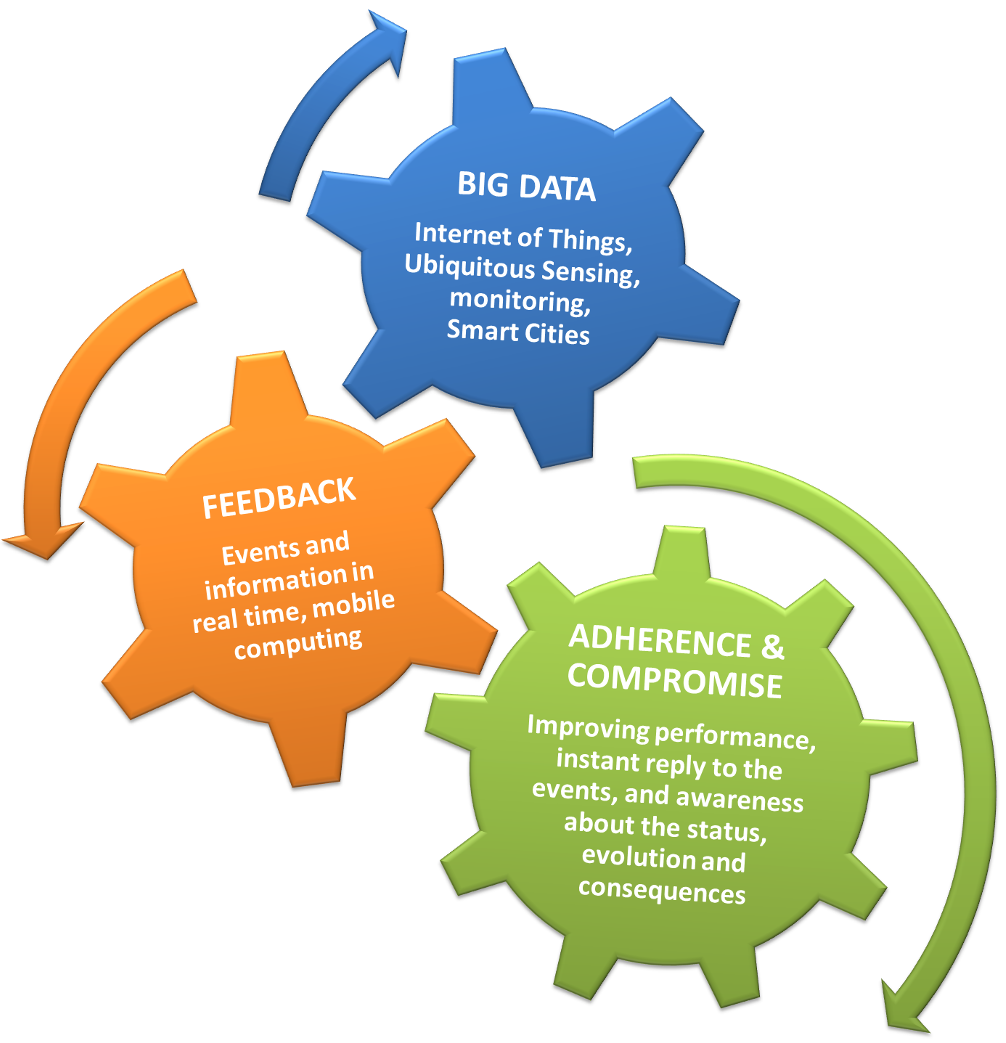
The most provocative claim of the paper is that IoT should be persuasive. Once a behavior is understood (e.g., poor dietary habits or excessive energy consumption), the system must "close the loop" by providing just-in-time feedback.
The authors suggest using metaphors rather than raw data:
- Instead of showing an energy bill, show a "digital garden" that withers when consumption is too high.
- For drug adherence, an avatar or a growing flower can signify health progress.
Critical Insight & Conclusion
The power of this research lies in its transition from quantitative sensing (how much?) to qualitative influence (why and how to change?). While early IoT was about connectivity, the "Social IoT" is about the Internet of People.
Limitations and Future Work
While the framework is robust, it faces significant challenges:
- Privacy: Turning citizens into prosumers requires a level of data surveillance that necessitates strict ethical safeguards.
- Invasiveness: How do we provide feedback without "nagging" the user? The authors suggest metaphors (flowers, avatars), but the long-term psychological impact remains an open research area.
- Fragmentation: The authors are currently working on integrating new wearables (smartwatches, glasses) into their "Mobile Digcovery" architecture to create a more seamless data flow.
Final Takeaway: This paper serves as a blueprint for the next decade of smart cities, where the focus shifts from managing infrastructure to empowering the human element within that infrastructure.