
The Dual Nature of SIoV: Bridging Social IoT and Human Drivers
A social internet of vehicles sharing SIoT relationships
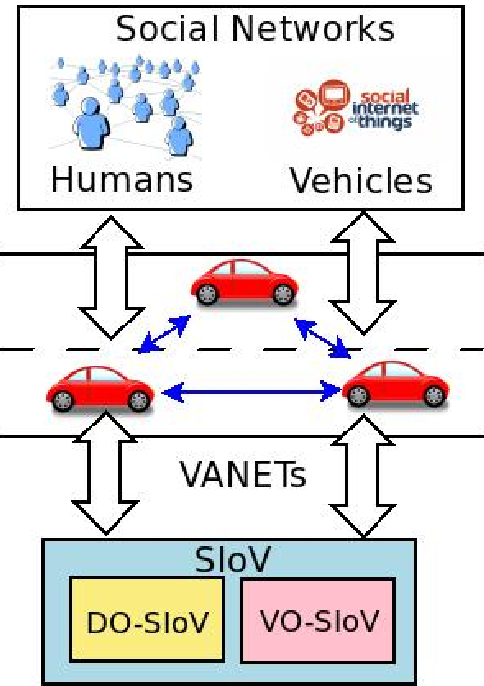
This paper introduces a unified framework for the Social Internet of Vehicles (SIoV), categorizing it into two distinct but coexisting dimensions: Vehicle-Oriented (VO-SIoV) and Driver-Oriented (DO-SIoV). By establishing autonomous social relationships among vehicles and human-centric ties among drivers, the study provides a roadmap for integrating Social Internet of Things (SIoT) concepts into Intelligent Transportation Systems.
TL;DR
The Social Internet of Vehicles (SIoV) is more than just "connected cars." This research formally splits SIoV into two layers: VO-SIoV (Vehicle-Oriented), focusing on stable machine-to-machine relationships, and DO-SIoV (Driver-Oriented), focusing on transient human-centric interactions. By differentiating these, the paper solves the conflict between long-term connectivity and real-time social needs.
Background: Beyond Simple VANETs
The evolution from VANETs to the Internet of Vehicles (IoV) brought connectivity, but it lacked "intelligence." The current shift toward SIoV treats vehicles as social entities capable of autonomous relationship building. However, the field has struggled with a fundamental identity crisis: Is the vehicle the social actor, or is it the human driver? This paper argues it is both, and they require different architectural approaches.
Problem & Motivation: The Heterogeneity Gap
Existing SIoV models often fail because they apply a "one size fits all" logic.
- Machine Logic vs. Human Logic: Vehicles have stable routines (buses, commutes), while humans have transient interests (finding a parking spot, following a football game).
- Architecture Mismatch: Using cloud-based SIoT architectures for human-centric social interactions creates unacceptable latency for fast-moving vehicular scenarios.
Methodology: The Twofold Architecture
The authors propose a bifurcated model that allows these two natures to coexist.
1. VO-SIoV (Vehicle-Oriented)
- Nature: Stable and slow-varying.
- Relationships: Based on SIoT pillars like Ownership Relationship (OOR) or Co-work Relationship (C-WOR).
- Infrastructure: Typically Cloud/Client-Server, as the information (like maintenance history or long-term routes) is not time-critical to the millisecond.
2. DO-SIoV (Driver-Oriented)
- Nature: Fast-evolving and opportunistic.
- Relationships: Content-oriented (CDR) or Position-based (PDR).
- Infrastructure: Edge or P2P. This is critical for low-latency tasks like sharing a video clip of a nearby accident or finding passengers for carpooling.
Simulation: How Social Networks Form on the Road
Using the SUMO (Simulation of Urban MObility) framework on a real-world map of Reggio Calabria, the researchers tested how the presence of different vehicle types affects network growth.
Key Findings:
- The Power of Randomness: Interestingly, a high percentage of "commuting" vehicles (those that follow the same route every day) actually slows down the growth of a total social network because they only ever meet the same neighbors.
- The Bridge Effect: "Randomly moving" vehicles (like delivery vans or taxis) act as social bridges, connecting isolated clusters of commuters into a "Giant Component."
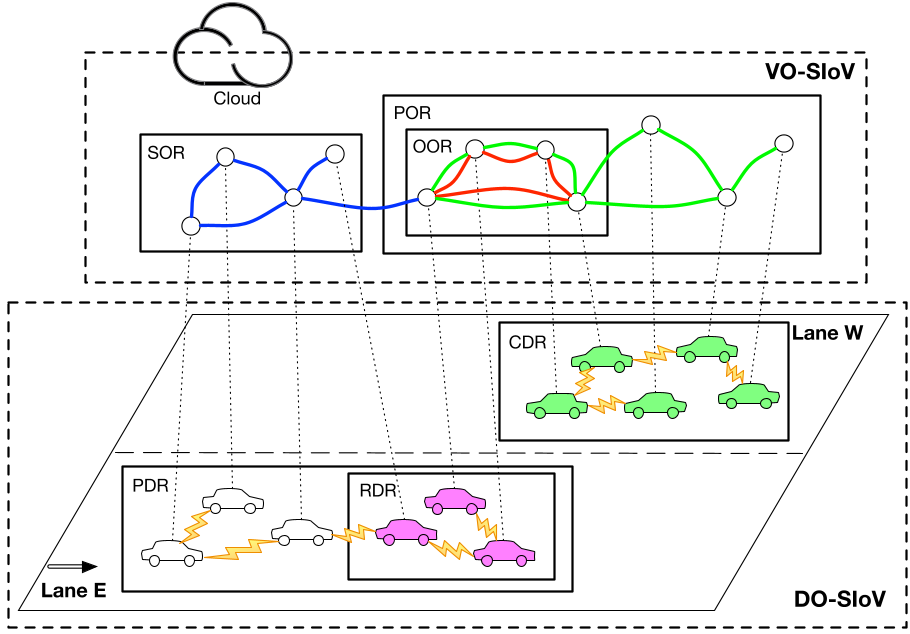 Figure: The overlap of VO-SIoV (stable blue edges) and DO-SIoV (dynamic on-the-fly clusters).
Performance Metrics
The researchers compared the two paradigms across several technical vectors:
- Latency: DO-SIoV achieves low latency via Edge nodes, while VO-SIoV accepts higher latency via Cloud.
- Connectivity: For all simulated scenarios, the network achieved a "Giant Component" (connecting over 90% of nodes) within 4 days, proving the feasibility of SIoT relationships in urban settings.
Critical Insight & Conclusion
The true value of this paper lies in its architectural realism. By admitting that a car is both a "thing" (IoT) and a "proxy for a human" (Social Network), researchers can design systems that don't compromise.
Future Work & Limitations:
- The Trust Factor: Establishing trust in DO-SIoV is difficult because human interactions are "short-lived." How do you verify a "friend" you only drive next to for five minutes?
- Privacy: The twofold nature doubles the privacy risk—protecting the vehicle's telemetry data is one thing; protecting the driver's social preferences is another.
In conclusion, the SIoV paradigm is the next frontier of ITS, moving us closer to a world where our cars are as socially aware as we are.