
SIoT: When Your Toaster and Tesla Become Friends to Save the Internet
The Social Internet of Things (SIoT) -When social networks meet the Internet of Things: Concept, architecture and network characterization q
This seminal paper proposes the Social Internet of Things (SIoT) paradigm, which integrates social networking principles into IoT to enhance service discovery and scalability. It establishes a framework for autonomous relationship management between objects and introduces a three-layered architecture validated through network characterization.
TL;DR
The Social Internet of Things (SIoT) is a paradigm shift that allows smart objects to form their own social networks independently of their owners. By mimicking human social structures, the SIoT solves the "Discovery Nightmare" of trillions of devices, creating a small-world network where any service is just ~3 "handshakes" away.
Background: The Scalability Wall
As we move toward a world with trillions of connected devices, traditional search and discovery mechanisms break down. How do you find a specific sensor or service in a sea of billions? The authors argue that the answer lies in Sociality. Just as humans use social circles to find experts or resources, objects can use "friendships" to navigate the digital world efficiently and securely.
The Five Pillars of Object Friendship
The core innovation of this paper is the formalization of relationships between "Things." These aren't just connections; they are social bonds governed by specific policies:
- Parental (POR): Built between objects of the same batch/manufacturer (e.g., all Kindle Gen 10s).
- Co-location (C-LOR): For objects always used in the same place (e.g., smart lights and thermostats in your home).
- Co-work (C-WOR): Established when objects collaborate for a task (e.g., emergency sensors during a fire).
- Ownership (OOR): Bonds between different devices owned by the same user.
- Social (SOR): Formed when objects cross paths because their owners spend time together (the "friend-of-a-friend" for things).
The SIoT Architecture
The paper proposes a robust three-layer architecture designed to manage these friendships without constant human intervention.
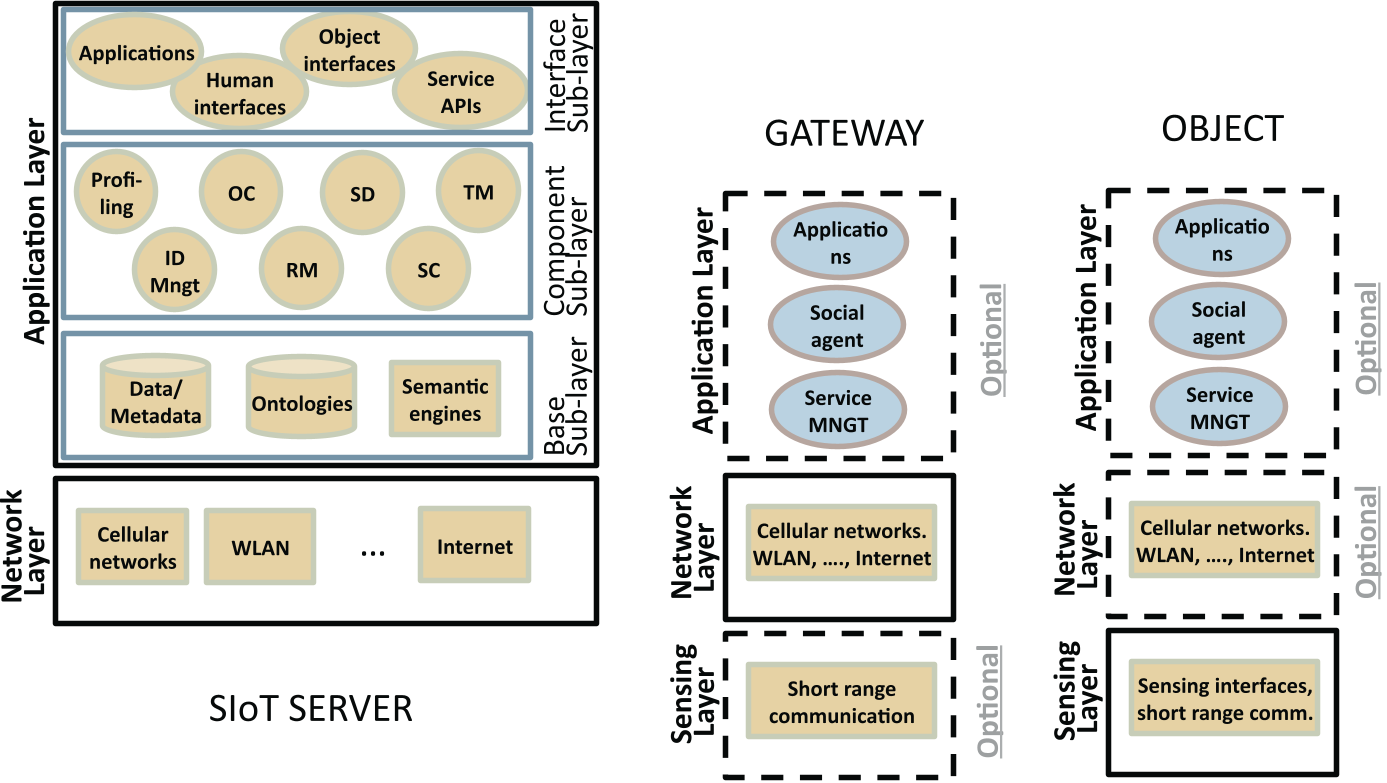
Key modules include:
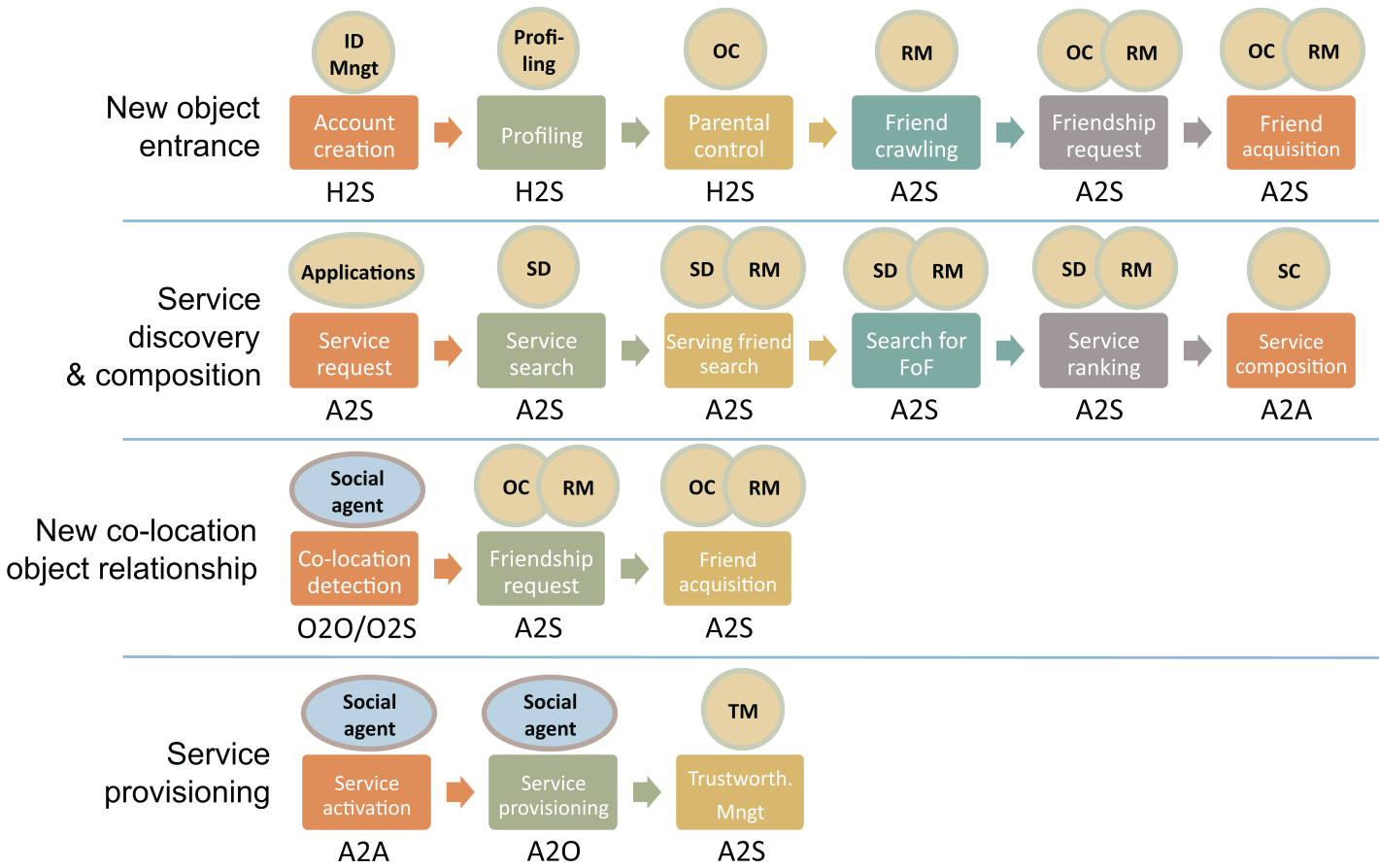
- Relationship Management: The brain that decides when to start or terminate a "friendship."
- Trustworthiness Management: A reputation system based on how reliable a "friend" object has been in previous service requests.
- Service Discovery: Instead of a global search, it crawls the social graph of the requesting object.
Experimental Evidence: A Small World for Things
Using the SWIM (Small World In Motion) mobility simulator, the researchers mapped out how these relations actually form in space and time.
The results are striking. The SIoT network behaves like a Small World. While a random network of the same size would have a diameter of 11, the SIoT brings it down to 6. Most nodes can find each other in fewer than 3 hops (2.85 average).
| Metric | SIoT | Random Network |
|---|---|---|
| Average Path Length | 2.85 | 3.03 |
| Network Diameter | 6 | 11 |
| Isolated Nodes | 0% | 4% |
Critical Insight: Why This Matters
The "Social" in SIoT isn't just a metaphor. It provides a formal Inductive Bias for the network. By grouping objects that are physically or logically related, the system creates "short-cuts" across the network.
However, the architecture does have a centralized bottleneck: the SIoT Server. Future iterations will need to explore how to move the "Relationship Management" to the edge to avoid total dependence on a central authority.
Conclusion
This paper transitioned IoT from a collection of "connected sensors" to a "community of agents." By leveraging social network theory, it provides a blueprint for an Internet of Things that is not only vast but also navigable, trustworthy, and autonomous.