
Hybrid Recommendation: Bridging Ontological Knowledge and Social Trust
Social knowledge-based recommender system. Application to the movies domain
This paper presents a hybrid recommender system for the movie domain that integrates Semantic Web ontologies with social network data. It introduces a "social aperture" mechanism to balance knowledge-based inference with collaborative filtering, achieving high accuracy in personalized movie suggestions.
TL;DR
Researchers have developed a hybrid movie recommender that doesn't just look at what you've watched, but understands the relationships between movies through ontologies and listens to your friends. By introducing a "Social Aperture" setting, users can decide how much their social circle influences their suggestions, effectively solving the "Cold Start" problem while maintaining high precision.
Background: Beyond Simple Matching
Most recommendation engines like those on Netflix or Amazon rely on Collaborative Filtering (users like you also liked...) or Content-Based filtering (you liked X, so you might like Y). However, these systems often hit a wall:
- Overspecialization: Recommending the same types of things forever.
- Cold Start: Knowing nothing about a new user or a brand-new movie.
- Context Blindness: Ignoring the fact that we trust our friends' opinions more than a random stranger's.
The Core Innovation: Knowledge Meets Social Aperture
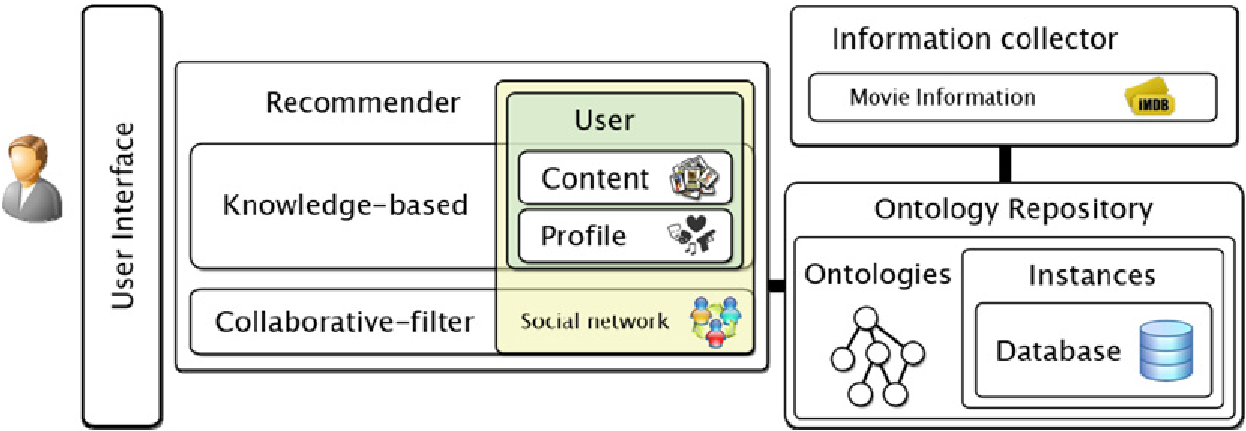
The system architecture consists of three pillars: an Ontology Repository, an Information Collector (populating data from IMDB), and the Hybrid Recommender Module.
1. The Semantic Knowledge Base
Instead of seeing a movie as a flat text string, the system uses the Movie Ontology (OWL). It understands that "Quentin Tarantino" is a and "Inglourious Basterds" is a linked via .
The similarity between two movies () is calculated using a weighted formula that considers common properties like genre, actors, and production decade:
2. The Social Aperture Mechanism
The most unique "human" aspect of this research is the Social Aperture. The system allows users to define how much they want to be influenced by their friends:
- Conservative: 100% Personal Preferences (No social influence).
- Moderate: 75% Personal Preferences / 25% Social Network.
- Liberal: 50% Personal Preferences / 50% Social Network.
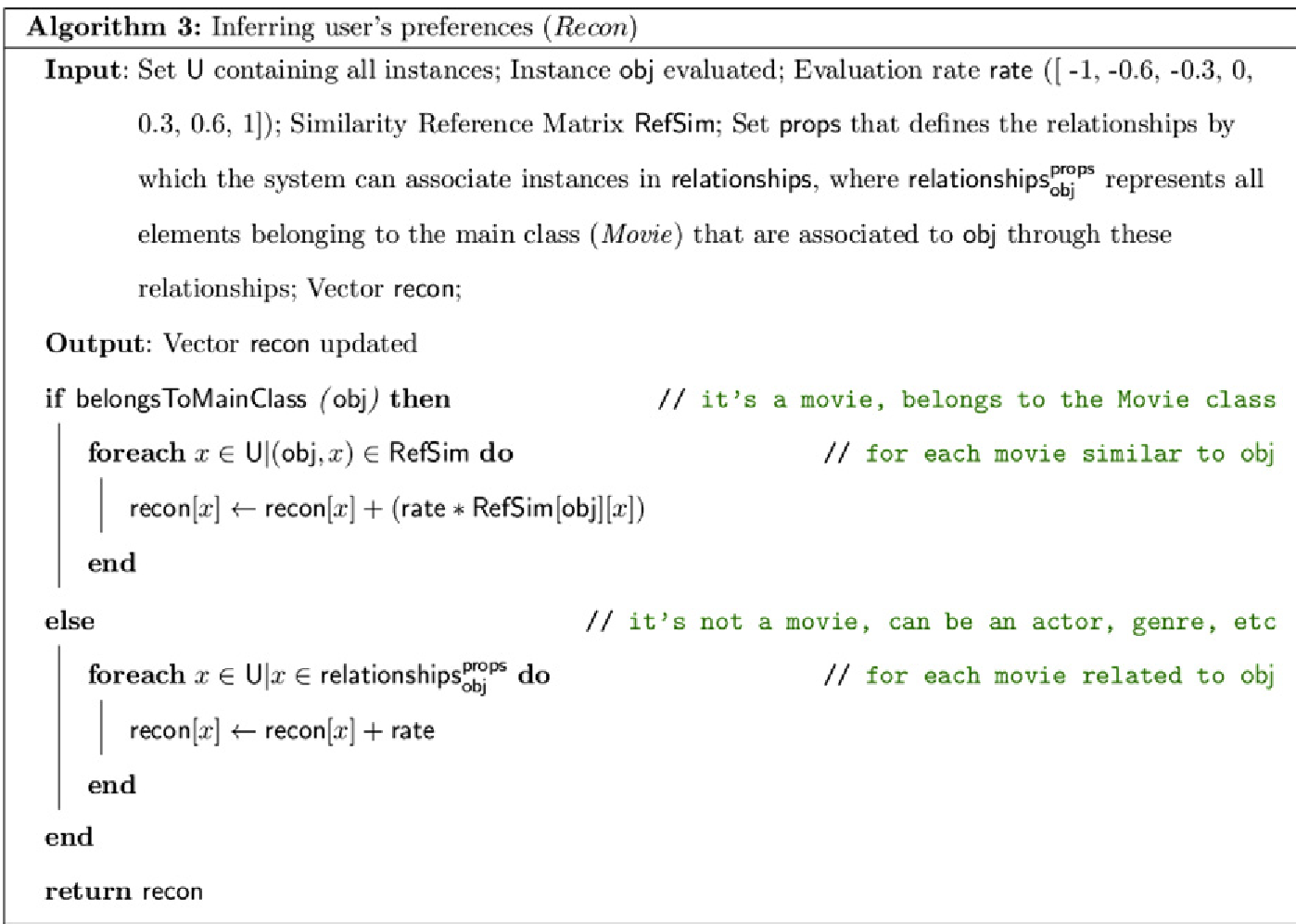
This is calculated by averaging the "Recon" (recommendation) vectors of all friends in the user's social network, normalizing them, and then mixing them with the user's own knowledge-based vector.
Methodology: How "Recon" Vectors Work
When a user rates an actor they like (e.g., Uma Thurman), the system doesn't just look for her name. It traverses the ontology, finds all movies linked to her, and boosts those movies' scores in the user's Recon Vector. If they also like a specific director, those scores compound, bubble-sorting the best matches to the top.
Experiments and Performance
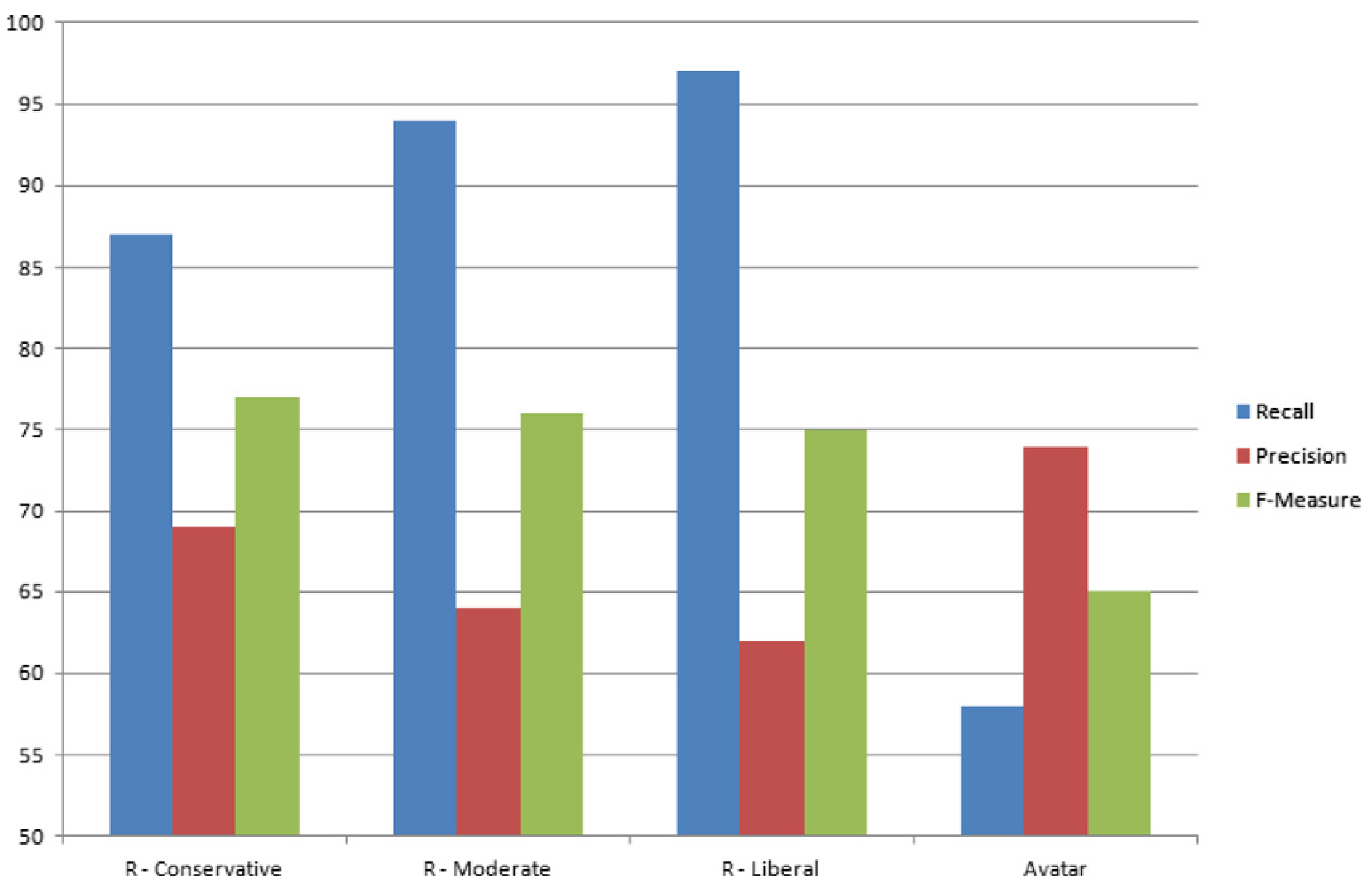
The system was tested with real users sharing an active social network. The results showed that adding social influence (Moderate/Liberal profiles) significantly improved Recall—the system was able to find more relevant movies that the user hadn't explicitly thought of.
| Metric | Conservative | Moderate | Liberal |
|---|---|---|---|
| Avg Precision | 69% | 64% | 61% |
| Avg Recall | 87% | 94% | 97% |
While precision drops slightly as more "diverse" social recommendations are pulled in, the F-measure remains highly competitive, outperforming older semantic-only models like AVATAR in terms of coverage.
Critical Insight: Why This Matters
The value of this work lies in the Inductive Bias that social circles share tastes. By using an ontology to bridge the gap between "what a movie is" and "who likes it," the researchers have created a system that mimics human word-of-mouth but scales with machine efficiency.
Limitations: The computational cost of calculating similarity across a massive, multi-class ontology in real-time is high. Future iterations may need to move toward cross-class similarity (e.g., suggesting a director because you liked a specific actor's style) to provide even deeper discovery.
Conclusion
This paper serves as a blueprint for the "Social Web 3.0" era of recommendations. By putting the user in control of their "Social Aperture," we move away from black-box algorithms and toward a more transparent, knowledge-driven digital assistant.