
Social Learning against Data Falsification: Turning Herding Behavior into a Defense Mechanism
Social Learning Against Data Falsification in Sensor Networks
This paper introduces a decentralized data fusion scheme based on Social Learning (SL) principles to secure sensor networks against data falsification (Byzantine) attacks. By mimicking decision-making in social networks, the method enables high network resilience and eliminates single points of failure, maintaining a miss-detection rate of less than 5% even when 30% of critical nodes are compromised.
TL;DR
To combat "Byzantine" attacks in sensor networks where an adversary hijacks critical nodes, this paper proposes a Social Learning (SL) framework. Instead of sending data to a vulnerable central Fusion Center, nodes sequentially observe their neighbors' decisions to form their own. This creates a resilient, distributed intelligence where the network can overcome a 30% compromise rate, maintaining high detection accuracy without a single point of failure.
Background: The Fusion Center Trap
In standard sensor network architectures (Distributed Sensing, Centralized Processing), the Fusion Center (FC) is the crown jewel. It collects raw data and makes the final call. However, for a "topology-aware" attacker, the FC is a glaring target. If the FC is compromised, the entire network’s inference capability drops to zero.
The authors argue that we need a DSDP (Distributed-Sensing with Distributed-Processing) approach. The challenge? Most DSDP schemes are NP-hard to optimize.
The Insight: Logic of the "Herd"
The researchers look to behavioral economics—specifically Social Learning. In a social network, if you see ten people running away from a building, you might start running too, even if you don't smell smoke. This is an Information Cascade.
While usually seen as a flaw in human decision-making (blindly following the herd), the authors realize it can be a resilience feature in sensor networks:
- Redundancy: In a cascade, every node eventually reaches the same high-quality conclusion.
- No Single Point of Failure: The "global estimate" is distributed across the whole network.
- Self-Correction: If the first few nodes are compromised and lie, a sufficient number of honest subsequent sensors can "overrule" the initial false information if their internal evidence is strong enough.
Methodology: The Social Data Fusion Rule
The paper models each node as a rational Bayesian agent. Each node makes a binary decision based on its local sensor and the sequence of previous decisions .
The core mechanism is the Log-Likelihood Ratio (LLR) update:
To make this practical for low-power sensors, the authors provide Algorithm 1, which computes the "social pressure" (likelihood of previous decisions) using a linear-time recursive function.
 Note: The iterative algorithm ensures that each node only needs to perform simple additions to update the network's collective belief.
Experimental Battlefront: Resilience against Byzantine Attacks
The authors tested a 200-node network against a worst-case scenario: an attacker who knows the sequence and compromises the first nodes to inject false zeros (miss-detections).
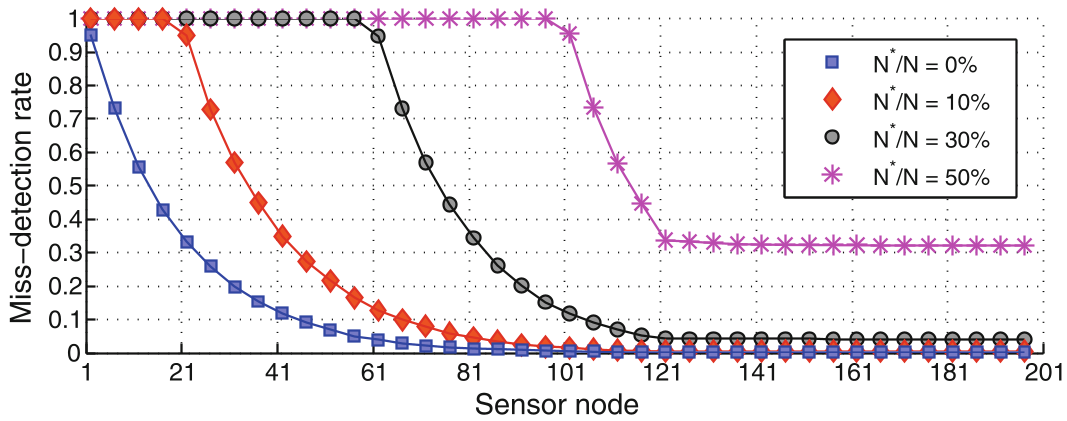 Fig 1: Average Miss-Detection rate remains low even as the number of compromised nodes increases.
Key Findings:
- The 30% Threshold: The network displays a "Byzantine-like" resilience threshold. Performance holds steady until approximately 1/3 of the nodes are compromised.
- Quality over Quantity: Sensors with a lower error rate () provide better resilience than sensors with a wider coverage range (). High coverage actually makes nodes "trust" each other too much, making them more susceptible to misleading cascades.
- Inference Speed: The network typically reaches an asymptotic global estimate by the 150th node.
Critical Insight & Conclusion
This work demonstrates that Topology-Aware Attacks—the nightmare of centralized networks—can be mitigated by embracing serial, distributed processing.
Takeaway for Practitioners: When designing secure IoT or sensor grids in hostile environments, avoid Centralized Processing. By implementing social learning rules, you ensure that even if an attacker takes out your most "critical" nodes, the collective intelligence of the remaining sensors can still reconstruct the truth.
Limitations: The current model assumes a static, fully-connected sequence. Real-world wireless conditions (packet loss, interference) and mobile topologies might disrupt the "chain" of social learning, which remains an open area for future research.