
Social Learning: How Log-Belief Consensus Decodes Global Truth
4734_Social Learning and Distributed Hypothesis Testing.
This paper presents a novel distributed hypothesis testing framework where nodes in a strongly connected network collaborate to identify a globally true hypothesis through a "non-Bayesian" learning rule. The method combines local Bayesian updates with a linear consensus strategy performed on log-beliefs, achieving an exponential convergence rate toward the true hypothesis.
TL;DR
In a world of distributed sensors and social agents, "truth" is often a jigsaw puzzle where no single agent holds all the pieces. This paper introduces a robust learning rule where agents perform local Bayesian updates and then average the logarithms of their neighbors' beliefs. This simple shift—moving the consensus into the log-domain—enables nodes to reject false hypotheses exponentially fast, even when they can't distinguish the truth on their own.
Contextual Positioning
Within the landscape of distributed signal processing, this work sits at the intersection of Social Learning and Distributed Hypothesis Testing. It moves beyond the need for a "Fusion Center," establishing a purely decentralized protocol where global identifiability emerges from local interactions.
The Problem: Local Blindness and Privacy
Imagine a network of sensors trying to locate a target. Sensor A might only see the X-coordinate, while Sensor B only sees the Y-coordinate. Individually, both are "blind" to the exact location.
- Prior Work Failure: Traditional methods either required sharing raw data (violating privacy) or used linear averaging of beliefs (), which often results in slower convergence and is mathematically less "elegant" when dealing with exponential likelihoods.
- The Challenge: How do we combine these "locally indistinguishable" pieces of information without a central brain and without sacrificing privacy?
Methodology: The Power of the Log-Domain
The authors propose a four-step iterative process:
- Local Observation: Nodes sample their environment.
- Bayesian Update: Each node updates its local belief using Bayes' rule.
- Communication: Nodes share their updated beliefs (as vectors) with neighbors.
- Log-Linear Consensus: Instead of a simple average, nodes update their internal state by calculating:
Why Log-Averaging?
The physical intuition here is profound. By averaging in the log-domain, the network effectively performs a distributed multiplication of likelihoods. In the limit, the rate of learning becomes a weighted sum of Kullback-Leibler (KL) Divergences, where the weights correspond to the "Eigenvector Centrality" (social influence) of each node.
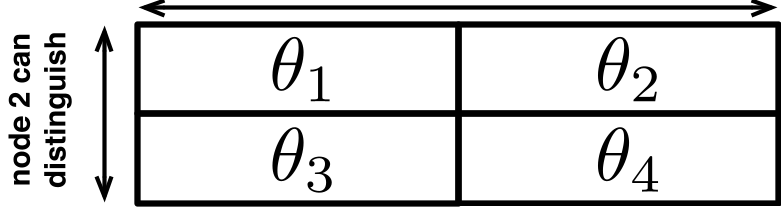 Fig 1: A conceptual example where local nodes can only distinguish a subset of the hypothesis space (rows vs. columns), requiring collaboration for full identification.
Experimental Insights & Results
The authors demonstrate the effectiveness of this rule through several key metrics:
- Exponential Rejection: The belief of a wrong hypothesis decays at the rate , which the authors coin as the Network Divergence.
- Superiority over Linear Averaging: Simulations clearly show that log-belief consensus rejects wrong hypotheses faster than standard belief averaging.
- Robustness to Topology: As long as the network is strongly connected, the "informed" nodes (those who can distinguish the truth) eventually propagate their certainty to the "uninformed" nodes.
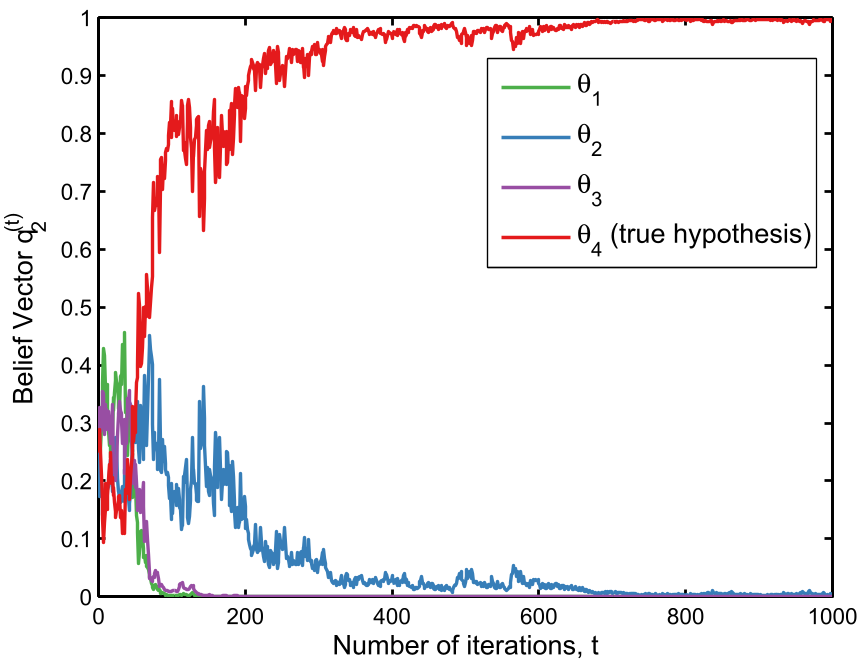 Fig 2: Evolution of beliefs over time. The true hypothesis converges to 1, while others vanish exponentially.
The "Influence" Factor
A fascinating finding is the role of Eigenvector Centrality. The convergence rate isn't just about who has the best data, but where they sit in the graph. If a highly "informed" node is placed in a central position (high eigenvector centrality), the entire network learns significantly faster compared to placing that node at a peripheral corner.
Large Deviation Principle (LDP)
The paper doesn't just stop at "almost sure" convergence. It provides a rigorous LDP analysis, determining the probability that the learning rate fluctuates or deviates from its mean. This is critical for engineering high-reliability systems where "tail risks" (slow learning paths) must be quantified. This analysis holds even for distributions with unbounded support, like Gaussian mixtures, which were often ignored in previous bounded-likelihood studies.
Critical Analysis & Conclusion
Takeaway
The shift to a log-logarithmic consensus is a "SOTA" move for distributed detection. It aligns the social learning process with the underlying information-theoretic geometry of the problem (KL Divergence).
Limitations & Future Work
- Communication Overhead: Transmitting full belief vectors () can be heavy for large hypothesis spaces. Although the authors show that 12-bit quantization is often sufficient, extremely large remains a challenge.
- Static vs. Dynamic: The current proofs focus on static graphs. Real-world social networks are fluid; adapting these LDP bounds to time-varying topologies is the next logical frontier.
In conclusion, this work provides a rigorous mathematical foundation for trust and belief propagation in networks, proving that collective intelligence is not just possible, but exponentially efficient under the right social rules.