
Toward Social Learning Environments: Designing for the Digital Native Generation
Toward Social Learning Environments
This vision paper explores the transition toward "Social Learning Environments" tailored for "Digital Natives." It proposes a framework built on Web 2.0 principles, integrating decentralized user modeling, social visualization, and incentive mechanism design to support contextual, peer-mediated learning.
TL;DR
As learning shifts from formal classrooms to the "Participative Web," e-learning systems must evolve into Social Learning Environments. This paper argues that instead of "teaching," technology should focus on helping users find contextual content, connecting them with the right peers, and using economic "Mechanism Design" to provide social rewards and motivation.
The "Digital Native" Paradox: High Skill, Low Attention
The 21st century has birthed a generation of "Digital Natives"—learners who are intuitively tech-competent but struggle with long-term goals and deep, principle-based study. These students learn "on the go," seeking solutions to immediate problems rather than memorizing abstract theories.
The author highlights a critical shift: The Long Tail of Knowledge. In modern interdisciplinary fields, specialized knowledge grows so fast that traditional universities cannot keep up. The solution lies in Web 2.0—leveraging the "wisdom of crowds" (like Wikipedia) to create a self-correcting, participatory learning ecosystem.
Methodology: The Three Pillars of Social Learning
To build environments that actually work for these learners, the paper identifies three technical pillars:
1. From Ontologies to Folksonomies
While classic AI researchers favored rigid Ontologies (predefined category maps), this paper argues they are too cumbersome for real users. Instead, it promotes Folksonomies—user-generated tags.
- The Insight: Machines struggle with tags, but humans thrive on them. The paper suggests a "Snap to Grid" approach where machine learning extracts tags and aligns them with background ontologies, keeping the UI simple but the data structured.
2. Trust and Reputation Mechanisms
Finding the "right people" is harder than finding the "right content." The paper proposes using Decentralized User Modeling. By calculating "Trust" based on past interactions and "Reputation" based on group consensus (gossiping), systems can match learners with experts or peers without a central authority.
3. Mechanism Design & Social Visualization
This is the core "How-To" for motivation. Inspired by Game Theory, Mechanism Design creates rules where self-interested users act in the community's best interest.
- Incentive Loops: Users are rewarded with "Status" (Gold/Silver/Bronze) or "Virtual Currency" (CPoints) for contributing.
- Feedback: Social visualizations (like the night sky/star charts) trigger Social Comparison, motivating users to improve their standing compared to peers.
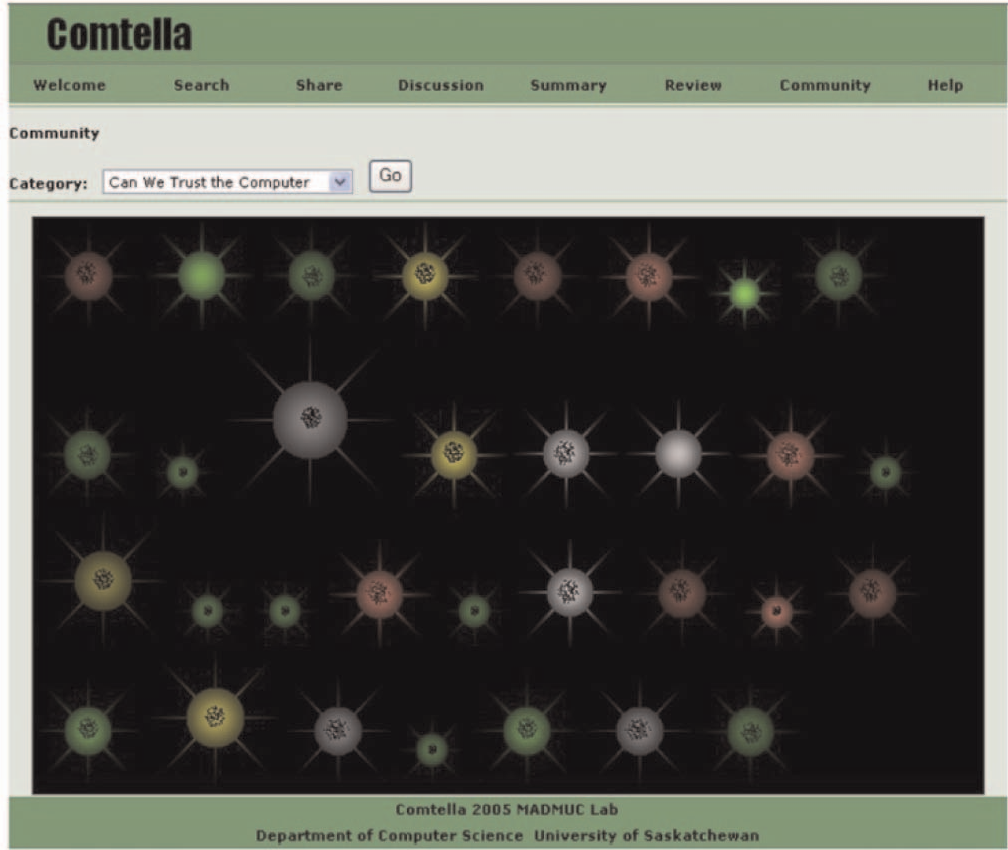 Figure: The Comtella community visualization showing students as stars, where brightness and color represent reputation and status.
Experiments: The Comtella Case Study
The author tested these theories through the Comtella system.
- Incentivizing Quality: Initially, students "gamed the system" by posting low-quality spam to get points. The fix? Introducing adaptive rewards. Points were worth more if you posted early in the week or if your posts received high ratings from others.
- Reciprocity: A unique visualization (see below) mapped the symmetry of relationships. If a student realized they were a "pop-star" (many people reading their posts but they weren't reading back), they were socially nudged to start reciprocating.
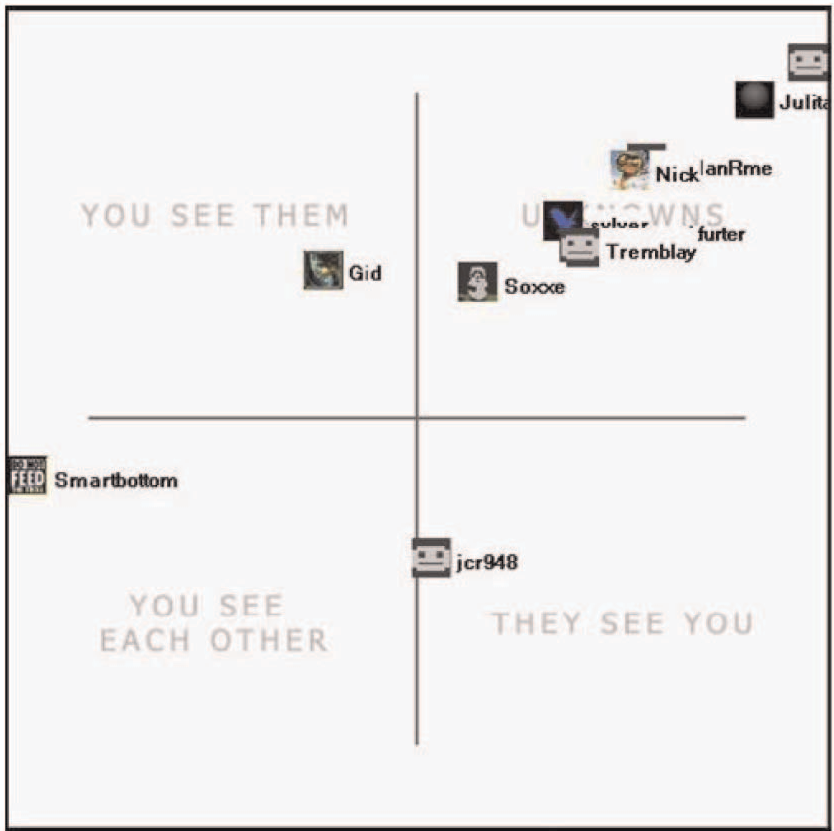 Figure: Mapping "Secret Admirers" vs. "Pop Stars" to encourage fair, reciprocal reading and interaction.
Critical Insight & Future Outlook
The paper’s most profound takeaway is that credentials still matter. While the Internet is a chaotic "Digital Disorder" (as David Weinberger puts it), the role of the University is shifting toward becoming an Accreditation Authority.
Future Directions:
- Educational Data Mining: Using usage patterns to suggest "pedagogically sound" paths without requiring manual tagging.
- Coursework as Mechanism Design: Grading schemes should be viewed as incentive structures that guide collective behavior rather than just static assessments.
Conclusion
Social Learning Environments are not just about adding a "chat" button to a website. They require a deep integration of social psychology and economic game theory to turn the chaos of the Participative Web into a structured, motivating, and contextual classroom for a generation that demands instant value.