
Social Learning Networks: Mapping the DNA of Digital Education
Social learning networks: A brief survey
This survey explores Social Learning Networks (SLNs), a graph-theoretic framework for modeling interactions among learners, instructors, and educational content. It synthesizes methodologies for prediction, recommendation, and personalization within Massive Open Online Courses (MOOCs) and Flipped Classrooms (FLIP), highlighting a shift toward data-driven, individualized education.
TL;DR
Online education is facing a paradox: as scale increases, completion rates plummet. This paper argues that the solution lies in Social Learning Networks (SLN). By modeling students and concepts as nodes in a dynamic graph, we can move away from stagnant "One-Size-Fits-All" (OSFA) teaching toward an individualized architecture that predicts performance, recommends study partners, and adapts content in real-time.
The Motivation: Why Online Learning is "Broken"
The rise of MOOC platforms like Coursera and Udacity promised a revolution in higher education. However, the reality has been stark:
- Massive Scale, Minimal Success: Enrollment is high, but completion rates rarely exceed 10%.
- Information Overload: Discussion forums become chaotic, making it impossible for students to find relevant help.
- Lack of Personalization: A student struggling with basic algebra is often presented with the same lecture as a math major, leading to frustration and dropout.
The authors propose that by viewing education as a Social Learning Network, we can use network science to bridge these gaps.
Methodology: The SLN Graph Framework
The core insight of the paper is the formalization of learning as a series of graph-theoretic relationships. They define four primary graph types:
- Undirected Learner-to-Learner: Capturing similarities (age, location, background).
- Directed Learner-to-Learner: Mapping information flow (e.g., student A answers student B's question).
- Undirected Bipartite (Learner-Concept): Connecting students to specific syllabus topics based on their forum activity or quiz performance.
- Directed Learner-Concept: Detailing the sequence of interactions, weighted by up-votes or engagement metrics.
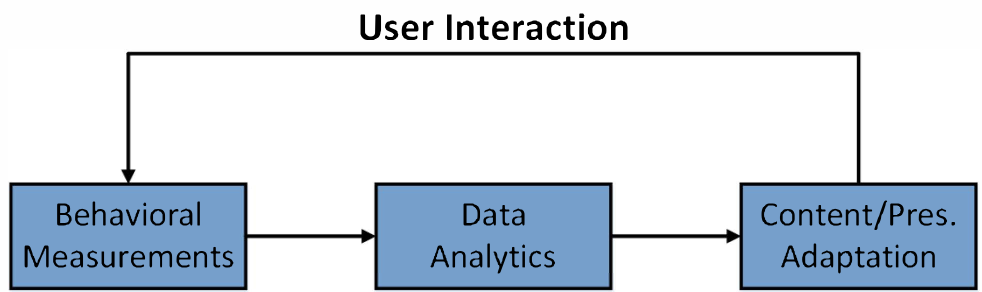 Figure: The feedback loop of individualization, involving behavioral measurement, data analytics, and content adaptation.
Predictive Power: From Big Data to Smart Data
The authors emphasize that pure volume of data isn't enough; we need structured understanding.
- Performance Prediction: By applying factor analysis to sparse quiz data, they achieved roughly 75-80% accuracy in predicting student grades. They suggest that incorporating SLN graph data (who you talk to and what they know) can further refine these scores.
- Drop-off Prediction: SLN data acts as an early warning system. A decline in forum activity or a change in the "small-talk" vs. "informational" ratio of a student's posts can signal an impending dropout before they fail an exam.
Experiments: MIIC vs. OSFA
The paper details trials using the MIIC (Mobile Integrated and Individualized Course) app.
Trial 1: Subjective Preference
Students were split between an individualized version (MIIC) and a standard version (OSFA). The MIIC version directed students down different "parallel universes" of content based on their prerequisite knowledge (e.g., explaining Google's PageRank with or without Linear Algebra).
- Result: Students overwhelmingly preferred the individualized version (p < 0.001) and reported better understanding.
Trial 2: Objective Engagement
As a proxy for engagement, researchers measured the "total page count" visited by users.
- Result: The distribution for MIIC was significantly skewed to the right, with a Wilcoxon rank-sum test showing a highly significant p-value of 0.009.
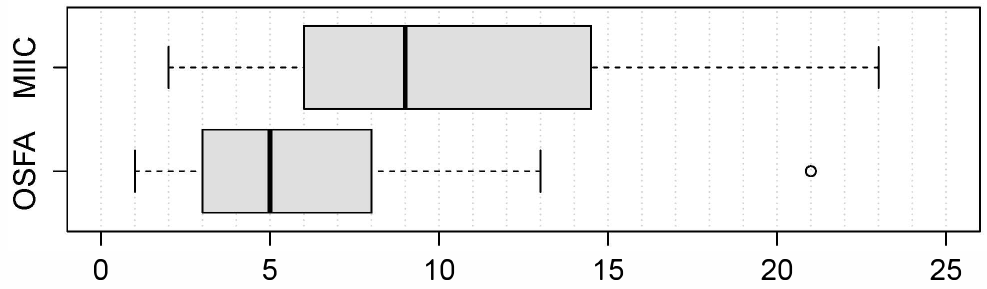 Figure: Comparison of engagement levels. Individualized learning users (MIIC) interacted with significantly more content than the control group.
Critical Analysis & Future Outlook
The paper provides a robust framework for the "next generation" of online education. However, a major challenge remains: Scalability of Implementation. While the model scales, the content must be authored in a "parallel universe" format, which is labor-intensive for instructors.
Conclusion: The shift from viewing education as a content-delivery service to a complex social network is essential. By leveraging graph theory and machine learning, SLNs offer a viable path to making massive-scale education as effective as a 1-on-1 tutoring session.
Takeaway: Future educational platforms must go beyond video Hosting; they must become intelligent "routing engines" for knowledge.