
The Power of Stubborn Experts: Can Social Networks Learn from Sparse Information?
Social Learning with Sparse Belief Samples
This paper introduces a non-Bayesian social learning model where agents share sparse samples (actions) from their belief distributions rather than full probability distributions. It proves that while this "coarse" communication can lead to mis-learning, the presence of "confident experts" and specific network dynamics can still guarantee almost sure convergence to the true state.
Executive Summary
TL;DR: This paper investigates whether a group can learn the truth when individuals only share a single "guess" (a belief sample) rather than their full reasoning. While sparse communication risks leading the whole group into collective error, the authors demonstrate that the existence of "Confident Experts"—individuals who trust their distinct private info more than the crowd—guarantees that the truth will eventually prevail.
Academic Positioning: This work bridges cognitive science and social network theory. It moves away from the mathematically convenient but practically impossible "full belief sharing" model toward a "sparse sampling" model, identifying the critical phase transition between collective wisdom and collective delusion.
Motivation: The Cognitive Cost of Truth
In classical social learning models, every agent is assumed to be a super-computer, capable of transmitting and receiving entire probability distributions. If there are 10 possible states of the world, you’d have to send 10 numbers every second to every friend you have.
Real life isn't like that. We share actions or samples: "I think it's going to rain," or "I'm buying this stock." The authors argue that this coarseness creates two major hurdles:
- Loss of Information: A single sample is a noisy representation of a complex belief.
- Redundancy Neglect: Agents often treat neighbors' opinions as independent new info, even when they are just echoing what they heard elsewhere.
Methodology: Bayesian Logic meets DeGroot Dynamics
The authors propose a hybrid update rule. In each step :
- Private Update: An agent observes a private signal and uses Bayes' Rule to update their internal belief.
- Social Pooling: The agent takes a weighted average of their own posterior and the "actions" (binary indicators) of their neighbors.
- Action Takers: Finally, the agent draws a random sample from their new belief to show his neighbors.

The core innovation is the definition of a Confident Expert. To learn state , an agent must be:
- Distinguishable: Their private signals for must be statistically distinct from all other states (outside the "convex hull" of other likelihood functions).
- Stubborn: Their weight on their own private signal () must exceed a threshold determined by the KL Divergence between the true state and the closest false alternative.
Experiments: The Value of Influence
The authors tested their math on a 5-agent network. They discovered a fascinating "centrality" effect.
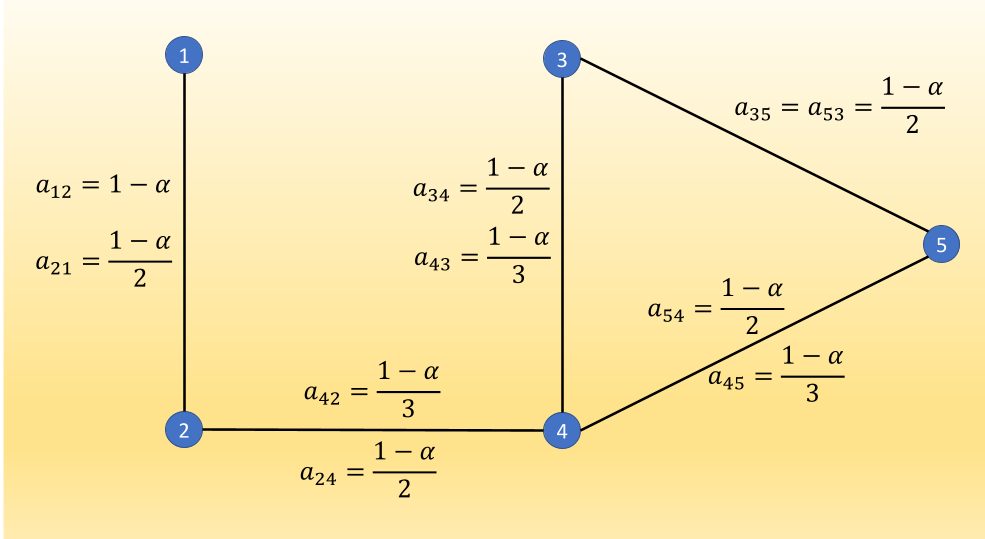
In Case A, when an uninformed agent was the most "central" (influential), the group's chance of learning the truth was low. However, in Case B, simply moving the source of quality information to the most influential agent (the "Confident Expert") increased the learning probability from 54% to 74%—even when communication was still noisy and sparse.
When the expert's self-trust () was raised to 0.8 (surpassing the 0.71 threshold), the group reached a 100% learning rate.
Critical Insight: Why "Stubbornness" is a Virtue
We often think of stubbornness as a social ill. However, this paper provides a rigorous mathematical proof that stubbornness is a prerequisite for collective learning in sparse environments. If experts are too "polite" (i.e., they value their neighbors' noisy samples as much as their own high-quality data), the group's belief can drift into a sub-optimal consensus from which it can never recover.
Future Outlook: This model offers a lens into why modern social media—filtered through limited "Likes" and "Retweets" (sparse samples)—can lead to massive mis-learning or polarization. If no "Confident Experts" are present to anchor the network, the "DeGroot-like" consensus mechanism will simply normalize whichever error happens to gain early traction.