
Bridging the Physical-Digital Gap: Efficient Social Link Journaling via Sensor Fusion
Social Link Analysis Using Wireless Beaconing and Accelerometer
This paper introduces a smartphone-based sensing system for identifying "Social Links" (real-world human interactions) using Bluetooth beaconing, accelerometers, and microphones. The system optimizes energy efficiency through activity-triggered sensing and improves data robustness by using sensor-fusion similarity metrics to predict missing proximity data.
TL;DR
Researchers from the University of Tokyo have developed a smartphone-based system that journals real-world social interactions by intelligently combining Bluetooth beaconing with motion and sound sensors. This approach solves two critical bottlenecks for "always-on" social sensing: it extends battery life by 21% and increases link discovery robustness by 4% through a novel similarity-based prediction mechanism.
The Problem: The High Cost of "Seeing" Friends
While our online social networks (SNS) are precisely mapped, our physical "Social Links"—the people we actually meet and talk to daily—remain largely unrecorded. Smartphones are the perfect tool for this journaling task, but two technical hurdles stand in the way:
- Battery Drain: Continuous Bluetooth scanning is energy-expensive (10 mW), which is unsustainable for a device that needs to last all day.
- Wireless Chaos (Collisions): In crowded environments, Bluetooth packets often collide. The authors discovered that in a room with 15 active devices, the discovery rate can drop to less than 50%, leading to massive gaps in social data.
Methodology: Intelligent Triggering & Sensor Fusion
The researchers' core insight is that social interaction is often correlated with specific physical states: staying in one place and talking.
1. Activity-Triggered Sensing
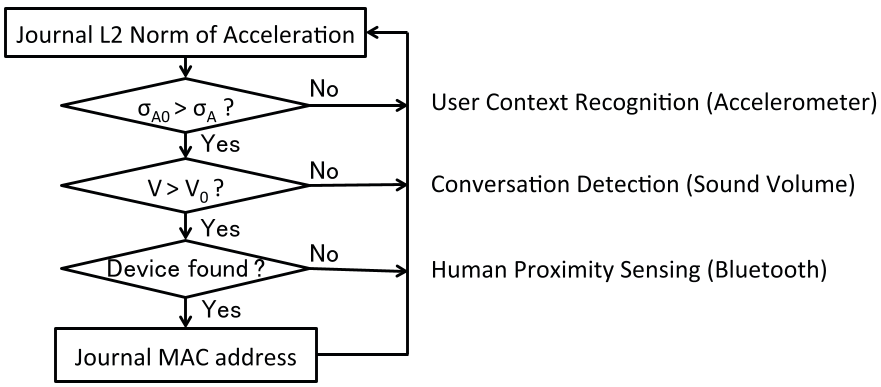
Instead of scanning the environment 24/7, the system uses the accelerometer and microphone as low-power "guards."
- Accelerometer: Detects a "staying" state (variance of L2 norm < 0.2).
- Microphone: Detects a "talking" state (volume > 58.3 dB).
- Action: Only when these conditions are met does the high-power Bluetooth module activate its inquiry mode to identify nearby MAC addresses.
2. Filling the Gaps with Similarity
To counter the "hidden node" problem and packet collisions, the paper introduces a Strength of Social Link formula. If Participant A fails to "see" Participant B directly, the system checks for:
- Bluetooth Similarity: Do A and B see the same other devices? (Using Jaccard Similarity of MAC address sets).
- Motion Similarity: Are A and B moving in the same pattern? (Using Pearson correlation of acceleration L2 norms).
Experimental Results
The authors validated their system through both indoor (static group) and outdoor (moving scenario) experiments.
Performance vs. Efficiency
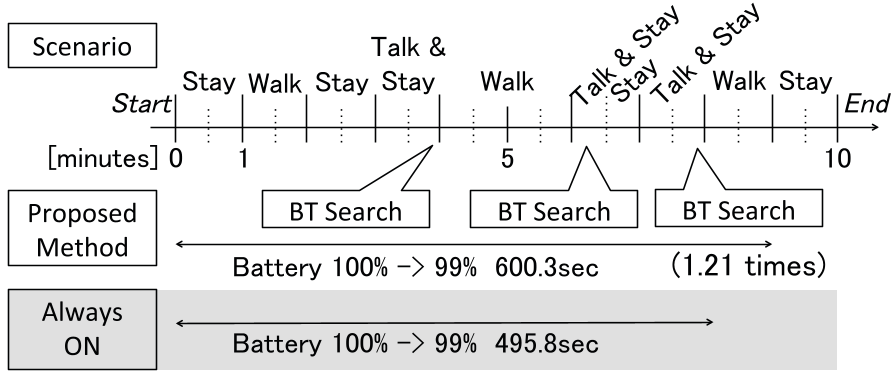
The "Triggered" method proved significantly more efficient, maintaining discoverability while prolonging the 1% battery drop window from 495 seconds to over 600 seconds.
Robustness Gains
The prediction mechanism proved its worth by identifying links that hardware alone missed. In the indoor experiment, 13.3% of "one-way" links (where one person's phone saw the other, but not vice-versa) were correctly identified as mutual links through similarity analysis.
Critical Insight: Why Acceleration Correlation Matters
In the outdoor experiment, researchers noted that acceleration similarity (staying around 0.6) was a crucial secondary marker for users walking together. This is a powerful inductive bias: people who are socially linked often synchronize their physical movements or environments, and capturing this "physical resonance" allows the system to remain robust even when wireless signals fail.
Conclusion and Future Work
The Tokyo team successfully demonstrated that a multi-modal approach—ranking sensors by their energy-to-information ratio—makes real-world social journaling practical. However, the system still faces challenges with static window sizes (currently fixed at 10 minutes) and the need for more granular threshold optimization to handle different user environments.
As we move toward more integrated Cyber-Physical Systems (CPS), these strategies for energy-aware, robust sensing will be foundational for the next generation of context-aware social applications.
Takeaways for the Industry:
- Context over Continuity: Don't sample high-power sensors continuously; use low-power motion sensors to determine "intent to sense."
- Surrogate Proximity: Use mutual environmental data (what else we both see) to infer direct proximity when hardware collisions occur.