
Social Engineering: The Hidden Fraud in Online Recommenders
Social Manipulation of Online Recommender Systems
This paper investigates "Social Manipulation" in online recommender systems, specifically within the Buzznet social network. It reveals how real users (not just bots) use social engineering to solicit votes, achieves a quantitative link between these requests and contest success, and proposes a detection framework using behavioral anomalies.
TL;DR
While the industry focuses on killing bots, this paper exposes how real humans are "gaming" the system. By studying Buzznet, researchers found that the top winners of popularity contests are often those who send thousands of "Buzz for Buzz" requests. More importantly, they prove that this manual manipulation—previously thought "undetectable"—leaves distinct statistical trails that can be caught with high precision.
The "Human Bot" Problem
Most cybersecurity research treats recommender system attacks as a "Bot vs. Algorithm" battle. We build firewalls against automated shill accounts. But what happens when the attacker is a real person asking another real person for a favor?
The authors argue that Social Manipulation is just as dangerous as bot attacks. It bypasses IP filters and CAPTCHAs because the interactions are genuine. On Buzznet, users entered contests where the "Most Buzzed" photo wins. This created a massive incentive to engage in social engineering.
Methodology: Detecting the Invisible
How do you tell the difference between a naturally popular photo and one that was boosted through "begging"? The authors used several ingenious "Academic Proxies":
- Social Distance: They found that organic interactions usually happen between friends (Distance = 1). Manipulators, however, reach out to strangers (Distance = 2 or more) to scale their influence.
- Comment Entropy: Humans are lazy. "Buzz me back" requests and the resulting responses have lower linguistic complexity (entropy) than actual organic conversation.
- Temporal Distribution: Organic popularity spikes early and decays. Manipulated items show artificial peaks much later as requestees slowly respond to messages.
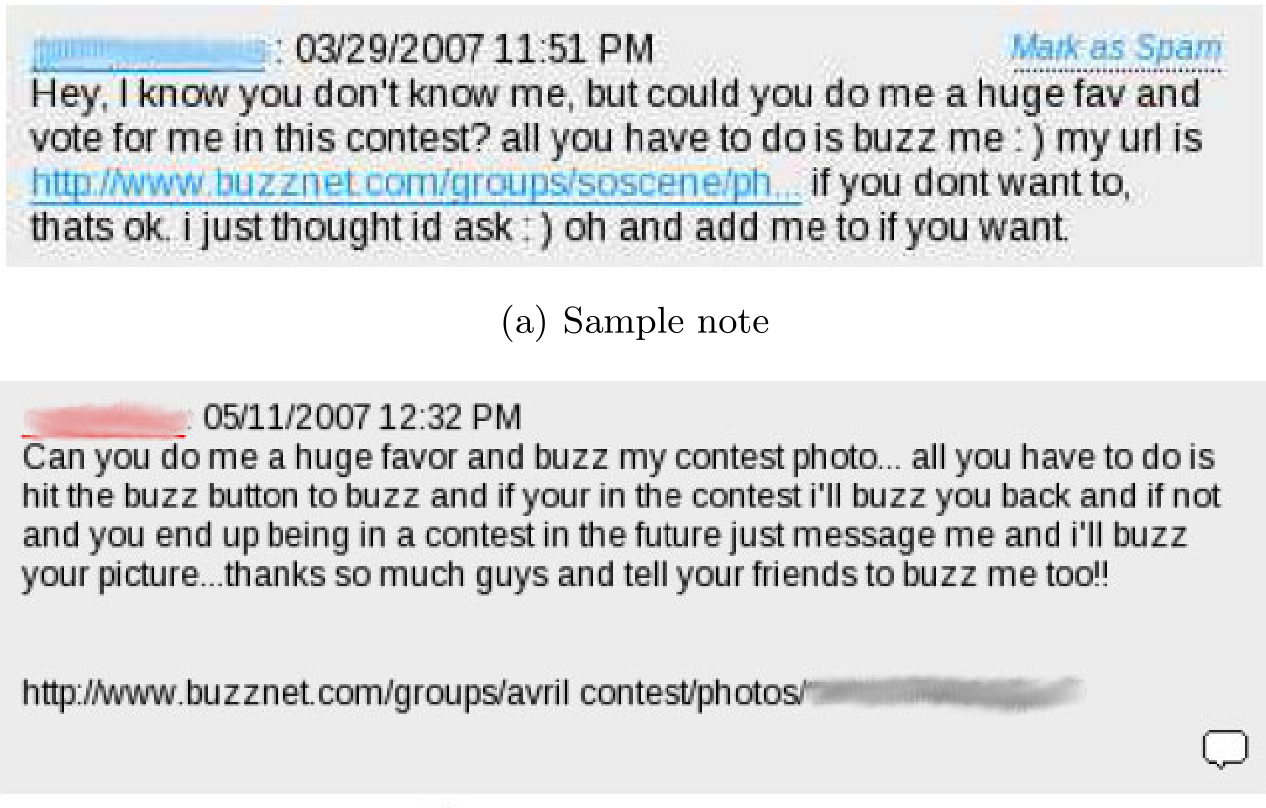 Figure 1: Examples of manual requests for "Buzz" in social networks.
Why It Works: The 0.995 Correlation
The data is startling. For normal users, the correlation between comments and votes is high (0.85). For "Buzz Me Spammers," it is a nearly perfect 0.995. This suggests that every single comment left on a manipulator's photo was effectively a "receipt" for a vote.
In "Contest 1" (I'm So Scene), the top 10 users—except for one—were verified spammers who sent between 376 and 3,750 manual requests. Without intervention, these systems are not "recommending" the best content; they are recommending the most aggressive social engineers.
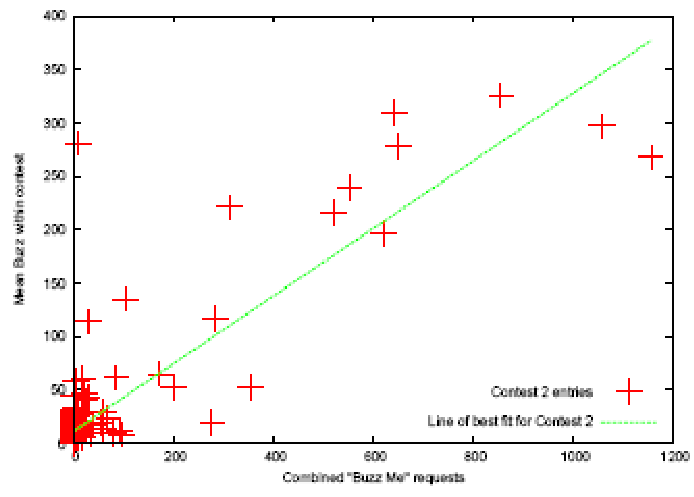 Figure 2: The clear linear relationship between sending requests and climbing the leaderboard.
Breaking the Cycle: The Detection Engine
The researchers built a classifier using a C4.5 Decision Tree. They discovered that Variance is the "smoking gun."
- Popular Users: Have high mean votes with moderate variance across all their posts.
- Manipulators: Have high mean votes on contest entries but extreme variance (sending requests for one specific photo) or zero variance (if they only posted one photo).
By combining these features with the Kolmogorov-Smirnov (K-S) test on comment dates, the authors could filter out most spammers with almost zero false positives. This is critical: in a social context, "falsely accusing" a popular user of cheating is worse for the platform's reputation than letting one cheater slip through.
Critical Insight & Future Outlook
This work serves as a wake-up call for platform designers. We often assume that if an account is "Verified" or "Real," its engagement is "Fair." This paper proves that fairness is a behavioral property, not an identity property.
Limitations: The study relies heavily on comments as a proxy because vote-level logs were private. In a modern setting (like TikTok or Reddit), researchers would ideally have access to millisecond-level timestamp logs of every "Upvote" to find even more subtle coordination patterns.
Takeaway: If you are building a contest or a global "Top Ten" list, don't just look at the raw numbers. Look at the Social Distance of the voters and the Variance of the user’s history. The data doesn't lie, even when the users do.