
Decoding Wikipedia’s Elite: Social Trust and the Road to Adminship
Social Mechanism of Granting Trust Basing on Polish Wikipedia Requests for Adminship
This paper investigates the social mechanisms of granting administrative trust within the Polish Wikipedia community. The authors introduce a method to correlate explicit Request for Adminship (RfA) voting results with an implicit social network mined directly from edit histories using the "WikiTeams" framework. Highlighting a trend towards professionalization and potential "cliquishness," the study demonstrates that trust and acquaintance metrics from edit interactions are strong predictors of successful adminship candidacy.
TL;DR
Is Wikipedia a true meritocracy or a closed society of elites? By analyzing 220GB of Polish Wikipedia edit data, researchers found that becoming an administrator (sysop) is getting significantly harder. The study maps an "Implicit Social Network" to show that your collaborative behavior—who you edit near and whose work you revert—predicts your chances of gaining power more accurately than your total edit count.
Background: The Administrator’s Dilemma
In the ecosystem of Wikipedia, administrators are the guardians against vandalism and the arbiters of "edit wars." However, as Wikipedia grows, two risks emerge:
- Burnout: A shortage of admins leads to slower response times.
- Cliquishness: The perception that admins form a "closed group of friends," creating a high barrier for new, qualified editors.
The authors set out to determine if social relationships, rather than just technical excellence, dictate who gets the "mop" (admin powers).
The "WikiTeams" Methodology: Mining Implicit Trust
The core of this research is the transition from explicit data (votes) to implicit behavior (edits). The authors developed a framework to analyze the Polish Wikipedia’s entire history, focusing on three dimensions of social interaction:
- Trust: Defined by proximity. If Editor B adds text next to Editor A’s work, it implies a silent review and acceptance of A’s contribution.
- Criticism (Distrust): Defined by reverts. If Editor B wipes out Editor A's work, it's a clear signal of conflict.
- Acquaintance: Measured through "Talk" pages—the digital watercooler of Wikipedia.
Architectural Insight: From Edits to Relationships
The research moves beyond counting edits. By using plagiarism-detection-style algorithms at the word level, the authors could track the "life" of a sentence and who influenced it.
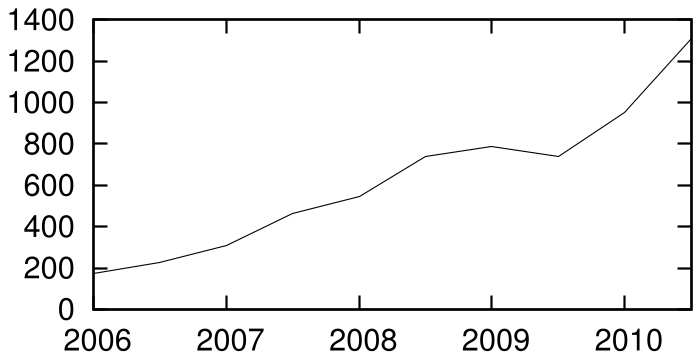 Above: Figure 4 & 5 demonstrate the skyrocketing requirements for successful candidates. Mean edits rose from ~2,000 to over 14,000 between 2006 and 2010.
Key Findings: The Professionalization of Power
The data confirms a massive shift in community standards. In 2006, an editor could become an admin in 182 days. By 2010, that requirement jumped to 1,310 days—nearly four years of active contribution.
1. The Predictability of Trust
The study found a statistically significant correlation between implicit network links and voting outcomes.
- "For" Votes: Average "Trust" weight was 442.24.
- "Against" Votes: Average "Trust" weight was 287.71.
- The Criticism Threshold: Once an editor’s "Criticism" score (reverts) hits a certain level, the probability of an "against" vote becomes nearly certain.
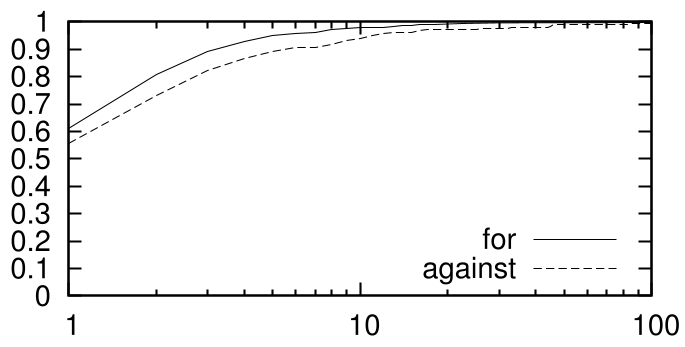 Above: Cumulative frequency distributions showing how higher Criticism values (reverts) correlate strongly with rejection during the voting process.
Critical Analysis: Is Openness Fading?
The most striking takeaway is the "forming of elites." The fact that no administrators appointed by late 2011 had created accounts in 2009 or 2010 suggests a "seniority bottleneck." While this ensures stability and adherence to rules, it threatens the "anyone can edit" ethos of the platform.
Limitations:
- Data Lag: The study relies on 2010 data; modern Wikipedia dynamics (influenced by AI and automated bots) may have shifted further.
- Cultural Specificity: The results are specific to the Polish Wikipedia community, which may have different social norms than the English or German versions.
Future Outlook
The authors suggest that these implicit social metrics can be used to build recommendation engines for admin candidates. Instead of waiting for someone to join the "clique," the system could automatically flag high-trust, collaborative editors as potential leaders, revitalizing the administrative workforce.
Takeaway for the Industry: For any community-driven platform (from Reddit to DAOs), total activity is a vanity metric. True health lies in the implicit network of collaborative trust built between members.