
One Smart Touch: Overcoming the Fragmentation of the Social Media Era
An application to manage widespread social media accounts with one smart touch
This paper introduces a centralized mobile application framework designed to manage multiple social media accounts through a single smart dashboard. By integrating features like Multi-application Posting and Instant Discovery, the system aims to streamline real-time big data collection for smart city operations while significantly reducing user overhead.
TL;DR
Social media management has become a cognitive and technical burden. This paper proposes a unified dashboard that consolidates multiple platforms into a single interface. By leveraging cloud storage and smart filtering, the framework reduces mobile switching delays by over 75% and provides a streamlined data source for smart city infrastructure.
Background: The Cost of Connectivity
In the context of Smart Cities, social media is more than just entertainment; it is a vital organ for real-time feedback and "smart citizen sourcing." However, the current landscape is fragmented. A single user might maintain accounts on Twitter, Facebook, Instagram, and LinkedIn—each requiring separate updates, separate logins, and competing for limited mobile resources (RAM, Storage, and Battery).
The "Switching" Problem & Research Intuition
The researchers identified that "Data Redundancy" and "Switching Latency" are the two primary technical bottlenecks. When a user posts the same image across three apps, they are manually duplicating effort and storage. The authors' insight is simple but powerful: Treat social media as a unified data stream at the dashboard level while maintaining platform-specific identities on the backend (Cloud).
Methodology: The Four Pillars of Unified Management
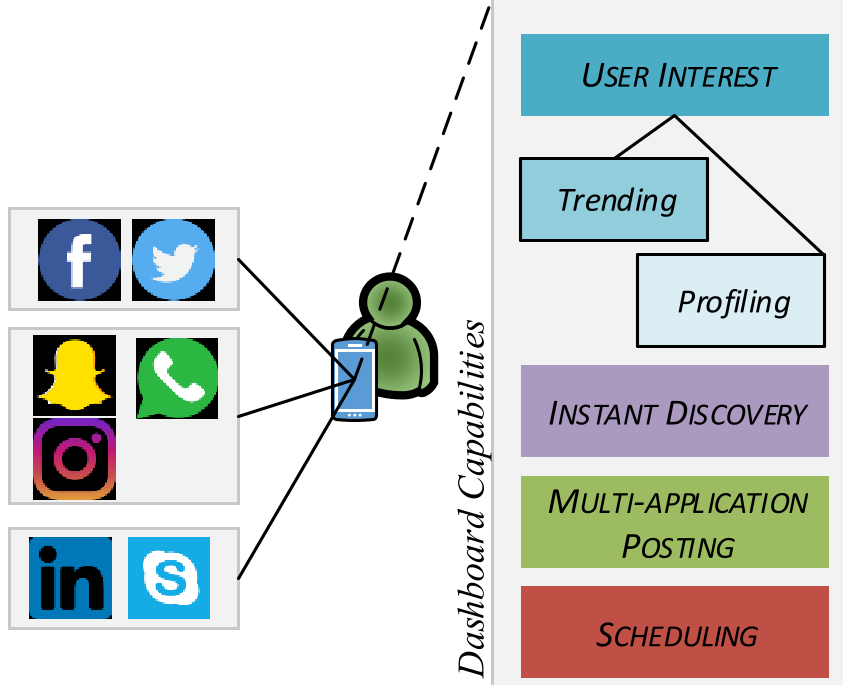
The proposed framework is built around four unique capabilities designed to minimize user friction:
- User Interest Filtering: A module that uses event-based (trending) and content-based (semantic profiling) analysis to ensure users see high-priority content across all networks first.
- Instant Discovery: Solves the "Follow Me" problem. Adding a friend on one platform (e.g., Snapchat) can trigger an automated or suggested add across all other linked accounts with a single touch.
- Multi-application Posting: An "inject once, distribute many" mechanism.
- Cloud-Centric Storage: Moving the social data cache from the local device to a cloud datacenter to improve mobile performance.
Experimental Results & Statistical Validation
The authors didn't just build a prototype; they validated the necessity of the tool using a multivariate statistical approach. By simulating 100 mobile nodes and surveying 120 users, they found:
- The Latency Driver: Stepwise regression identified that the "Frequency of Visits" and "Number of Apps" are the primary predictors of user delay ().
- Performance Gain: By centralizing these into one app, the model predicts a 75% reduction in latency and a significant decrease in storage overhead.
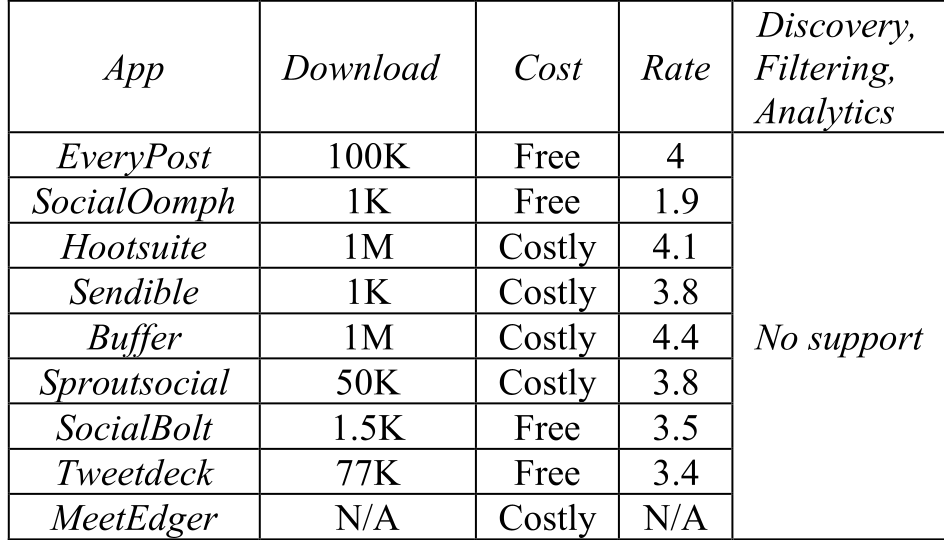
| App Name | Discovery Support | Cost | Analytics |
|---|---|---|---|
| Hootsuite | No | Costly | Limited |
| Proposed App | Yes (One-Touch) | Optimized | Integrated |
Deep Insight: Beyond the App
The real value of this work lies in its contribution to Smart City Development. When social data is aggregated through a single dashboard, it becomes much easier for municipal systems to capture real-time feedback for crowdsourcing and collaborative governance.
Limitations & Future Work
While the paper demonstrates clear gains in efficiency, the "Instant Discovery" feature raises interesting questions regarding API Rate Limiting and Privacy. Future iterations would need to focus on how to maintain this "one-touch" simplicity without violating the terms of service of increasingly closed social media ecosystems (e.g., Meta or X’s API restrictions).
Conclusion
As we move toward 2026, the consolidation of digital identities is no longer a luxury—it is a technical necessity. This paper provides a robust statistical and architectural blueprint for how we might manage our digital lives more efficiently.