
SMAF: Quantifying the "Fuzziness" of Human Emotion in Product Design via Social Media
A Social Media Analytical Framework Incorporating Fuzzy Regression for Affective Design
This paper introduces SMAF (Social Media Analytical Framework), a novel approach for affective design that integrates social media data mining with Urso’s fuzzy regression. The framework is designed to capture and quantify both the magnitude and the inherent uncertainty of consumers' emotional responses toward product attributes, achieving high-fidelity modeling of subjective perceptions in the automobile industry.
TL;DR
Designers are no longer just selling functions; they are selling emotions. This paper presents SMAF (Social Media Analytical Framework), a system that scrapes Twitter data and uses advanced Fuzzy Regression to map out not just what people like, but how certain or ambiguous those feelings are. By applying this to the car industry, the study reveals that while we might all agree on "White" cars, colors like "Red" or "Black" trigger much more polarized and uncertain emotional responses.
Problem & Motivation: The Subjectivity Gap
In the world of Affective Design (or Kansei Engineering), the goal is to translate human feelings into product specs. Traditionally, this was done via focus groups—expensive, small-scale, and often biased.
The shift to Social Big Data (Twitter, Instagram) solved the scale problem but introduced a new one: Uncertainty. Human language is inherently "fuzzy." When someone says a car looks "interesting," is that a 4/5 or a 2/5? Traditional statistical regression treats every data point as "crisp" (absolute), ignoring the gray areas of human perception. The authors argue that to truly understand the market, we must model the Magnitude of an emotion and its Uncertainty simultaneously.
Methodology: From Tweets to Fuzzy Polynomials
The SMAF framework operates in two distinct stages:
- Social Media Pipeline: Using PHP and Twitter APIs, the system collects thousands of tweets. Through NLTK (Natural Language Toolkit), it filters noise and extracts specific "Design Attributes" (e.g., Kidney Grille, Rooftop, Color) and "Affective Qualities" (Sentiment scores).
- Urso’s Fuzzy Regression: This is the "secret sauce." Unlike linear models, this uses polynomial functions to handle non-linearity.
- The Center (): Represents the average predicted quality.
- The Spreads (): Represent the "fuzziness" or uncertainty. If the spread is wide, it means consumer opinions are highly fragmented.
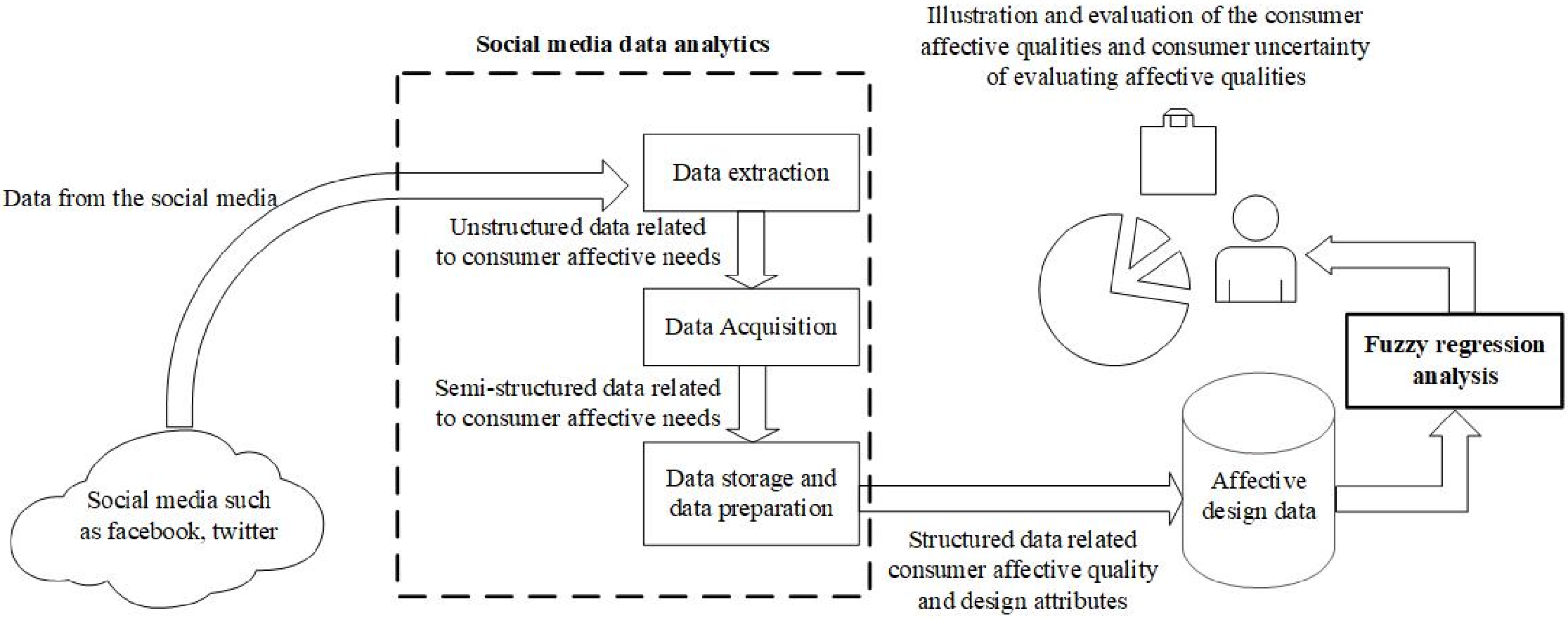 Fig 1: The architecture of the Social Media Analytical Framework (SMAF).
Experiments: The Automobile Case Study
The researchers applied SMAF to luxury brands like BMW, Porsche, and Land Rover, focusing on Color Wavelength as the primary design attribute.
Key Insight: The "Certainty" of White
By comparing Order-1 (Linear) and Order-3 (Polynomial) models, the study found that the Order-3 model provided a much tighter fit for human sentiment.
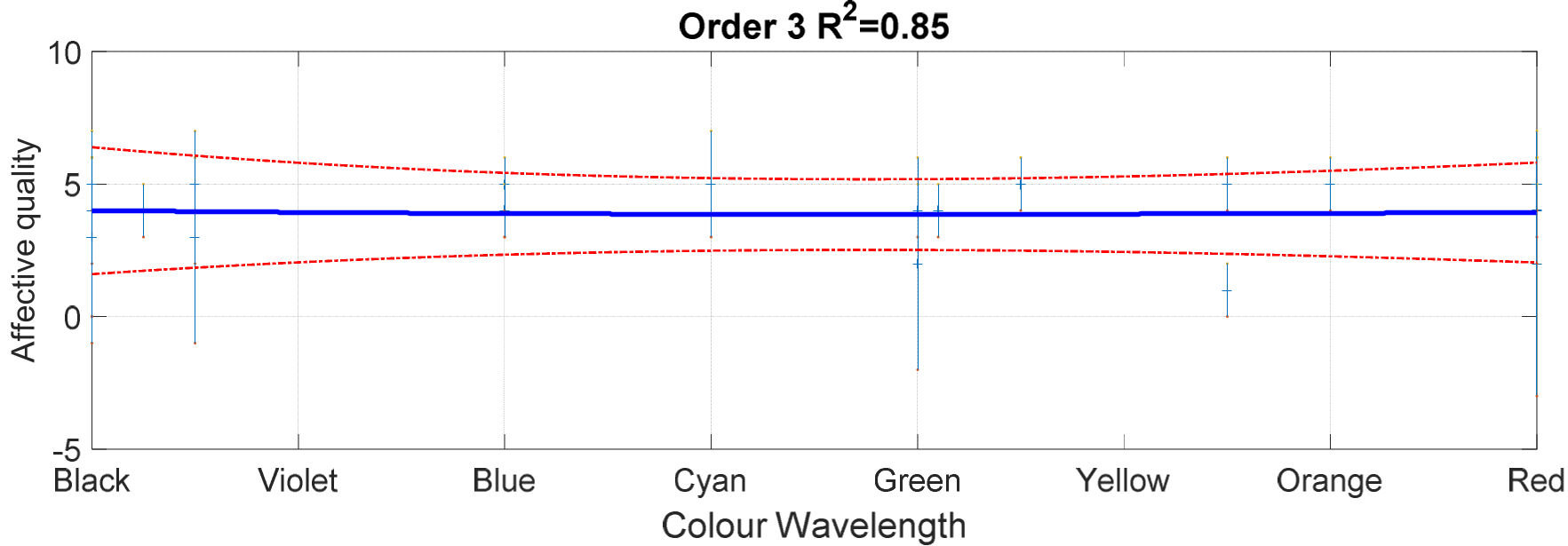 Fig 2: Affective quality (blue) vs. Uncertainty (red dotted lines) across color wavelengths.
The results were striking:
- Low Uncertainty (Convergence): Colors in the middle of the spectrum (White, Green, Blue) showed narrow spreads. This implies a "consensus" in the market—most people view these colors through a similar emotional lens.
- High Uncertainty (Divergence): Colors at the extremes—Black (low wavelength/absence) and Red (high wavelength)—showed massive spreads. This suggests that while some love a "Red" Porsche, others find it "individual" or even "bad," creating a high-risk/high-reward scenario for manufacturers.
Critical Analysis & Conclusion
The value of SMAF lies in its ability to give designers a "Risk Map." If a car brand launches a "Vantablack" model, this framework warns them that market reception will be highly unpredictable compared to a "Pearl White" model.
Limitations:
- Single-Variable Constraint: The current model focuses heavily on color. In reality, affective design is a symphony of shape, texture, and sound.
- The "Wavelength" Proxy: Assigning wavelengths to "Black" (0) and "White" (Mid) is a clever mathematical workaround but may not perfectly represent psychological perception.
Future Outlook: The integration of Multi-Variable Fuzzy Regression will be the next frontier. By combining text sentiment from Twitter with image recognition (Computer Vision) from Instagram, we could potentially create a 360-degree emotional profile of any product before it even hits the assembly line.
Takeaway: SMAF proves that in the age of Big Data, the "vague" nature of human opinion isn't a bug—it’s a feature that can be measured and modeled.