
Turning Reviews into Revenue: Sentiment Analysis as a Sustainable Competitive Edge
The Key Role of Social Media in Identifying Consumer Opinions for Building Sustainable Competitive Advantages
This paper investigates the identification of consumer opinions through sentiment analysis of social media and e-commerce reviews to build sustainable competitive advantages. Using the "Women's Clothing E-Commerce Review" dataset, the authors implement a lexicon-based approach integrated with supervised machine learning, specifically Logistic Regression and Multilayer Perceptron (MLP) neural networks, to predict product recommendations with high accuracy.
TL;DR
In the hyper-competitive global fashion market, "listening" to customers is no longer optional. This study leverages a dataset of 23,486 e-commerce reviews to demonstrate that by combining text-mined sentiment scores with machine learning (Logistic Regression and MLP Neural Networks), businesses can predict customer recommendations with up to 94.5% accuracy. The research highlights that while numerical ratings are vital, the sensitivity of written text is a critical secondary indicator of brand loyalty.
Contextualizing Social Media in Business Strategy
Social media has evolved from a mere communication tool into a "research medium." The authors position this work within the Web 2.0 framework, where user-generated content (UGC) acts as the primary driver for brand awareness. The core intuition is simple: if a company can quantitatively decode the "feeling" behind a review, it can identify specific product flaws and strengths that numerical stars alone might miss.
Methodology: From Words to Weights
The researchers employed a two-stage analytical pipeline:
- Lexicon-Based Sentiment Mining: Using the Harvard-IV Dictionary, they calculated three primary metrics: PosGI (Positivity), NegGI (Negativity), and SentGI (Overall Sensitivity). They also calculated normalized versions (per 100 words) to eliminate bias from longer reviews.
- Supervised Classification: These scores were used as independent variables to predict the "Recommended" (0 or 1) status.
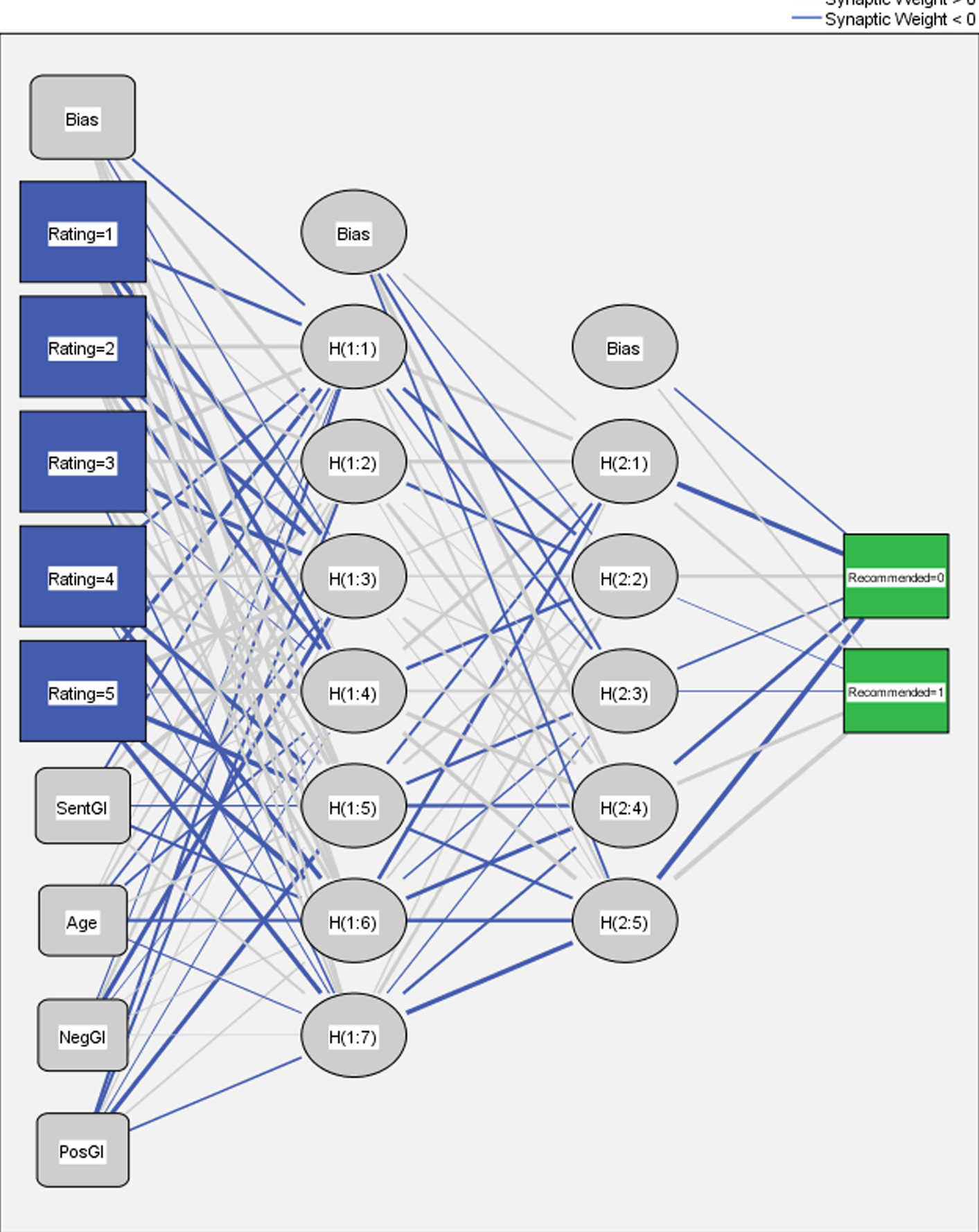 Figure 5: The architecture of the applied MLP neural network showing the flow from input variables to the hidden layers.
Deep Dive: Logistic Regression vs. Neural Networks
The study compared two distinct approaches:
- Logistic Regression: Proved that
Rating,SentGI, andAgeare statistically significant. One unit increase inRatingincreases the odds of recommendation by a staggering 27.57倍. - MLP Neural Network: Utilized hyperbolic tangent and softmax activation functions. While Logistic Regression removed certain variables like
PosGIas insignificant, the Neural Network successfully utilized them by identifying non-linear relationships, resulting in a higher accuracy (94.5%).
Experimental Insights & Results
The "Word Cloud" and frequency analysis identified that positive terms like "love," "perfect," and "comfortable" dominate recommendations, while "returned" and "disappointed" are the primary churn indicators.
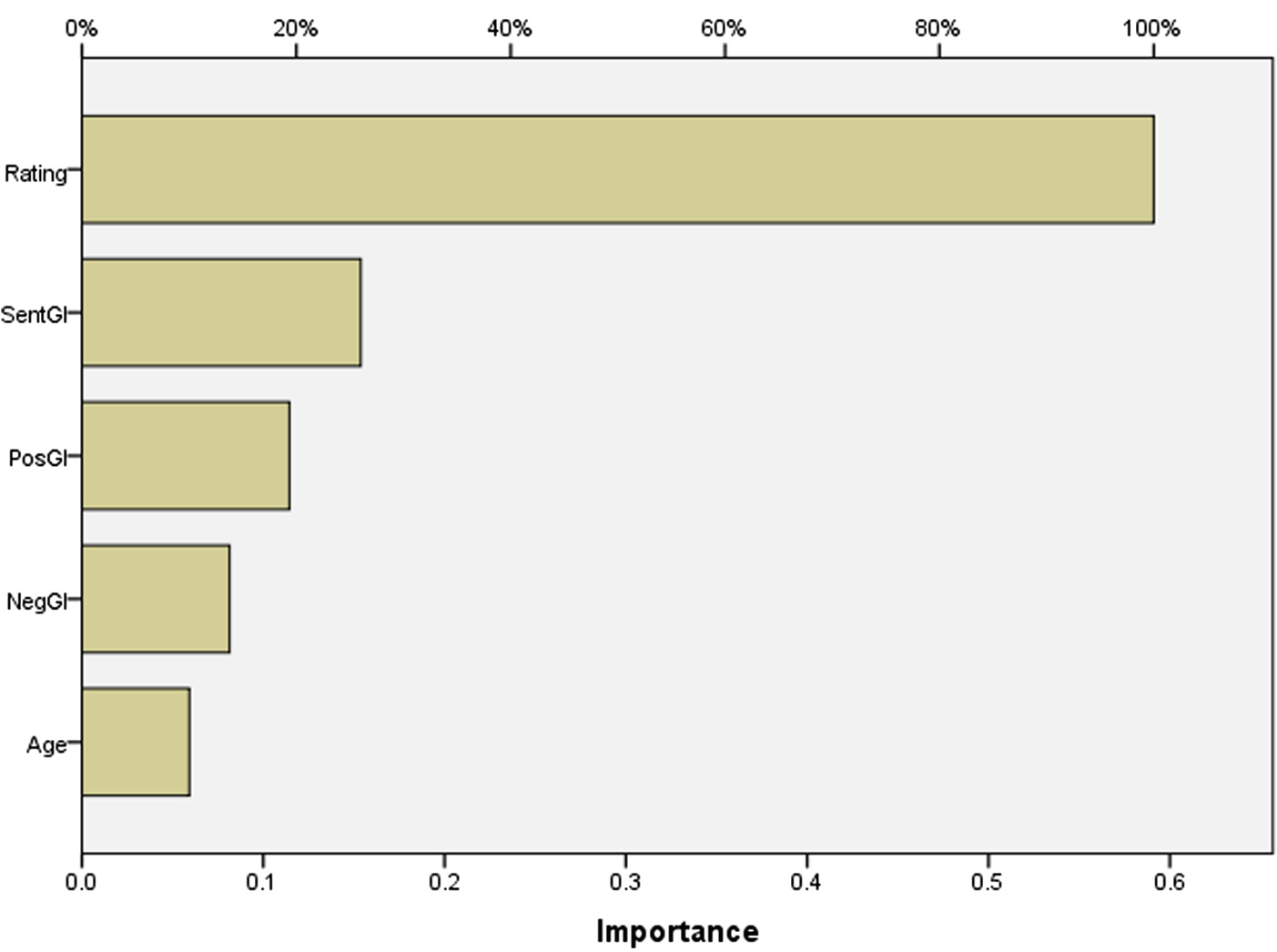 Fig 7: Relative importance of factors. Note how Rating dominates, but SentGI provides significant additional predictive value.
The ROC curve (AUC = 0.976) confirms that the model is exceptionally robust at distinguishing between those who would recommend a product and those who wouldn't.
Critical Analysis & Takeaways
Key Takeaway: Sentiment Analysis isn't just a "nice-to-have" metric—it’s a predictor of future business success. The SentGI (Sensitivity Index) acts as a bridge between qualitative feedback and quantitative strategy.
Limitations: The authors acknowledge that sentiment is context-dependent. A "tight" fit might be positive for leggings but negative for a summer dress. Future research must look into domain-specific lexicons or LLM-based embeddings to better capture these linguistic nuances.
Conclusion: For modern retailers, the path to a sustainable competitive advantage lies in the transition from "broadcasting" to "listening." By automating the analysis of sentiment, companies can adapt their marketing and product development in near real-time.