
Decoding Online Extremism: A Multi-Modal Approach to Identifying Proud Boys Support
Identifying Social Media Content Supporting Proud Boys
This paper presents a machine learning framework to identify social media content supporting the "Proud Boys," a far-right extremist group. By extracting linguistic, social, and auxiliary features from Twitter data, the authors demonstrate that an Artificial Neural Network (ANN) can achieve a SOTA accuracy of approximately 90% in distinguishing extremist sympathy from opposition.
TL;DR
Researchers from the University of Connecticut have developed a robust machine learning framework capable of identifying Twitter content supporting the Proud Boys with 90% accuracy. By merging deep linguistic analysis with social metadata and stylistic "auxiliary" features, the study provides a blueprint for automated radicalization monitoring that balances the protection of free speech with public safety.
Background: From Viral Rhetoric to Physical Violence
The digital age has turned social media into a double-edged sword. While it fosters global connection, it also serves as a fertile ground for extremist groups. The "Proud Boys," designated as a hate group by numerous organizations, utilized social media extensively during the 2020 protests. The core challenge is: how do we filter extremist sympathy from the millions of daily "innocuous" posts without manual labor or infringing on legitimate political debate?
The "Digital Fingerprint" of Radicalism
The authors argue that extremist content isn't just about what is said, but how it is distributed and structured. They analyzed a corpus of tweets following violent protests in Portland and Kalamazoo, identifying distinct "digital fingerprints" for supporters and detractors.
1. Linguistic Patterns
Through Word Clouds, a clear divide emerges. Supporters focus on "Antifa," "patriots," and "fighting back," while detractors use terms like "fascist," "terrorist," and "racist."
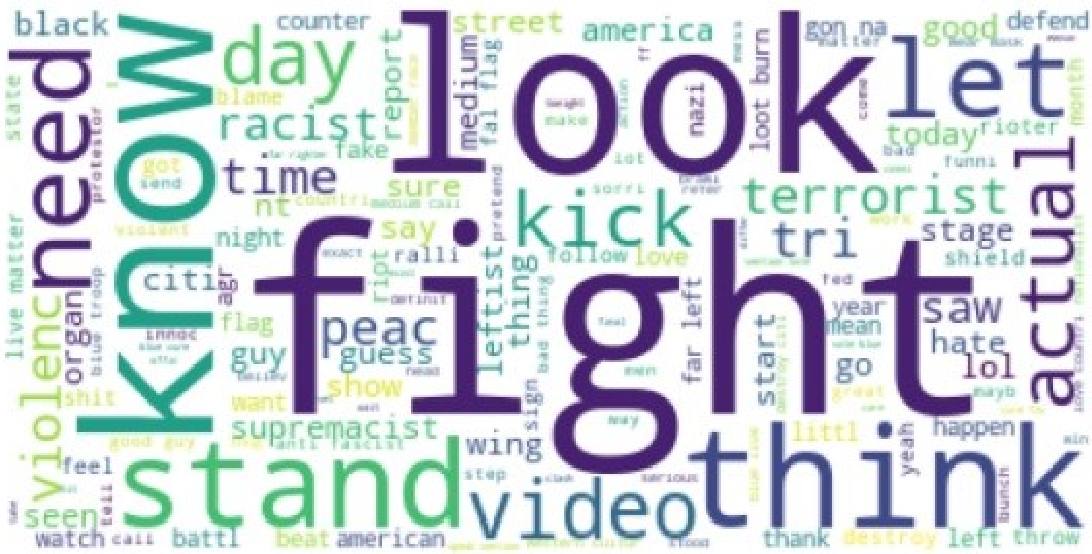 Word Cloud of Supporting (Extremist) Tweets.
2. The Power of Auxiliary Features
One of the paper’s most profound insights is the role of Auxiliary Features. Because online text lacks the facial expressions and tone of face-to-face radicalization, supporters over-index on:
- Punctuations (exclamations, question marks) to convey intensity.
- Mentions and URLs to spread the "alternative" narrative.
- Media content (images/video) to document and glorify conflict.
3. Social Reach
Interestingly, the study found that while supporting tweets made up about 1/3 of the corpus, they had significantly lower engagement (retweets and likes) and were posted by accounts with fewer followers compared to the opposition. This suggests that the ideology, while vocal, lacks broad-based popular support on the platform.
Methodology: The Classification Engine
The researchers compared several models, including Random Forest (RF), Support Vector Machines (SVM), and Artificial Neural Networks (ANN).
- Feature Combination: The best results were achieved by combining Linguistic (75% importance), Auxiliary (15%), and Social (11%) features.
- The Model: The ANN emerged as the winner. It utilized a 3-layer architecture with Adam optimization and Sigmoid activation.
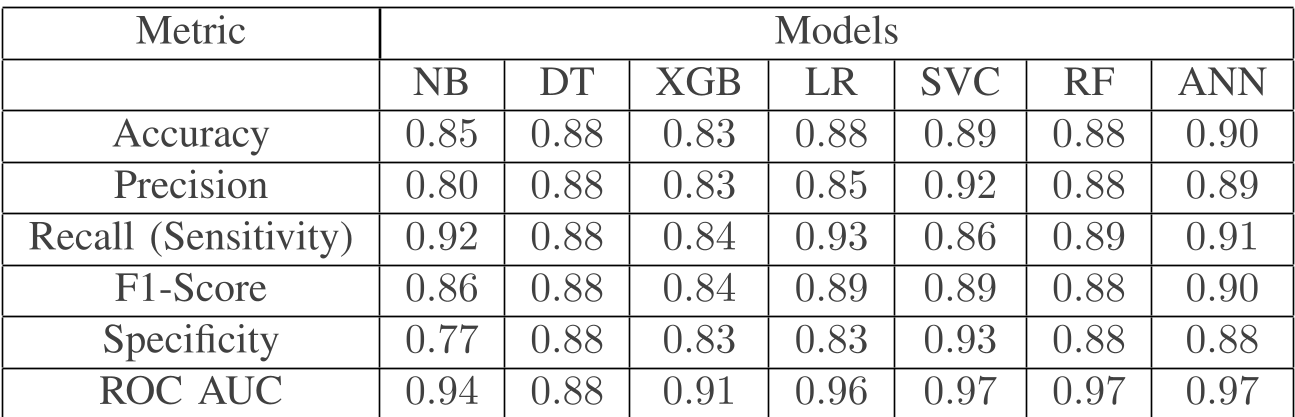 Comparative performance of various ML models.
Results & Insights
The ANN achieved a 0.90 Accuracy and a 0.97 ROC-AUC, indicating an exceptional ability to distinguish between classes.
Feature Importance Breakdown:
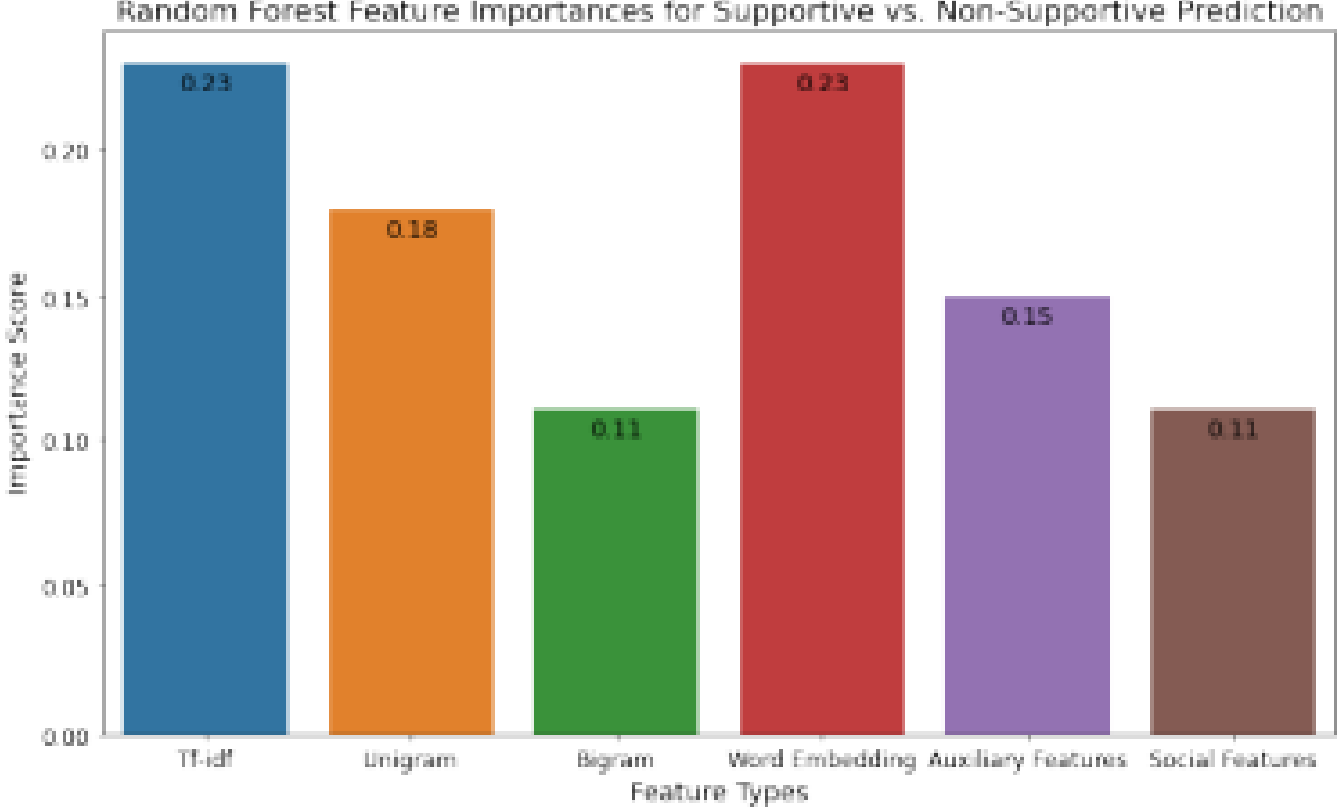 TF-IDF and Word Embeddings provide the bulk of the classification power, but Auxiliary and Social metadata provide the critical "extra mile" for accuracy.
Critical Analysis: Why This Matters
The breakthrough here is the balance between Precision and Recall.
- High Precision prevents "False Positives"—wrongfully flagging users as extremists, which protects free speech and reputation.
- High Recall prevents "False Negatives"—letting radicalization slip through the cracks to incite violence.
By achieving levels near 90% for both, the ANN model proves that automated systems can be both effective and ethical.
Conclusion and Future Outlook
This research demonstrates that machine learning can detect "early warnings" of discontent before they precipitate into offline bloodshed. Future work aims to expand this to detect sarcasm and offensive content directed at other vulnerable groups, such as the Asian American community. As political polarization increases, these tools will become essential for platform moderators and security agencies to maintain social order in both digital and physical spaces.