
Beyond the Survey: Real-Time Customer Insights via Social Media Mining
Social Media as a Main Source of Customer Feedback - Alternative to Customer Satisfaction Surveys
This paper explores the feasibility of replacing traditional customer satisfaction surveys with real-time social media analytics, specifically using Twitter data. The researchers developed a pipeline involving sentiment analysis (TextBlob/NLTK) and hashtag co-occurrence networks to extract actionable customer feedback for a biotechnology giant, Illumina.
TL;DR
Is the annual customer survey dead? This study suggests it might be. By leveraging Twitter data and NLP, researchers demonstrated that social media provides faster, cheaper, and more granular feedback than traditional 5%-response-rate surveys. Through sentiment analysis and network mapping, the paper reveals how a biotech company can turn "tweets" into actionable engineering and logistics improvements.
Background: The Bankruptcy of the Annual Survey
For decades, the "Annual Customer Satisfaction Survey" has been the gold standard for corporate feedback. However, the authors argue this model is fundamentally flawed for the modern era:
- High Friction: It requires active participation, leading to dismal response rates.
- Memory Decay: Customers forget specific pain points that happened months ago.
- The "B2B Gap": Surveys often target decision-makers (purchasers), completely missing the actual end-users (scientists/technicians) who vent their frustrations on social platforms.
Methodology: Mapping the Social Pulse
The researchers built a technical pipeline to transform raw Twitter noise into structured business intelligence.
1. Sentiment Classification
Using the Sentiment140 corpus as a foundational dataset, the authors utilized the TextBlob and NLTK libraries to classify tweets into positive, negative, and neutral categories. This allowed them to create a "Sentiment Scoreboard" for specific products like the NovaSeq or TruSeq.
2. Hashtag Co-occurrence Networks
One of the more sophisticated elements of this study is the use of graph theory to optimize data collection. By building a network where nodes are hashtags and edges represent their appearance in the same tweet, the team could identify "hidden" topics relevant to the brand.
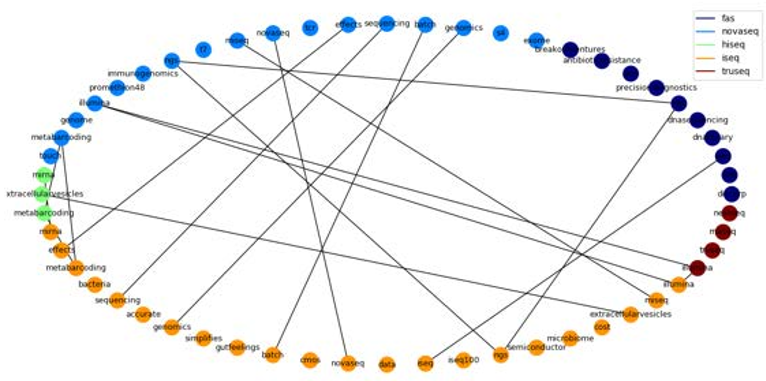 Figure: The Hashtag Co-Occurrence Network identifying overlapping themes in the genomics community.
Key Insights: What the Survey Missed
The results highlight a fascinating discrepancy between what companies think they should ask and what customers actually care about.
- Logistics Realism: One user tweeted about reagent reagents being "stowed away in the nick of time" and requested more dry ice. This level of hyper-specific logistics feedback rarely survives the journey to a formal survey.
- M&A Sentiment: Social media captured real-time speculation about company acquisitions (e.g., PacBio) which impacts brand perception long before an annual survey would be released.
- The "Noise" Paradox: While surveys are structured, they often yield vague results like "improve customer service." In contrast, tweets are noisy but occasionally contain "gold nuggets" of specific, localized advice.
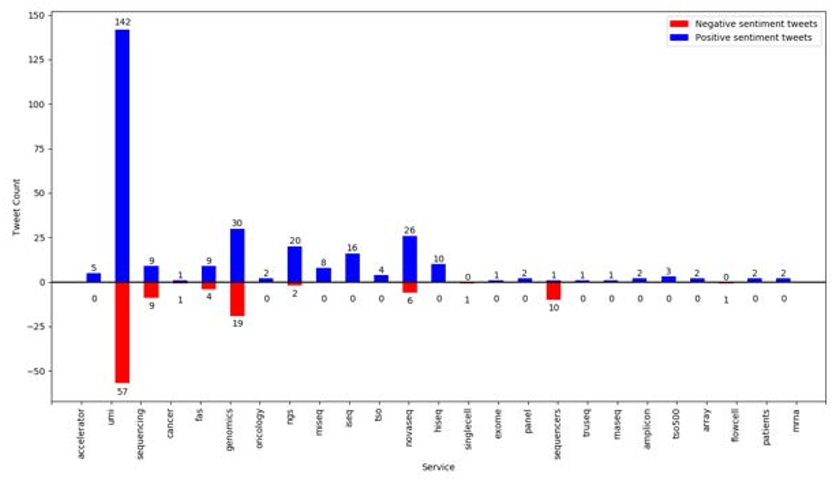 Figure: Distribution of Positive vs. Negative Sentiment across different Illumina product lines.
Critical Analysis & Conclusion
The study proves that social media is no longer just for marketing—it is a critical sensor for R&D and Operations.
Limitations:
- Demographic Bias: Not all customers tweet. The "loudest" voices on social media are not necessarily the most representative.
- Language: This study primary focused on English-speaking users.
The Takeaway for the Industry: The transition from "Passive Surveys" to "Active Social Listening" is inevitable. Companies that automate this pipeline—integrating geographic metadata and multilingual support—will have a massive competitive advantage in responding to market shifts in days rather than years.
Future Outlook: The next step for this research is the integration of Geographic Information Systems (GIS) to map sentiment by region, allowing global companies to deploy support teams to "hot zones" before a minor technical glitch turns into a PR disaster.