
Transforming Social Media Noise into Life-Saving Alerts: The EmerGent Strategy
Strategy for processing and analyzing social media data streams in emergencies
The paper introduces a comprehensive strategy and software architecture developed under the EmerGent project for processing large-scale social media data during emergencies. It leverages a pipeline of information gathering, enrichment, semantic ontology modeling, and automated quality assessment to transform noisy streams into actionable alerts for emergency services.
TL;DR
During a crisis, social media is a double-edged sword: it offers real-time situational awareness but floods emergency responders with millions of noisy, duplicate messages. The EmerGent project introduces a sophisticated software pipeline that automates the transition from high-volume raw data to low-volume, high-value alerts using semantic ontologies and tailorable quality frameworks.
Background Positioning
This work serves as a foundational architectural blueprint for Social Media Integrated Crisis Management. It moves the needle from "passive monitoring" to "active semantic synthesis," positioning itself as a bridge between data mining research and the operational needs of police and fire departments.
The Problem: The Signal-to-Noise Ratio in Disasters
Existing methods for processing social media data in emergencies often fall short because:
- Format Heterogeneity: Data from Twitter, Facebook, and YouTube arrive in vastly different structures.
- Linguistic Noise: Crisis-related posts are often "messy," full of abbreviations, and lack standard grammar, breaking traditional NLP tools.
- Human Resource Scarcity: Emergency services lack the manpower to manually sift through millions of mentions (e.g., the 3.4 million "Sandy" mentions) to find the few that report actual injuries or resource needs.
Methodology: The Core Processing Pipeline
The authors propose a logical workflow to distill raw data into "vetted" alerts:
1. Homogenization through OpenSocial
To solve the heterogeneity problem, the system uses the Activity Streams format. This converts every social interaction into a standardized triplet: Actor (the user), Verb (posted/shared), and Object (the message/image).
2. Semantic Information Modeling (The Ontology)
The most critical innovation is the mapping between the "Social Media World" and the "Emergency Domain World."
- The Bridge: A tweet is not just a string; it is an "Artifact" that "Reports About" an "Incident."
- The Logic: By using semantic relations, the system can understand that different posts from different platforms are actually describing the same physical event.
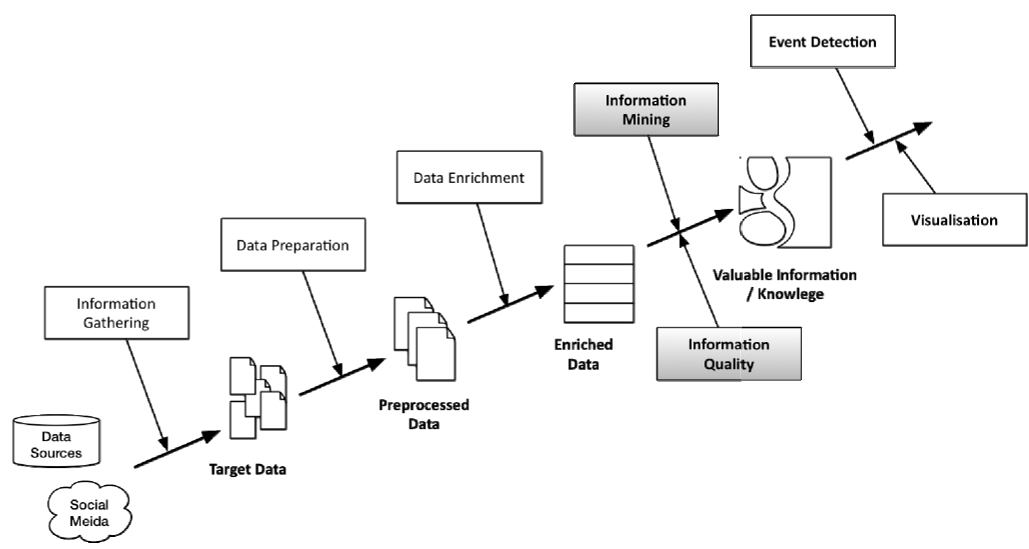 Fig 1: The simplified pipeline from raw social media streams to refined knowledge.
3. Tailorable Information Quality (IQ)
Information quality is subjective. What a researcher finds "interesting" is different from what a firefighter finds "actionable." The project introduces a framework where criteria like Timeliness, Understandability, and Believability can be weighted by the end-user.
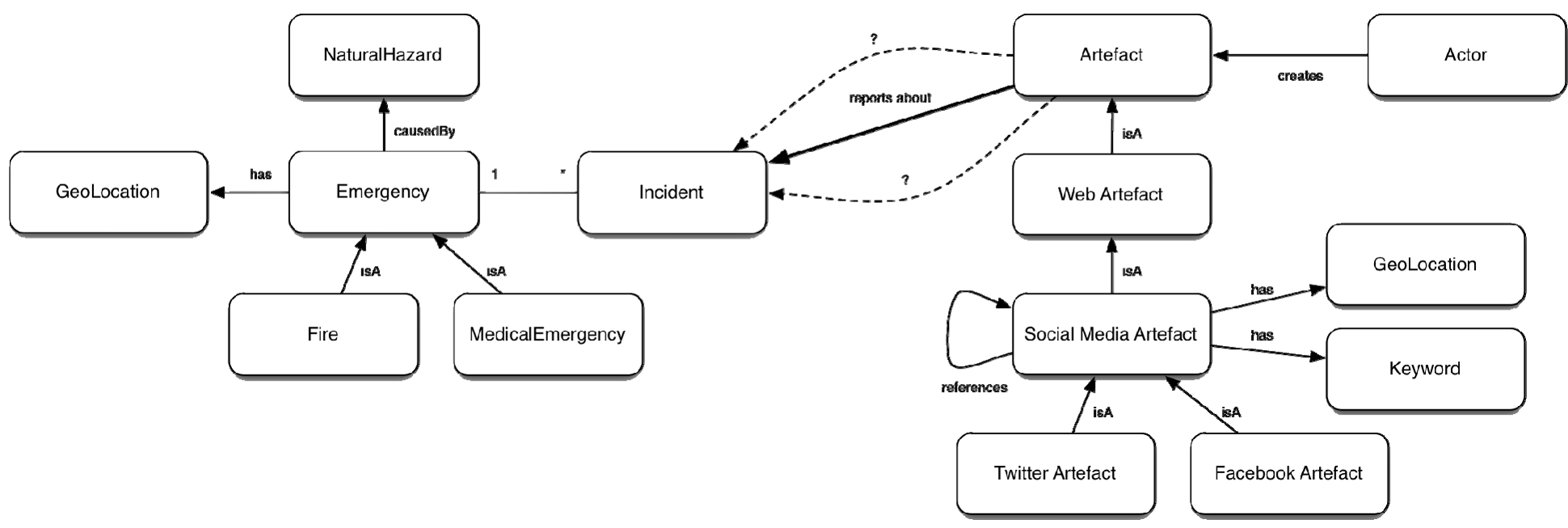 Fig 2: Example of the EmerGent Ontology mapping social media artifacts to emergency incidents.
Experiments & Results: From Data to Alerts
By implementing a Naïve Bayes Classifier (similar to those used in spam filters), the system effectively isolates messages with high relevance to emergency services.
- Clustering: The system uses similarity measures to group duplicate reports, ensuring emergency personnel aren't overwhelmed by 1,000 tweets about the same fallen tree.
- Alert Detection: Using semantic reasoners like Drools, the system infers logical consequences. If multiple high-quality "injured person" reports cluster in one geo-spatial area, a high-priority alert is triggered.
Critical Analysis & Conclusion
Takeaway
The true value of this paper lies in its holistic view. It doesn't just look at "sentiment" or "keywords"; it attempts to model the entire lifecycle of information—from its birth on a smartphone to its visualization on a command center dashboard.
Limitations
While the pipeline is robust, it heavily relies on the availability of metadata (like Geo-location), which many users disable for privacy. Furthermore, the reliance on traditional Naïve Bayes may struggle with the nuanced sarcasm or evolving slang often found in localized crises.
Future Work
The authors foresee moving towards a Service-Oriented Architecture (SOA), allowing different emergency departments to plug in their own specialized analysis modules. As AI evolves, integrating LLMs into the "Information Mining" stage of this pipeline could further solve the "bad language" problem mentioned by the authors.