
Beyond Individualism: Engineering Social Media for the Collectivist Soul
Social Media Design Requirements for the Collectivist International Students
This study investigates "Social Media Design Requirements for Collectivist International Students" by employing a co-design methodology with the Value Sensitive Action-Reflection model. The research identifies critical mismatches between US-centric (individualist) SNS designs and the interpersonal needs of collectivist users, proposing a set of culturally-aware design frameworks.
TL;DR
Current social media platforms are "Individualist by Design," prioritizing personal branding and wide outreach. This paper argues that for the 67% of international students coming from collectivist cultures, these tools are fundamentally misaligned. Through co-design sessions, the authors identify a shift toward "narrow" but "deep" digital ecosystems that prioritize group harmony, elder accessibility, and constant situational awareness over viral self-expression.
Problem & Motivation: The Cultural "Hard-Coding" of SNS
Software is never neutral. Most SNS giants (Facebook, X/Twitter, Instagram) were born in the US, a culture with a 91/100 individualism score. Consequently, these platforms favor Bridging Social Capital—connecting with acquaintances to gain information.
However, international students from collectivist backgrounds (scoring <25 on the individualism scale) value Bonding Social Capital. For them, SNS is a lifeline to maintain tightly-knit, high-cohesion groups. The mismatch is stark: individualist designs encourage "Broadcasting," whereas collectivist values demand "Narrowcasting." This tension results in a "cultural friction" that exacerbates loneliness and social isolation for students abroad.
Methodology: Co-Designing the "Dream Tool"
The researchers didn't just survey users; they invited them to be architects. Using the Value Sensitive Action-Reflection model, they paired international students to design a "dream social media tool" from scratch.
The process involved:
- Low-Fidelity Prototyping: Sketching interfaces without platform constraints.
- Stakeholder Prompts: Testing their designs against complex social scenarios.
- Designer Prompts: Using "envisioning cards" to force reflection on group decision-making and situational awareness.
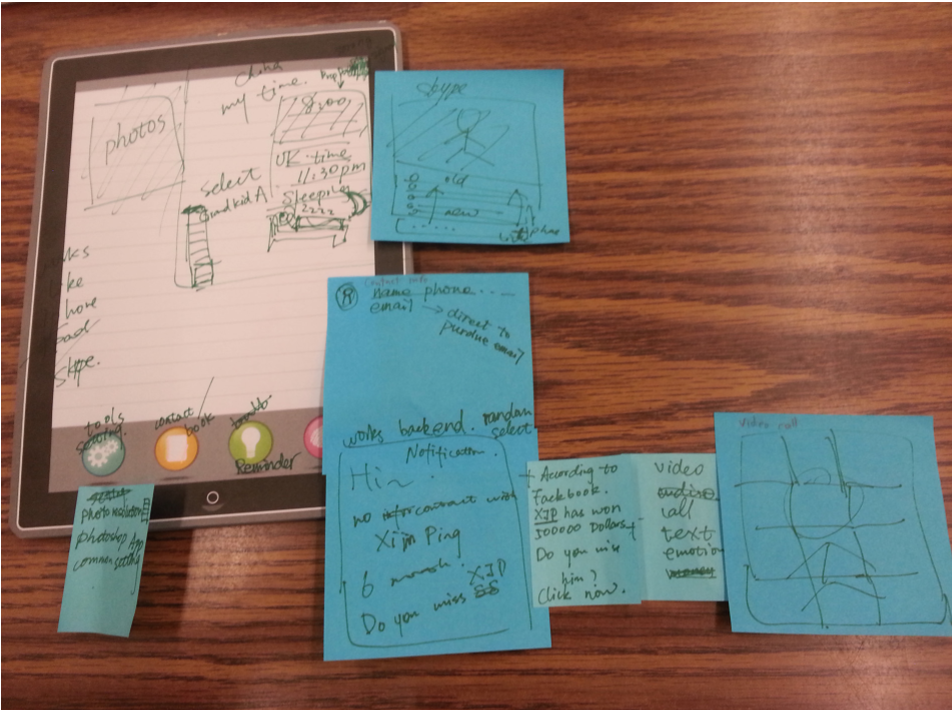 Figure 1: An example of a low-fidelity prototype created by participants, emphasizing grouped interpersonal spaces.
Methodology Core: The Four Pillars of Collectivist Design
The study distilled the co-design outputs into four thematic requirements:
1. High-Fidelity Presence (Media)
Collectivists don't just want to "chat"; they want to "be there." There is an overwhelming preference for synchronous video chat over text. One participant noted that clear video and audio solve "all problems," as it replicates the physical presence of family.
2. Radical Accessibility (User-System Interaction)
Collectivism is intergenerational. Participants demanded features that allow their grandparents to use the system unassisted. This includes:
- Voice Commands: Support for varying accents (e.g., Thai-English or regional Chinese dialects).
- Handwriting Recognition: For elders who may not know phonetic input systems like Pinyin.
3. Smart Time-Sync (Interpersonal Interaction)
The "Time Zone Gap" is a major pain point. Instead of manual scheduling, participants envisioned systems that:
- Auto-calculate "Good to Talk" windows by merging calendars.
- Display Status Visually: Showing a picture of a "sleeping child" to inform a grandparent why they shouldn't call, rather than just a "Busy" icon.
4. Narrow Group Boundaries
In collectivist designs, the "Friend List" is not a public badge—it is a private inner circle. The requirements emphasize:
- Explicit Invite/Acceptance: No one can join a group or see content without a formal gatekeeping process.
- Granular Privacy: Different "faces" for family, close friends, and acquaintances.
Critical Analysis & Conclusion
The core takeaway of this research is a challenge to the Inductive Bias of Western developers. We often assume "more connection is better," but for collectivist users, "higher quality, restricted connection" is the goal.
Limitations & Future Work
While the study provides a rich qualitative framework, its sample size is small (6 participants). Furthermore, it focuses solely on the Individualism-Collectivism axis. Future research should integrate Power Distance (how hierarchy affects online interaction) and Uncertainty Avoidance (how users react to ambiguous social alerts).
Conclusion: The future of globalized SNS lies in "Cultural Adaptive Interfaces"—systems that don't just translate language, but translate the very logic of human relationship maintenance.