
Twitter as a Lifeline: Decoding Social Media's Role in Indonesia's Disaster Mitigation
Social Media as Tools of Disaster Mitigation, Studies on Natural Disasters in Indonesia
This study investigates the strategic role of Twitter as a disaster management and communication tool during multiple natural disasters in Indonesia in early 2021. Utilizing Qualitative Data Analysis Software (Q-DAS) and Nvivo 12Plus, the research demonstrates how social media facilitates real-time information dissemination, volunteer coordination, and donation mobilization across different disaster types.
TL;DR
In January 2021, Indonesia faced a barrage of natural disasters ranging from plane crashes to volcanic eruptions. This research analyzes how Twitter served as a decentralized command center, transforming hashtags into tools for coordination, empathy, and real-time data verification. The study highlights that the type of disaster dictates the public response—whether it's mobilizing volunteers for search and rescue or gathering donations for flood relief.
Background: The Digital Frontline of the Ring of Fire
As a nation situated on the "Ring of Fire," Indonesia is a frequent stage for catastrophic natural events. Traditional top-down communication often struggles with the velocity of these crises. This paper positions social media, specifically Twitter, as a critical peer-to-peer infrastructure that bridges the gap between institutional response and community action.
The Problem: Information Asymmetry in Emergencies
The core issue during a disaster is not just the event itself, but the "information void" that follows. Prior methods relied on centralized government reports which are often slow. This research addresses:
- The Coordination Gap: How to synchronize thousands of willing volunteers and donors.
- The Information Integrity Crisis: Combating hoaxes that spread as fast as the disaster itself.
- The Emotional Recovery Shortfall: Providing immediate psychological support (Mental Health Recovery) to victims and families.
Methodology: Qualitative Data Analysis with Nvivo
The researchers used a Qualitative Data Analysis Software (Q-DAS) approach, specifically utilizing Nvivo 12Plus, to categorize thousands of tweets via trending hashtags. They focused on five major events in January 2021: the Sriwijaya Air SJ182 crash, South Kalimantan floods, Sumedang landslides, Majene earthquakes, and Merapi/Semeru eruptions.
 The workflow utilized by the researchers to transform raw Twitter hashtags into structured disaster mitigation insights.
Key Insights: Disaster-Specific Communication Patterns
The study discovered that "disaster mitigation" is not a one-size-fits-all process. Public behavior on social media adapts to the nature of the tragedy:
1. Coordination & Volunteers vs. Donations
- Sudden Kinetic Events (Plane Crashes/Volcanoes): These triggered a massive surge in volunteer coordination. For the SJ182 crash, the coordination role for volunteers reached a staggering 100%.
- Environmental/Slow-Onset (Floods/Earthquakes): These focused heavily on material support. Floods in South Kalimantan saw an 85% dominance in donation-related coordination.
2. Empathy as a Metric
The research quantified "Empathy" through sensory and perspective-taking parameters. Interestingly, landslides and floods scored highest in "understanding different perspectives" (80%), suggesting that social media helps the broader public internalize the suffering of those in affected regions.
3. Fighting the "Infodemic"
A critical finding was Twitter's role in Data Updating and Hoax Prevention. In the case of volcanic eruptions, while 67% of data was for information sharing, 33% was dedicated to debunking false rumors, proving that the community acts as a self-correcting filter.
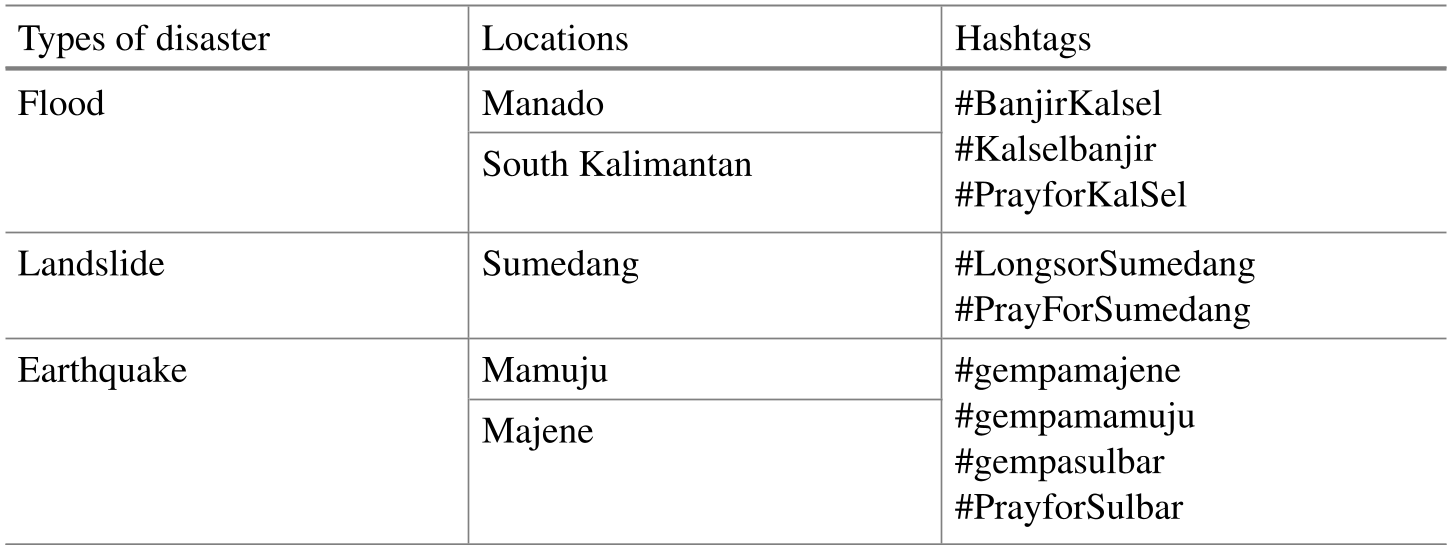 Table 2: Categorization of disaster types and their corresponding localized hashtags used for the analysis.
Critical Analysis & Future Outlook
The study confirms that Twitter is a high-fidelity sensor for societal needs during a crisis. However, it also highlights limitations:
- Platform Dependency: The research is limited to Twitter; other platforms like TikTok or WhatsApp (which are huge in Indonesia) might offer different coordination dynamics.
- Digital Divide: The data reflects the voices of those with internet access, potentially marginalizing rural victims.
Takeaway for the Future: Government agencies should officially integrate social media sentiment analysis into their emergency dashboards. The transition from "broadcasting to the public" to "listening to the community" is the next frontier in disaster resilience.
Summary Table of Findings
| Disaster Type | Dominant Aspect | Primary Social Role |
|---|---|---|
| Plane Crash | Recovery/Volunteer | Infrastructure improvement & Search support |
| Flooding | Coordination | Donation mobilization & Mental health support |
| Earthquake | Empathy | High perspective-taking and physical aid |
| Eruption | Information | High hoax prevention and real-time alerts |
Note: This analysis is based on the research titled "Social Media as Tools of Disaster Mitigation, Studies on Natural Disasters in Indonesia" (2021).