
The Social Media Genome: Decoding the DNA of Online Influence
The Social Media Genome: Modeling Individual Topic-Specific Behavior in Social Media
This paper introduces the Social Media Genome, a framework that models individual user behavior using topic-specific "genotypes" (interest, activity, and susceptibility) rather than static follower structures. By analyzing Twitter data, the authors demonstrate that these behavioral signatures are invariant within topics and can be used to extract "influence backbones" that significantly outperform traditional structural features in prediction tasks.
TL;DR
Researchers have developed a "Social Media Genome" that moves beyond who you follow to how you behave. By modeling users with topic-specific "genotypes"—capturing traits like how fast you react to tech news versus sports—this framework can predict information spread with 20% higher accuracy and cut communication delays in half by targeting just 1% of key users.
Background: Beyond the Static Follower Graph
In the world of social media research, the "Follower Graph" has long been king. However, as any Twitter or Reddit user knows, following someone doesn't mean you listen to everything they say. A static link is purely a potential channel; it doesn't represent actual influence.
The authors of "The Social Media Genome" argue that to understand how information actually flows, we must look at the Genotype: a unique, invariant set of behavioral traits that define how a specific user interacts with specific topics.
The Problem: The "Inactive Link" Paradox
Why do some hashtags go viral while others die, even when shared by accounts with millions of followers?
- Topic Specificity: You might follow a chef for recipes but ignore their political rants.
- Individual Susceptibility: Some users are "early adopters" who jump on trends immediately, while others are "leaf consumers" who only react after seeing a critical mass of posts.
- Structural Noise: High-degree nodes (celebrities) often have many inactive followers, making traditional metrics like PageRank misleading for predicting actual spread.
Methodology: Building the Genome
The researchers defined the genotype using several key metrics (alleles) across five major topics: Business, Celebrities, Politics, Science/Tech, and Sports.
Key Genotype Metrics:
- LOG-LAT (Normalized Latency): How long it takes a user to post a hashtag after their first exposure, normalized against network averages. This proved to be the most consistent behavioral signature.
- N-PAR (Number of Parents): How many people you need to see a hashtag from before you adopt it.
- Topic-Specific Activity: The frequency of your engagement within a specific domain.
Extracting the Influence Backbone
By mapping these behaviors, the authors extracted the Influence Backbone—a sub-network of the follower graph where actual influence occurs.
 Table 1: The mathematical definitions of genotype metrics, highlighting Latency (LAT) as a core innovation.
Experiments & Results: Proving the Invariance
The core of the paper's thesis is that these genotypes are stable. To prove this, they trained classifiers to identify the topic of a hashtag based only on the adoption behavior of users.
- High Accuracy: Combining individual genotypes into a network-wide "consensus" classifier yielded an 87% accuracy rate.
- Superior Prediction: When predicting who would adopt a new hashtag, the "RW+Act" (Random Walk + Activity) predictor, which uses both the genotype and the backbone structure, outperformed structural-only models (like counting followers) by over 20%.
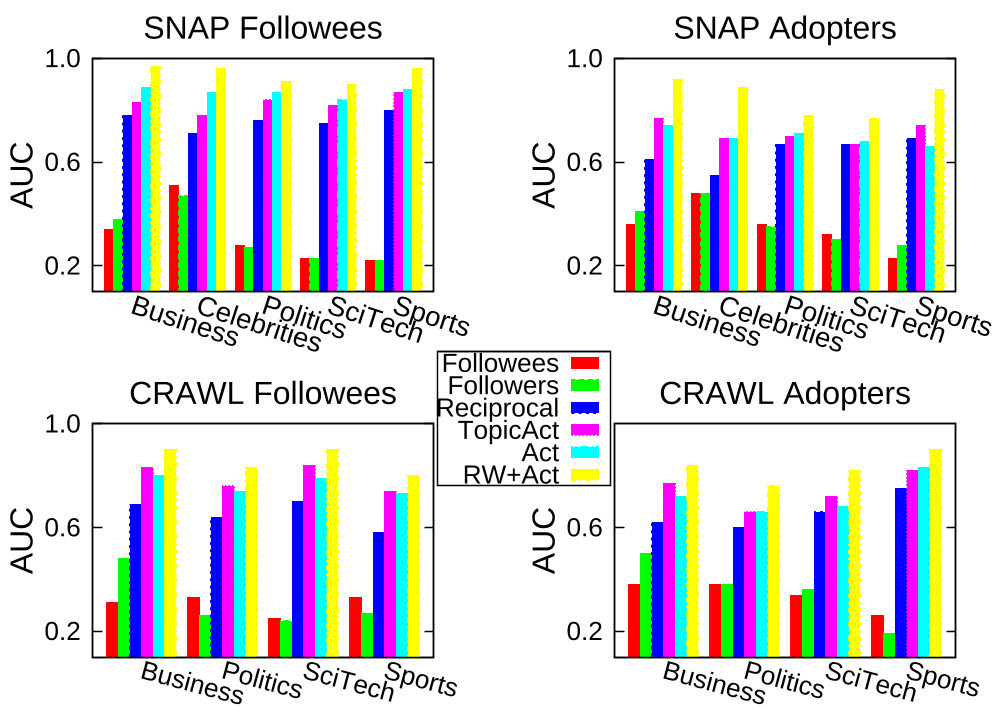 Fig 5: Comparison showing that Genotype-based predictors (Act, Topic Act) significantly outperform structural counterparts (Follower count).
Application: Latency Minimization
One of the most striking findings involves Latency Minimization. In scenarios like disaster relief, spreading information fast is life-saving. The authors used a "Greedy" heuristic that targets nodes based on both their centrality (structure) and their genotype (speed of reaction).
By "optimizing" the behavior of just 1% of nodes, they were able to reduce the average network-wide information delay by 50%.
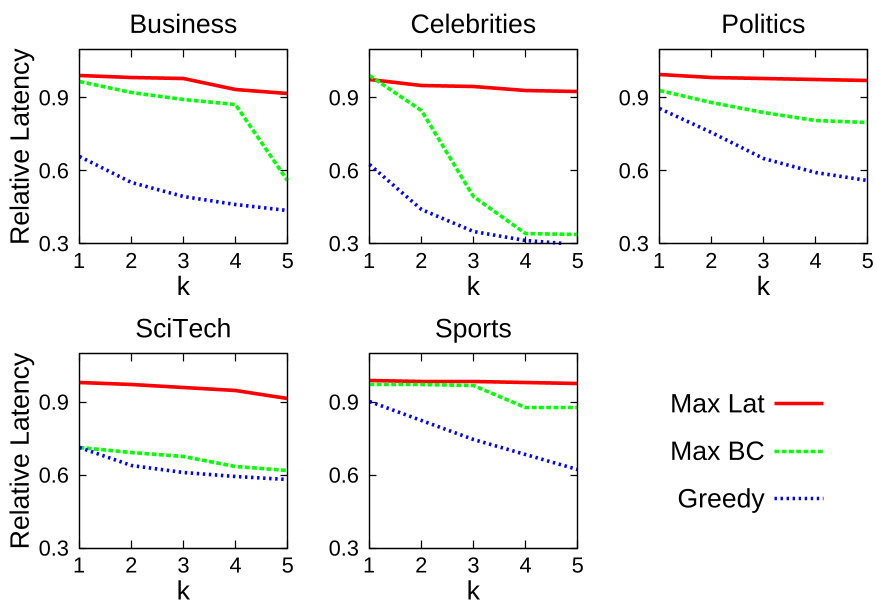 Fig 6: The Greedy approach (combining genotype and structure) achieves the fastest reduction in network latency.
Critical Insight: The "Thinning" of Influence
The study reveals that "Influence Backbones" are much more like Directed Acyclic Graphs (DAGs) than the highly reciprocal, cyclic follower networks we usually see. In the Celebrities topic, for instance, the backbone is almost entirely one-way—from a few sources to many leaf consumers—with very little feedback.
Conclusion & Future Work
The "Social Media Genome" shifts the focus of network science from topology to personality. It suggests that our digital footprints are not just random interactions but are governed by consistent behavioral "DNA."
Future Outlook: While this study focused on hashtags, the framework can be applied to URLs, sentiments, or even misinformation. Future research might look at how these genotypes evolve over years or how they shift during major global crises.