
Decoding Crowdfunding: How Social Media Diffusion Drives Leetchi Success
3926_The Impact of Social Media on Leetchi Crowdfunding Projects Success.
This paper investigates the correlation between social media activity and project success on Leetchi, a major donation-based crowdfunding platform. By analyzing 19,000 tweets and 438 projects, the authors identify key Social Network Analysis (SNA) metrics that predict funding levels using Random Forest classifiers.
TL;DR
Is a viral tweet enough to fund your project? Not quite. This research analyzes the Leetchi platform to prove that while simple "buzz" (tweet volume) helps small projects, truly successful crowdfunding campaigns (>1,000 €) rely on complex social diffusion networks and the ability to bridge multiple online communities.
Background: Beyond the Reward Model
Most crowdfunding research focuses on Kickstarter's "all-or-nothing" reward model. However, donation-based platforms like Leetchi operate differently, often under "keep-it-all" rules. The authors identify a gap: we don't fully understand why some donation projects explode while others stay silent. Their insight? The structure of the conversation matters as much as the volume.
Methodology: Mapping the Social Web
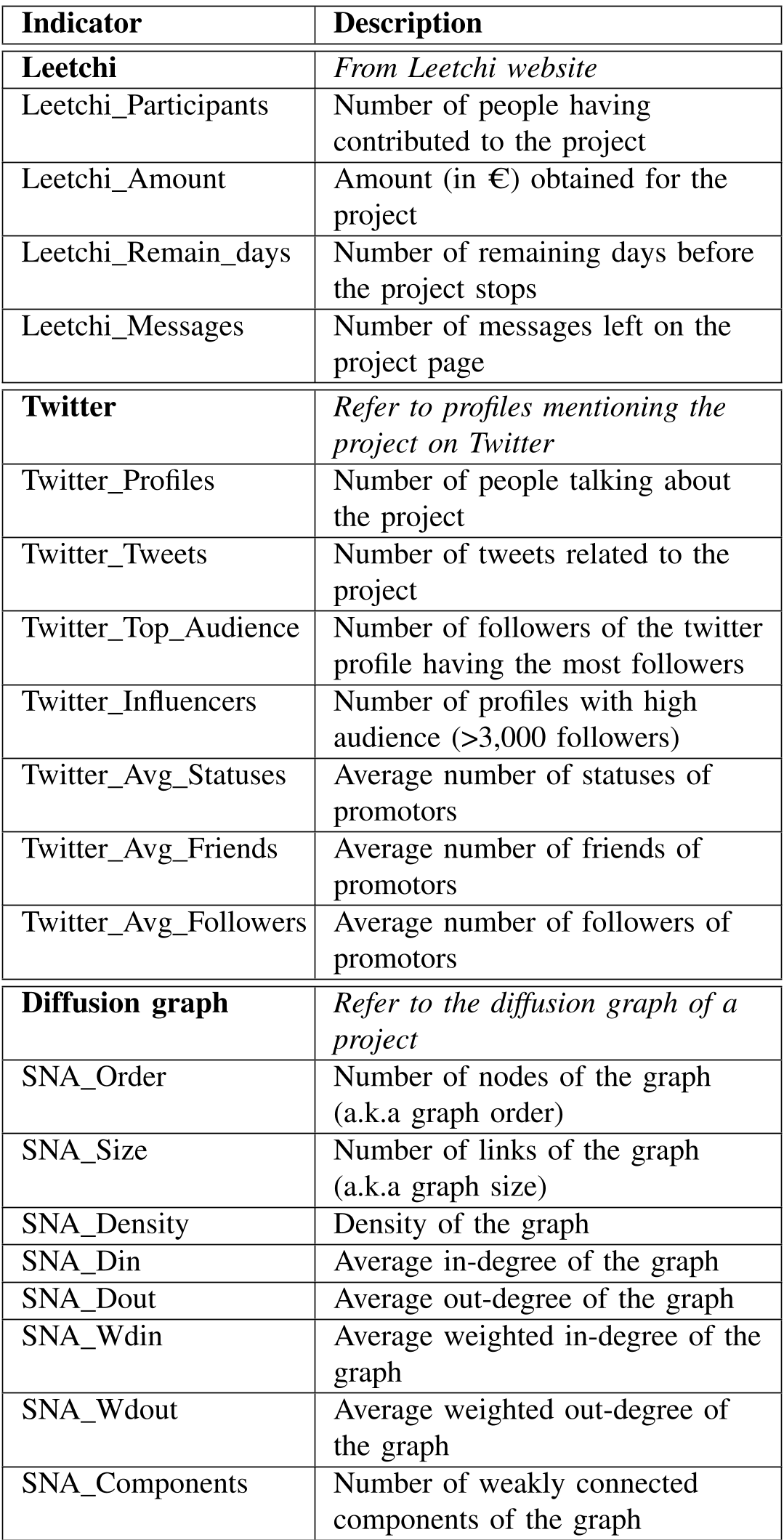
The researchers combined web scraping from Leetchi with Twitter Streaming API data to build a dataset of 438 projects. They didn't just count followers; they built Diffusion Graphs.
1. Traditional Metrics
- Counts: Total tweets, number of profiles.
- Influence: Number of influencers (>3,000 followers) and the "Top Audience" reach.
2. Deep SNA (Social Network Analysis) Features
The core of the methodology lies in modeling the campaign as a graph , where:
- Nodes (N): Twitter users.
- Edges (E): Retweets or mentions.
- SNA_Components: Represents distinct communities or "clusters" involved in the campaign.
- Weighted In-Degree (SNA_Wdin): Measures how often a user's content is amplified by others.
Experiments & Results: What Makes a Winner?
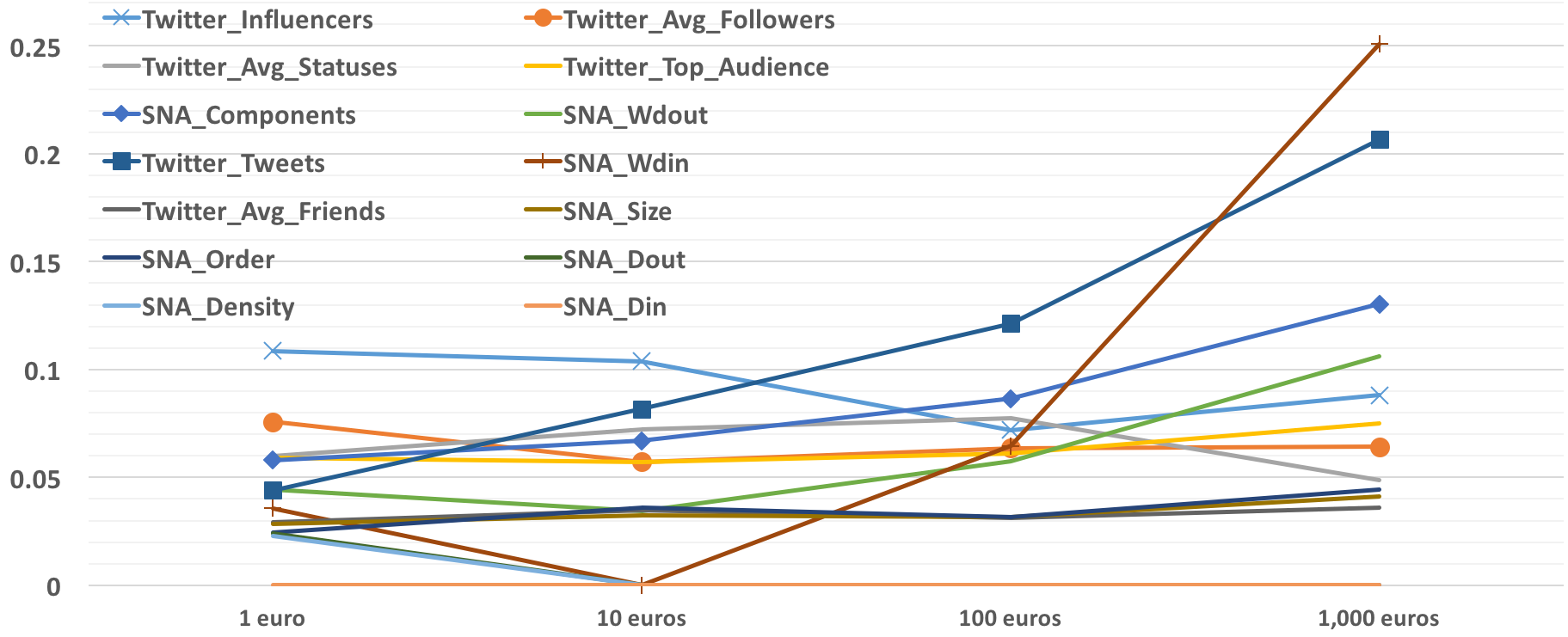
Using a Random Forest classifier, the study attempted to predict if a project would cross specific funding thresholds (1 €, 10 €, 100 €, 1,000 €).
Key Findings:
- The 1,000 € Barrier: Predicting high-success projects was significantly more accurate (AUC: 0.81) than predicting low-success ones. This is because high-success projects exhibit very specific social "fingerprints."
- Interaction is King: For projects raising over 1,000 €, the Weighted In-Degree and Out-Degree were the top predictors. This indicates that the promoters were not just shouting into the void; they were engaging in two-way interactions (mentions/retweets).
- Community Bridging: The number of connected components was a vital indicator. Winners didn't just stay in one "bubble"; they successfully reached multiple independent groups of people.
Critical Analysis & Conclusion
Takeaway
If you are running a crowdfunding campaign, don't just aim for a high number of tweets. Aim for high-engagement tweets that spark retweets and try to seed your project in different social circles. Success in donation-based crowdfunding is a "team sport" where the quality of the interaction network trumps the size of the owner's follower count.
Limitations
The study is focused on a 1-month window on a single platform (Leetchi) and a single social network (Twitter). In 2026, the landscape includes more visual/algorithmic platforms like TikTok, where "diffusion" looks very different from the retweet-based graphs studied here.
Future Work
The authors suggest that future research should integrate Natural Language Processing (NLP) to analyze whether the sentiment or narrative of the tweets further boosts the predictive power of these structural graph models.