
Twitter Optimization: Leveraging Social Swarm Intelligence to Solve the Set Covering Problem
Using a Social Media Inspired Optimization Algorithm to Solve the Set Covering Problem
This paper explores the application of a novel metaheuristic called the Twitter Optimization (TO) algorithm to solve the NP-complete Set Covering Problem (SCP). TO mimics human social interactions—following, tweeting, and retweeting—to achieve a balance between exploration and exploitation, successfully outperforming baseline metaheuristics like Harmony Search in 90% of tested instances.
TL;DR
Researchers have successfully applied a social-media-inspired metaheuristic—Twitter Optimization (TO)—to tackle the Set Covering Problem (SCP). By simulating how trending topics go viral through following and retweeting, the algorithm efficiently navigates complex solution spaces, outperforming established methods like Harmony Search and Black Hole algorithms in nearly all benchmark tests.
Background & Motivation: Beyond Biological Inspiration
The field of metaheuristics is traditionally dominated by biology-inspired models like Ant Colony Optimization or Genetic Algorithms. However, human social behavior on the internet represents a highly evolved filtering system for information.
The authors argue that when we "Retweet," we act as an unconscious optimization filter, promoting valuable content (better solutions) while discarding noise. This paper maps this social dynamic onto the Set Covering Problem (SCP)—a classic NP-complete challenge used in airline scheduling and network defense—to see if "social intelligence" can find global optima faster than traditional swarm models.
Methodology: The Mechanics of the "Tweet"
The TO algorithm translates Twitter's social graph into a mathematical search strategy.
1. The Social Hierarchy
- Tweets: Each tweet is a binary solution vector .
- Celebrities: The top 1% of users with the best fitness. They represent the current local/global optima.
- Following: Users maintain a directed graph, following those who produce "Tweets" with better fitness scores, ensuring the population gravitates toward high-quality regions of the search space.
2. Retweeting as a Perturbation Operator
To prevent the algorithm from getting stuck in local optima, TO uses the "Retweet" mechanism as its core search engine. When a user retweets, they choose between:
- Comments (Exploration): Slightly modifying the solution using a random disturbance.
- Participation (Exploitation): Adopting the solution directly to strengthen the current "trend."
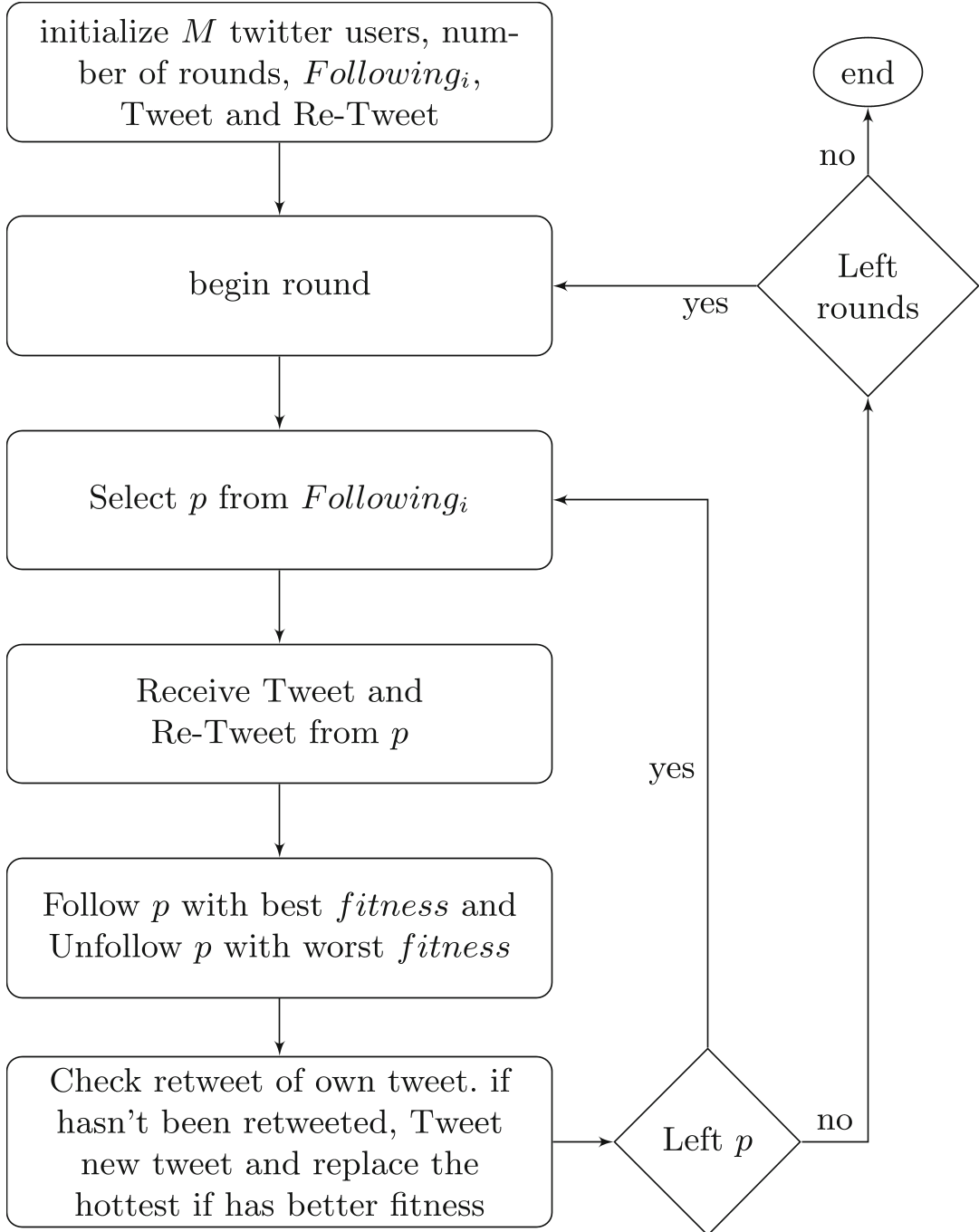 Figure 1: The logic flow of Twitter Optimization, illustrating the cycle of tweeting, retweeting, and following.
Experiments and Results
The authors tested TO against the OR-Library (Beasley) benchmark. The performance was measured using Relative Percentage Deviation (RPD), which tracks how far the algorithm's result is from the theoretical optimum.
Key Findings:
- Precision: TO achieved an RPD between 1% and 19% across all instances. In the best case (SCP4.1), the error was a mere 1.10%.
- Superiority: In a head-to-head comparison with Harmony Search (HS) and Black Hole (BH) algorithms, TO was the "Best Algorithm" in 90% of the cases.
- Convergence: The algorithm demonstrated a rapid "asymptotic behavior," quickly narrowing down the search space in initial iterations.
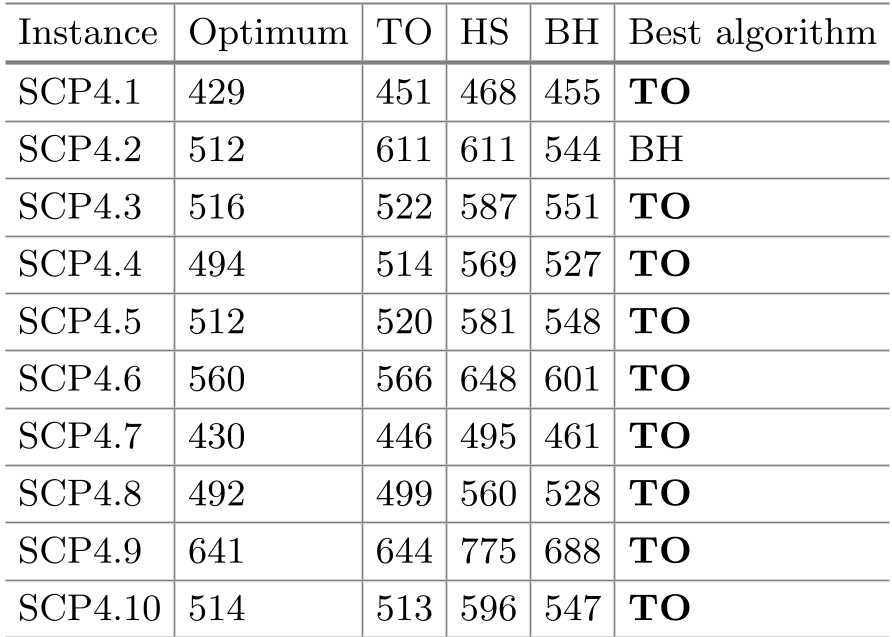 Table 1: TO outperforming HS and BH across different benchmark instances.
Critical Insight & Conclusion
The success of Twitter Optimization lies in its Filtering Mechanism. By forcing agents (users) to follow only those with better solutions, the algorithm creates a "popularity" pressure that drives the population toward the global optimum.
Limitations: While powerful, the current TO implementation relies on standard binarization. Future versions could benefit from more advanced "transfer functions" to handle the discrete constraints of SCP more natively.
The Takeaway: If you are dealing with large-scale resource allocation or scheduling problems, social-media-inspired algorithms offer a surprisingly robust framework for balancing exploration and exploitation. Sometimes, the best way to solve a hard math problem is to act like a trending meme.
Future Outlook
The authors suggest that future work will involve refining the "Update" operators to improve the "Intensity" of the search, potentially integrating hybridized local search methods to further reduce the RPD in more complex, non-linear scenarios.