
Social Media Intelligence: Decoding Brand Perception through Real-Time NLP
Social Media Intelligence for Brand Analysis
This paper presents "Socialis," a real-time brand analysis system that streams data from the Twitter API, processes it using NLP techniques, and visualizes insights via an interactive dashboard. The system utilizes a parallel processing architecture to handle real-time sentiment analysis (Naive Bayes) and Named Entity Recognition (Stanford NER) specifically focused on brand perception.
TL;DR
In the hyper-fast world of social media, a brand's reputation can shift in minutes. This paper introduces a robust, real-time intelligence system that moves beyond simple keyword counting. By leveraging Naive Bayes for sentiment analysis and Stanford NER for entity extraction, the authors provide brands with a live dashboard of public perception, geographic hotspots, and key influencers.
Background & Motivation
Most organizations struggle with "Data Wealth, Insight Poverty." While millions of tweets are posted daily about brands like Nike or Adidas, the data is often messy, filled with emojis, and unstructured. Static analysis (analyzing data weeks after it was posted) is no longer sufficient. The authors identified a gap: the lack of a tool that combines real-time streaming with deep linguistic preprocessing to offer immediate visual insights.
Challenges in Modern Brand Analysis
- Volume & Noise: Popular brands see thousands of tweets per minute; filtering the "gold" from the "garbage" (URLs, bot spam) is computationally intensive.
- Entity Ambiguity: Distinguishing between "Nike" as a brand and "Nike" in other contexts, or identifying that "Rafael Nadal" is a key person associated with the brand, requires sophisticated Named Entity Recognition.
- Latency: Processing data must happen fast enough to keep up with the Twitter "firehose."
Methodology: The "Socialis" Architecture
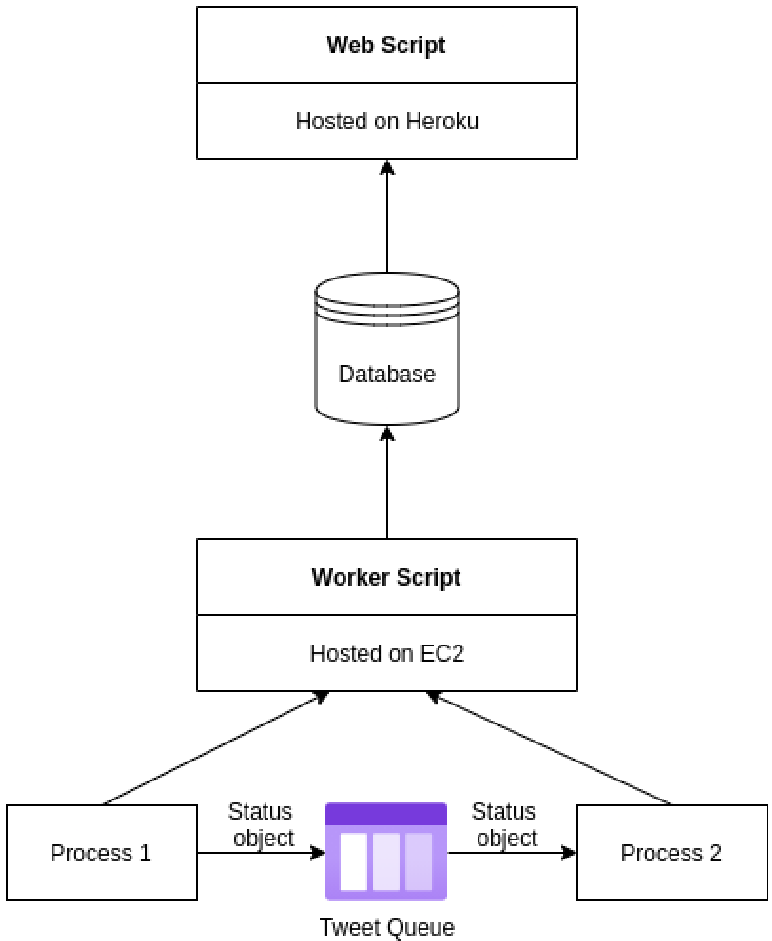
The system is built on a split-infrastructure model to maximize efficiency.
1. Parallel Processing Pipeline
The authors use a multiprocessing approach to prevent bottlenecks. While Process 1 handles the heavy lifting of the Twitter Streaming API connection, Process 2 consumes from a shared queue to perform cleaning and sentiment prediction.
2. Advanced Preprocessing
The authors emphasize Lemmatization and Decontraction (e.g., turning "isn't" into "is not"). This preserves the semantic meaning before noise removal, ensuring the sentiment model doesn't lose context.
3. Sentiment & Entity Intelligence
- Sentiment Analysis: Using a Naive Bayes Classifier and TF-IDF vectorization, the system achieves 87.23% accuracy in categorizing tweets as Positive, Negative, or Neutral.
- Named Entity Recognition (NER): By employing Stanford’s CRF models, the system identifies people, organizations, and locations associated with the brand. This reveals "hidden" associations—such as which athletes are currently driving the most conversation for a brand.
Experimental Results & Visual Insights
The system was tested using "Nike" as the target query. The results were categorized into several high-value visualizations:
- Temporal Sentiment Tracking: A time-series chart that reveals how public mood fluctuates in 10-second intervals.
- Global Reach: A choropleth map using Geo-Py and ISO country codes to visualize where the brand is trending globally.
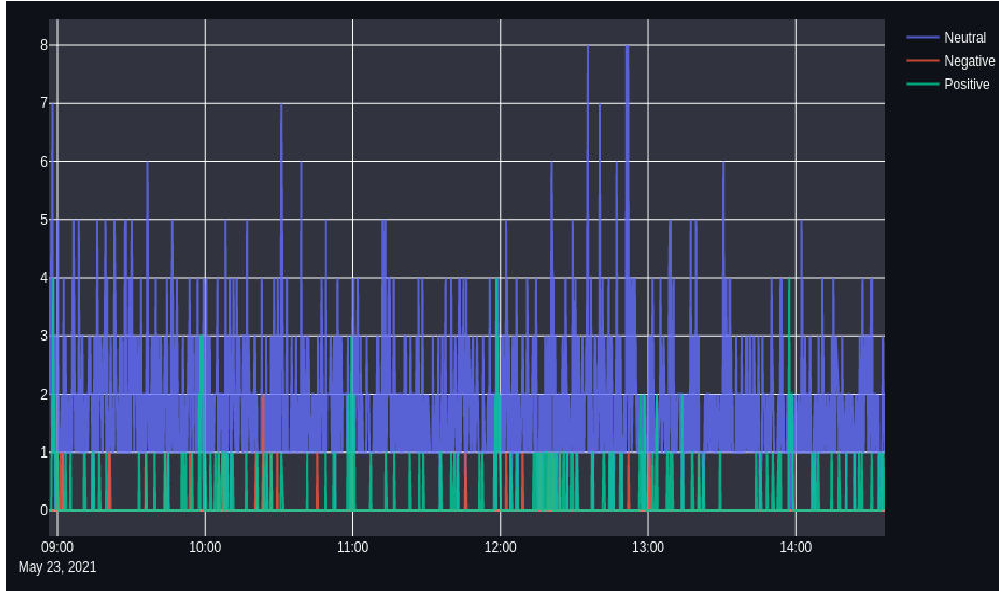 Fig: Real-time sentiment trends help brands measure the instant impact of local events or ad drops.
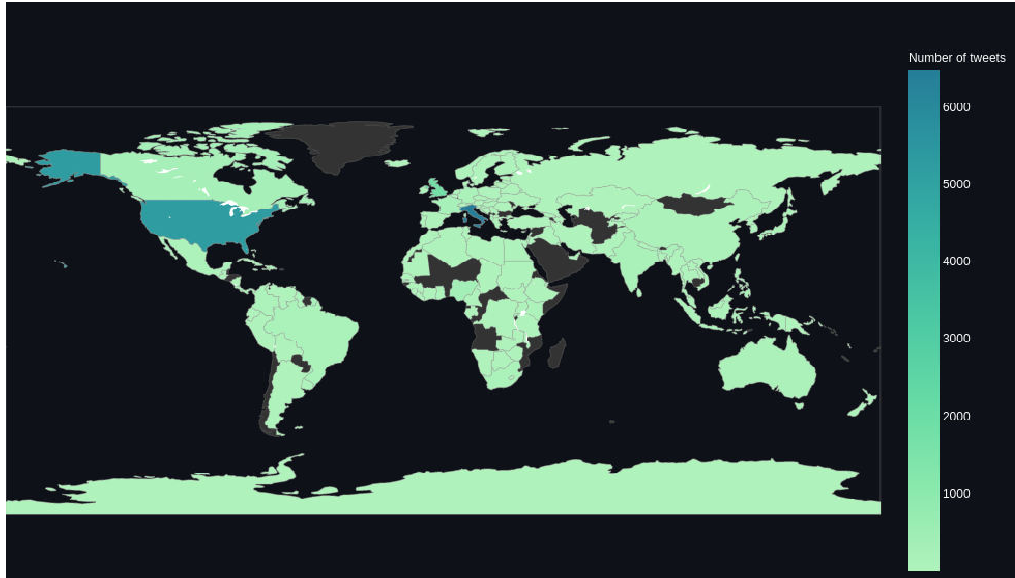 Fig: Identifying the geographic density of conversations facilitates targeted regional marketing.
Critical Analysis & Conclusion
The strength of this work lies in its real-time nature. By not storing raw tweets long-term, it prioritizes "live" intelligence over historical archiving, making it more storage-efficient.
Limitations: The authors candidly note that the system is hardware-dependent. A massive spike in traffic (e.g., during the Super Bowl) could overwhelm a standard AWS/Heroku instance. Furthermore, NER is computationally expensive compared to sentiment analysis, creating a potential time-lag in the pipeline.
Future Outlook: Integrating Transformer-based models (like BERT or GPT) could significantly improve sentiment accuracy, especially for sarcasm detection, which remains a challenge for Naive Bayes. However, the trade-off would be higher latency—a challenge future researchers must address to maintain the "real-time" promise.