
SMLearning: Transforming Passive Viewers into Interactive Scriptwriters
Social Media Learning: An approach for composition of multimedia interactive object in a collaborative learning environment
This paper introduces Social Media Learning (SMLearning), a collaborative platform and methodological framework designed for creating Multimedia Interactive Objects. By extending the SMIL standard into a specialized "Multimedia Learning Script" (MLS), the system allows students and teachers to co-create interactive educational content within a social media-driven environment.
TL;DR
SMLearning is a collaborative environment that shifts multimedia learning from passive video watching to active content creation. By providing an Authoring Tool based on an extended SMIL (Synchronized Multimedia Integration Language) framework, it enables students to co-design learning objects that include questionnaires, simulations, and branching paths, all within a social media ecosystem.
The "Passive Consumption" Problem in E-Learning
Despite the explosion of video content on platforms like YouTube and Vimeo, the educational value is often limited by a lack of true interactivity. Current systems usually offer "social interactivity" (likes, comments) but fail to provide "conceptual interactivity"—mechanisms that allow learners to control the information stream, practice skills, or receive immediate feedback within the media itself.
The authors argue that for learning to be effective, students must move from mere observation to imitation and eventually to self-regulation. This requires tools that allow them to manipulate and structure knowledge, not just watch it.
Methodology: The Four-Step Collaborative Loop
The paper introduces a rigorous methodological guideline for building Multimedia Learning Scripts (MLS):
- Analysis: Authors build a shared database of raw multimedia resources.
- Synthesis: Evaluators structure concepts, using tagging and hierarchical organization to create a mental model.
- Composition: Scriptwriters use the Authoring Tool to sequence segments and add interactive points (e.g., questions or pauses).
- Reproduction: Learners consume the MLS, and their interaction data is reported back to supervisors for iterative improvement.
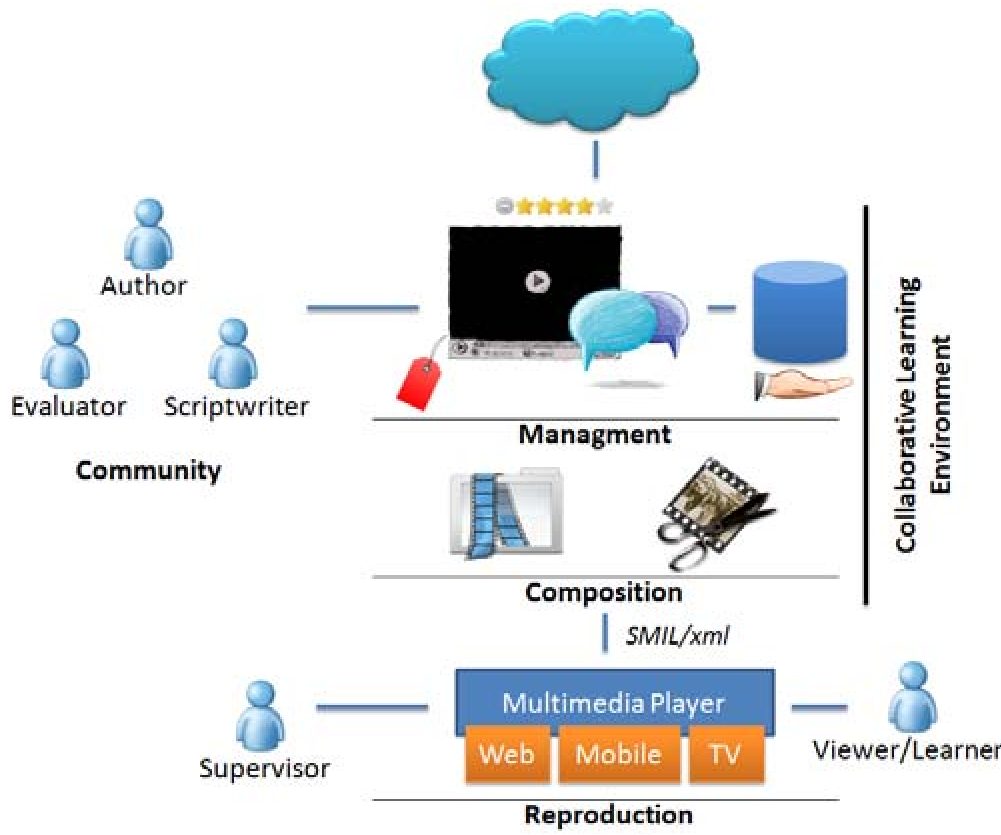 Fig 1: The SMLearning system architecture integrates social services with specialized authoring views.
Technical Core: Extending SMIL for Interactivity
The technical breakthrough of SMLearning is its document model. The authors extended SMIL (Synchronized Multimedia Integration Language), a W3C recommended markup language, with specific tags for education:
<question>: Defines parameters for multiple-choice, open-input, and feedback loops.<prefetch>: Optimizes performance by pre-loading assets to reduce latency.<url>: Allows embedding of external advanced mechanisms like SQL test tools or text-to-speech systems.
The Authoring Tool handles the complexity of XML through a multi-view interface, including a "Sequence View" for orchestration and a "Historical View" for collaborative version control (rollback capability).
 Fig 2: The Multimedia Player View showing how interactive questions are overlaid on video content.
Experimental Validation: Social Interaction Matters
The system was tested in a Master's course on "Collaborative Systems." The results were striking:
- High Engagement: Students were not just completing assignments; they created 137 individual video resources and 761 tags.
- The Social Link: Using sociograms (social network analysis), the researchers found that students who participated more in "annotations" (social feedback) reported significantly higher motivation levels.
- Learning Progression: The quality of "tagging" and "scripting" improved visibly between the first and second deliveries, validating the "observation-to-practice" transition.
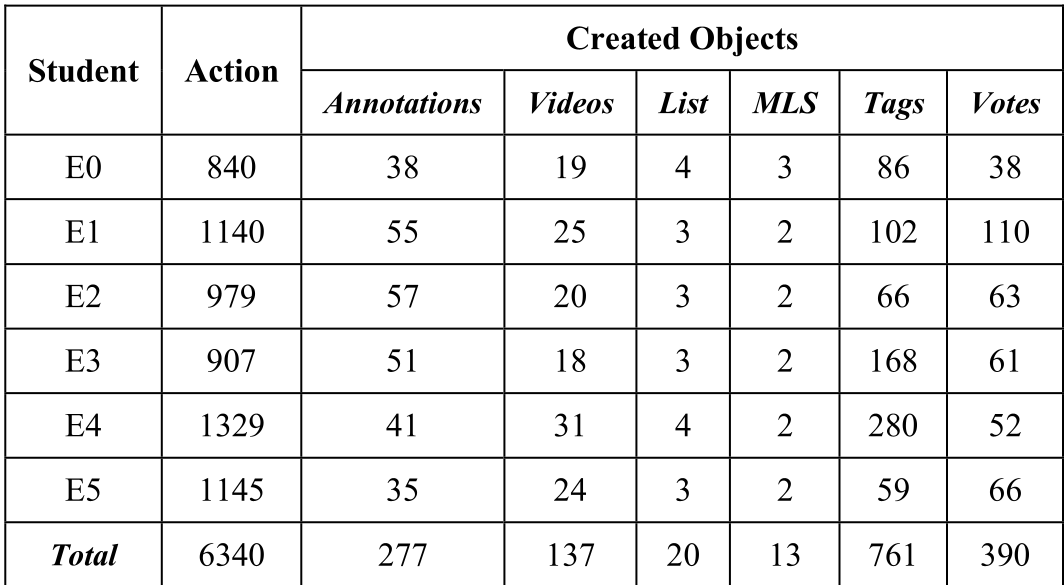 Table 1: Quantitative breakdown of student actions, demonstrating a high volume of peer annotation and voting.
Critical Analysis & Conclusion
While SMLearning successfully bridges the gap between social media and formal education, it faces a few challenges:
- Performance Bottlenecks: High volumes of pre-loaded flash-based resources caused synchronization glitches in the prototype.
- Complexity: Authoring interactive scripts requires a higher cognitive load than typical forum participation, though the authors argue this is "productive" load.
Future Outlook: The move toward integrating these tools with mainstream LMS platforms like Moodle could revolutionize how we assign "homework." Instead of asking students to watch a video, we may soon ask them to remix a video into an interactive tutorial for their peers. The SMLearning framework provides a solid technical and pedagogical blueprint for this "Author-as-Learner" future.