
Social Media Profiler: Decoding Digital Personas Through Visual Attributes
Social Media Profiler: Inferring Your Social Media Personality from Visual Attributes in Portrait
This paper presents the "Social Media Profiler," a framework designed to infer "Social Media Personality" by analyzing visual attributes in portrait images. By integrating social media behaviors (e.g., posting frequency, active periods) and content (concepts/emotions in posts) into a multi-modal representation, the authors identify key facial and stylistic markers that correlate with specific digital personas.
TL;DR
Can a single portrait reveal how often you post on social media or whether you are a night owl? This paper introduces the Social Media Profiler, a framework that maps visual traits in portraits (like garment type and facial lines) to specific social media behaviors. By moving beyond subjective surveys to "Social Media Personality" defined by data, the authors achieve an 80.38% accuracy in predicting user groups from images.
Problem & Motivation: The Gap Between Image and Behavior
Most existing research on personality and multimedia falls into two traps:
- Subjectivity: Ground truth labels usually come from self-reported questionnaires, which are prone to bias.
- Content Isolation: Previous works look at what is in the photo but ignore the behavior of the person behind the account (e.g., active periods, interaction levels).
The authors argue that our physical appearance—even in a static portrait—is influenced by our habits. Serious people may have pronounced nose-mouth lines; selfie-takers might favor fancy clothing. The goal is to bridge the gap between visual attributes and social behaviors.
Methodology: Mapping Face to Data
The researchers developed a pipeline that translates digital footprints into visual predictions:
1. Defining "Social Media Personality"
Instead of using the standard "Big Five" traits, the authors clustered 1,000 users into 8 groups (Types A-H) based on a 54-dimensional vector. This vector includes:
- Content: 30 concept detectors and 8 emotion histograms from their posted images.
- Behavior: Active time periods, frequency of posts/forwards, and attention levels (fans/interests).
2. Attribute Selection & Feature Extraction
Using Multinomial Logistic Regression, they identified which visual attributes actually matter. Interestingly, Hair style, Eye shape, Nose-mouth lines, and Garment type showed the highest contribution values (up to 1.0).
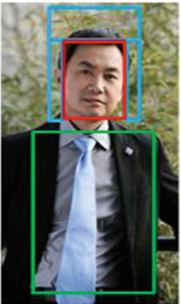 Figure 1: The framework isolates specific regions (Face, Hair, Apparel) rather than analyzing the whole image to reduce noise.
Low-level features like Local Binary Patterns (LBP), Histogram of Gradients (HOG), and HSV color spaces were then extracted from these specific regions to train LibSVM classifiers.
Experiments & Results: Precision in Localization
The authors tested their model on 5,000 portraits. The regional focus proved superior to "Baseline" methods that used the whole image.
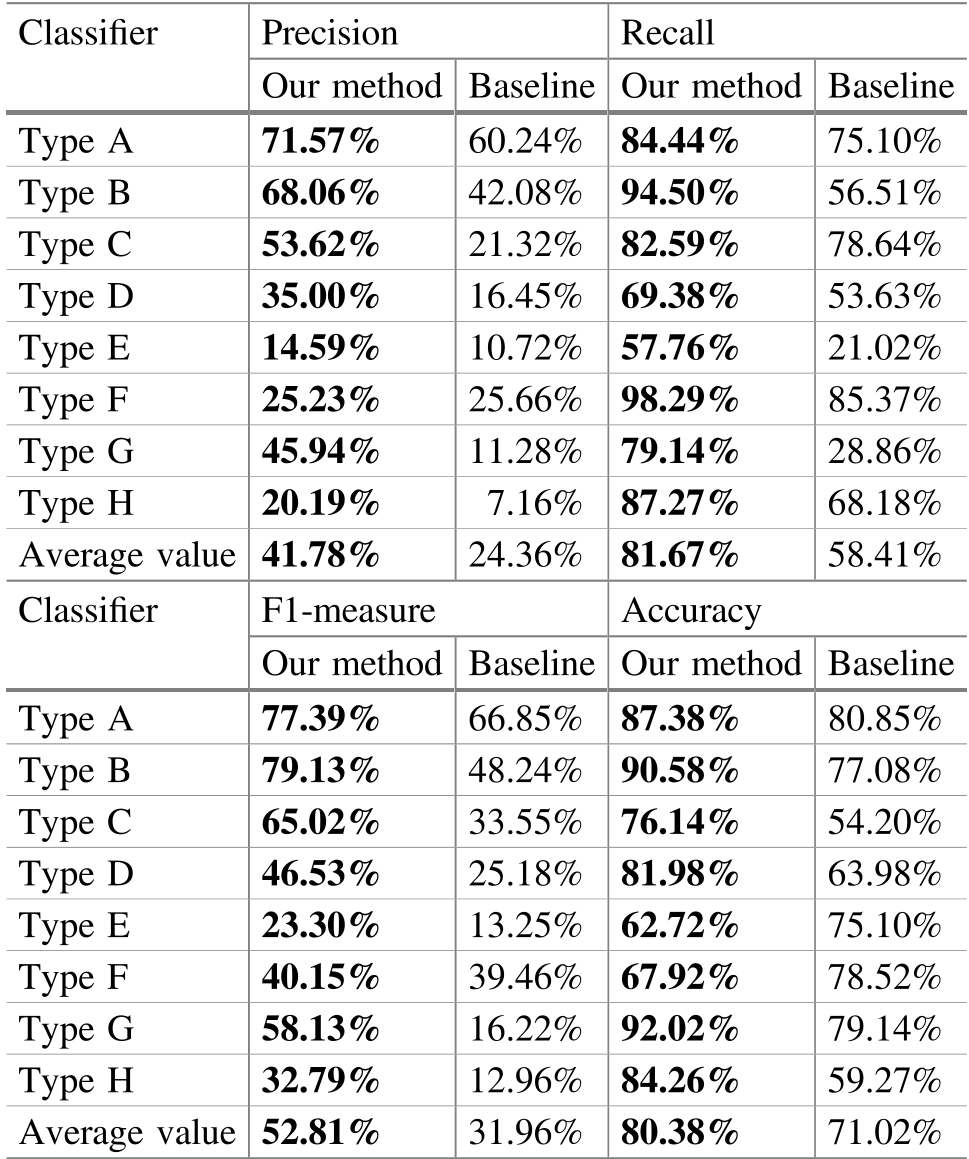 Table 1: Comparison showing significant gains in Precision and Recall across different personality types.
Key Findings:
- Accuracy: Achieved 80.38%, outperforming the baseline by nearly 10%.
- Type A Persona: Characterized by short hair (83%) and fancy wear (75%). These users were typically night owls (89.5% active at night) interested in sports.
- Type B Persona: Often wore formal attire (55.5%) with tightened lips (67.2%), reflecting a more serious social media presence.
Critical Insight: The "Social Mask" vs. Reality
One of the most fascinating aspects of the study is the "confusion" between types. For instance, Type D users (active posters) were often misclassified as Type A because both groups dress stylishly. However, their social behaviors—specifically the volume of selfies vs. generic posts—were the true differentiators. This suggests that while visual attributes provide a strong signal, they sometimes represent an "intended" persona that only behavior can fully verify.
Conclusion
The Social Media Profiler demonstrates that our portraits are subtle resumes of our digital lives. By focusing on discriminative regions like the nose-mouth area and garment style, the model effectively filters out background noise to find the "signal" of personality.
Future Directions: The reliance on manual labeling for the initial visual attributes is a bottleneck. Applying end-to-end Deep Learning (like CNNs or Vision Transformers) could further refine these correlations and scale the system to millions of "common" users beyond the public figures studied here.